BIDAX CEO Says Custody Is Key Infrastructure for Maturing Digital-Asset Market
Forecast Trend Report by Period


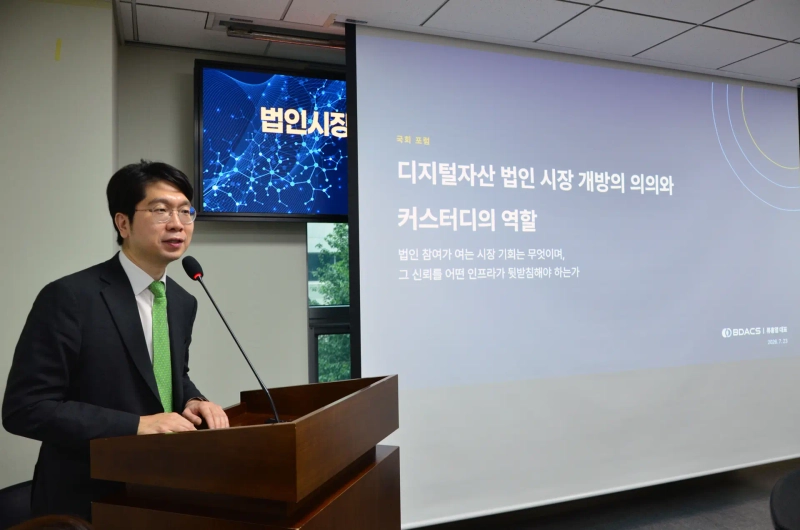
"Corporate participation is essential for the digital-asset market to mature. Once companies start entering the market, safeguards that can ensure trust, such as custody services and internal-control systems, become necessary."
Ryu Hong-yeol, chief executive officer of BIDAX, made the remarks on July 23 at an academic conference on opening the corporate market and building a safe digital-asset ecosystem, held at the National Assembly Members' Office Building in Yeouido, Seoul.
Ryu said opening the market to corporations would help transform South Korea's digital-asset market from one driven by individual investors into a more mature market with institutional participation. Overseas, corporate treasuries, pension funds and listed companies have already been incorporating digital assets, helping the market mature, he said. South Korea should also build infrastructure that institutions can trust as corporate participation expands.
He argued that trading and asset custody functions should be clearly separated. Because corporate assets are subject to financial statements and external audits, they require a different level of internal control from personal investments, Ryu said. The party making trading decisions should be separated from the party responsible for storing and verifying assets so that audits and board oversight can function properly.
In traditional finance, separating trading from custody is a basic principle for maintaining market trust, he added. Regulations should be designed to require corporations and institutional investors to use independent custodians.
Ryu said opening South Korea's digital-asset market to corporations could generate economic effects amounting to trillions of won. Even if only 5% of the equity capital of South Korean listed companies were managed in digital assets, that could create about 75 trillion won ($54.3 billion) in potential custody demand, he said. Inflows of corporate funds could also boost market liquidity and credibility while helping ease price volatility.
But simply allowing corporate accounts will not be enough for the government's push to open the corporate market to succeed, Ryu said. The Digital Asset Basic Act should also define the legal status and scope of custody services, require the use of independent custodians, and incorporate firewall, or Chinese wall, rules to block information sharing between trading and custody functions.
Ryu also said custody will be needed in connection with digital-asset taxation set to take effect in 2027. To ensure accuracy and transparency in taxation, exchanges and custodians should build a dual reporting system under which they separately submit trading records and asset custody data, he said. Independent custody infrastructure will also be needed to respond to the Crypto-Asset Reporting Framework, or CARF.

Uk Jin
wook9629@bloomingbit.ioH3LLO, World! I am Uk Jin.