Kyobo Securities’ Shin Says Institutional Crypto Era Starts With Clear Control Systems
Summary
- Shin Hee-jin said allowing corporations to open digital-asset accounts is only a starting point and that a clear control framework must be established.
- In corporate and institutional investing, investment decision-making, asset-specific investment limits, trade approvals, and asset custody and accounting treatment must be linked within a single control framework.
- Shin said the institutional-investor era will begin when the separation of trading and custody, independent custody by external custodians, and clear responsibility and recovery procedures in the event of incidents are in place.
Forecast Trend Report by Period


“Allowing corporations to open digital-asset accounts is only a starting point. A clear control framework must define who approves investments, who handles trading and custody, and who bears responsibility and manages recovery if an incident occurs.”
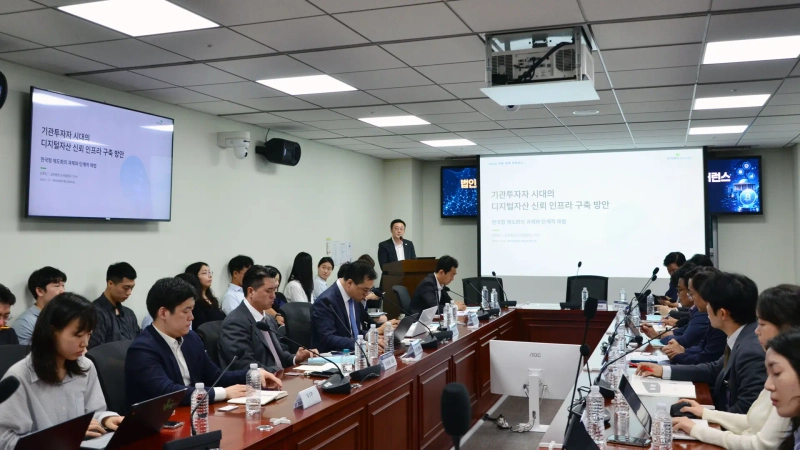
Shin Hee-jin, a director at Kyobo Securities, made the remarks on July 23 at an academic conference on opening the corporate market and building a safe digital-asset ecosystem, held at the National Assembly Members’ Office Building in Seoul’s Yeouido district.
Shin said individual investors and corporations or institutions bear different investment responsibilities. Individuals are responsible for their own decisions, while corporations and institutions are accountable to shareholders, creditors, clients and employees. Investment decisions need to be supported by a single control framework that links the legitimacy of those decisions with oversight by the board and investment committee, asset-specific investment limits, trade approvals, custody and accounting treatment, and reporting to regulators.
When determining which corporations should be allowed to enter the market, the key criterion should be risk-control capacity rather than company size or name, he said. Access should vary based on a broad assessment that includes capital strength and financial soundness, professional staffing, an investment committee, a risk-management organization, anti-money laundering systems, and the ability to handle external audits, disclosures and regulatory reporting.
Shin also called for a phased expansion of eligible investment assets. A token’s listing only means it can be traded, not that it is suitable for institutional investment. Assets should be reviewed separately for trading history over a certain period, market capitalization, liquidity, the verifiability of issuance and circulating supply, the risk of price manipulation, disclosure standards and technical stability.
He described the separation of trading and custody as the core of internal controls. Investment policy should be approved by the board or an investment committee, while order execution and trade approval should be handled by different personnel. Assets should be held independently by an external custodian. Custody, he added, should develop beyond a technical service that simply stores private keys into a system that can ensure legal rights over assets and operational responsibility.
“The safety institutional investors seek is not a system with no incidents. It is a system in which responsibility and recovery procedures function when incidents occur,” Shin said. “The era of institutional investors will begin not on the day corporate accounts are opened, but on the day it becomes clear who invests, who safeguards assets, who monitors them, and who is responsible when something goes wrong.”

Uk Jin
wook9629@bloomingbit.ioH3LLO, World! I am Uk Jin.