Won-Dollar Volatility Hits Highest Since Financial Crisis, Swinging From Near 1,560 to 1,300s
Summary
- The won-dollar exchange rate's volatility has widened this year to its highest level since the global financial crisis.
- After surging in March following the Middle East war, the exchange rate later plunged 125.4 won in July, underscoring unusually large monthly and daily swings.
- Continued dollar selling by exporters, coordinated intervention by US and Japanese foreign-exchange authorities, and fading expectations for a US rate hike combined to increase appreciation pressure on the won.
Forecast Trend Report by Period


Exchange rate jumped 90.4 won in March, then plunged 125.4 won in July
Daily swings are the biggest since 2009
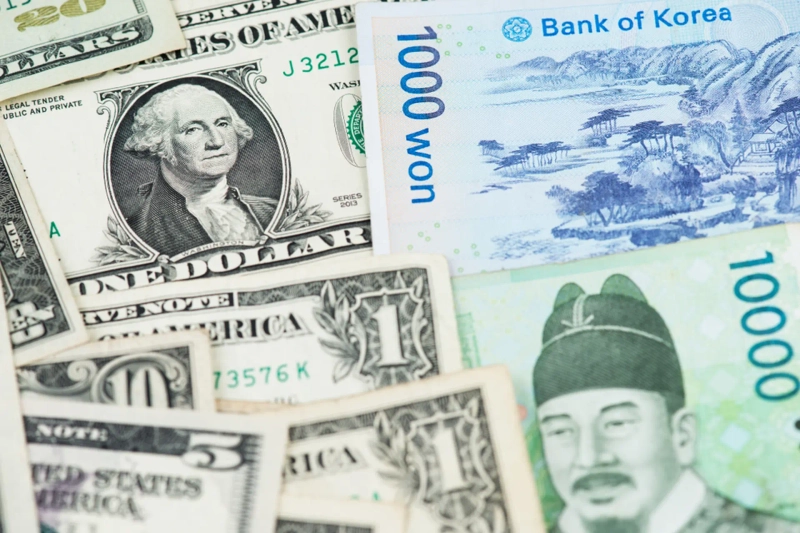
Volatility in the won-dollar exchange rate has surged this year to its highest level since the global financial crisis 16 years ago. The rate at one point neared 1,560 won per dollar, putting 1,600 won in sight, before dropping sharply and moving close to the 1,300-won range.
Data from the Seoul foreign-exchange market and the Bank of Korea's Economic Statistics System, or ECOS, show the average monthly change in the exchange rate this year through the end of July was 47 won, based on the 3:30 p.m. level against the previous month-end. That was the largest since 2009, when the average monthly swing reached 61.2 won during the financial crisis.
Only four years on record have posted an average monthly swing of more than 40 won: 1997 at 72.2 won during the Asian financial crisis, 1998 at 97.6 won, 2008 at 68.3 won during the global financial crisis and 2009.
By month, the exchange rate climbed 90.4 won in March, immediately after war broke out in the Middle East. It then fell 46.8 won in April on expectations for US-Iran talks. In May and June, the rate rose 24.6 won and 41.5 won, respectively, as foreign investors were heavy net sellers of stocks and Middle East tensions persisted. It then tumbled 125.4 won in July.
Daily volatility showed a similar pattern. Through Aug. 7, the won-dollar rate posted an average daily move of 8.2 won this year, based on the 3:30 p.m. level against the previous trading day. That was the highest since 2009, when the average was 9.4 won. It was also unusually large compared with the 5-won average during the Covid-19 pandemic.
The recent pace of the won's gains has also outstripped the move seen from April to June last year, when US tariffs drove volatility. After peaking at 1,555.8 won per dollar on Aug. 2, the rate fell 139.7 won over 25 trading sessions through Aug. 7, or an average of 5.6 won a day. That was more than double the 2.5-won average daily decline from April 9, 2025, when the rate stood at 1,472 won, to June 30, 2025, when it fell to 1,347.1 won.
The exchange rate dropped quickly into the low 1,400-won range in July as exporters continued to sell dollars and factors that had weighed on the won, including yen weakness and dollar strength, eased. A key trigger was fund inflows tied to SK Hynix Inc.'s US American depositary receipt listing, which prompted a wave of dollar selling by exporters and abruptly shifted foreign-exchange market flows toward won buying.
The move was reinforced by unusual coordinated intervention by US and Japanese foreign-exchange authorities, adding momentum to stronger East Asian currencies. On July 31, the US and Japan jointly bought yen to counter the Japanese currency's weakness. It was the first such coordinated intervention since 1998, during the Asian financial crisis.
The dollar-yen exchange rate, which had approached 164 yen, briefly fell to the 155-yen range before rebounding to the 157-yen range as of Aug. 8. The won moved in tandem, facing stronger appreciation pressure.
A weaker dollar also supported the won as expectations for another US interest-rate increase receded. US employment data released on Aug. 7 came in weaker than expected, dampening expectations for a Federal Reserve rate hike this year. The dollar index, which measures the greenback against six major currencies, fell as low as 99.399 during the session.
The won-dollar rate was trading at 1,409.5 won at 6 a.m. on Aug. 8. On an intraday low basis, at 1,407.3 won, it was the lowest level since Oct. 2, 2025, when the rate touched 1,399.5 won.
Park Su-bin, Hankyung.com reporter waterbean@hankyung.com

Uk Jin
wook9629@bloomingbit.ioH3LLO, World! I am Uk Jin.