PiCK
Min Byung-deok Says Global Acceptance Is Key to Won Stablecoin Success, Vows Second-Stage Bill in H2
Summary
- Rep. Min Byung-deok said the success of a won stablecoin depends not on issuance alone but on building trust, real-world use, global connectivity and an industry ecosystem.
- Min said Wonsco (won stablecoin) could become the payment infrastructure for the K-content economy if it is used across K-pop, dramas, games, webtoons, digital goods and fandom platforms.
- Min cited the market dominance of dollar stablecoins and the case of JPYC, and said he would refine second-stage legislation including the Digital Asset Basic Act to help secure passage in the second half of the year.
Forecast Trend Report by Period


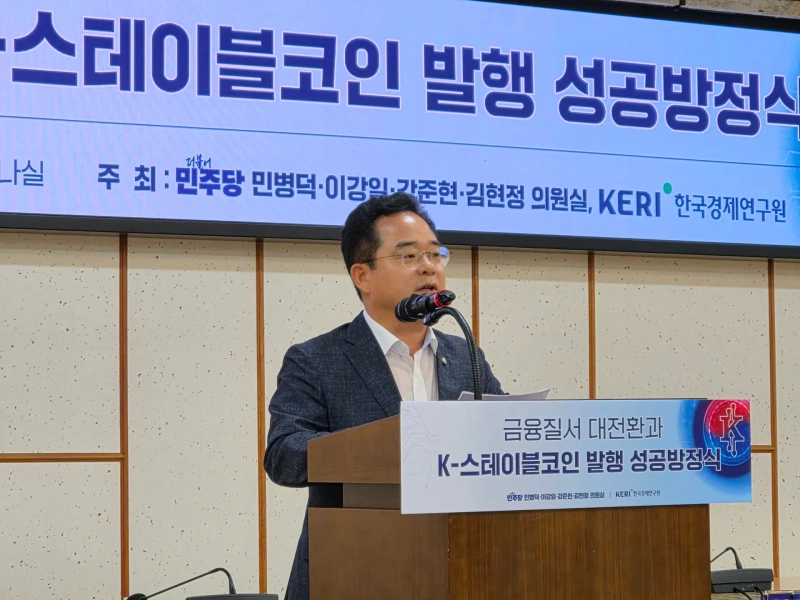
Min Byung-deok, a lawmaker from the Democratic Party of Korea, said the success of a won stablecoin hinges not on issuance alone but on trust, real-world use, global connectivity and a broader industry ecosystem.
Speaking in a congratulatory address at a policy seminar in Seoul's Yeouido on August 21 titled “A Great Transformation in the Financial Order and the Formula for Successfully Issuing K-Stablecoins,” Min laid out four conditions for a won stablecoin to succeed: trust, practical use, global connectivity and an industry ecosystem.
He said a stablecoin must build trust through sufficient reserve assets, redemption rights and transparent disclosure if it is to establish itself as a payment instrument similar to money. An exchange listing alone is not enough. It also must be used repeatedly in everyday transactions such as payments, remittances and content purchases.
Min also described global connectivity as essential. A won stablecoin that is completed for domestic use but not accepted overseas would struggle to compete, he said. It should therefore be designed from the outset so issuance, redemption and payments are possible abroad as well.
He also proposed linking won stablecoins with sectors where South Korea has an edge, particularly content. That means building a self-sustaining payment ecosystem that allows their use across K-pop, dramas, games, webtoons, digital goods and fandom platforms.
“If Wonsco becomes that payment infrastructure, culture can open a new frontier for currency,” Min said. “Across K-pop, dramas, games, webtoons, digital goods and fandom platforms, Wonsco can serve not as a foreign-exchange tool but as the payment infrastructure of the K-content economy.”
Min said those conditions are needed because dollar stablecoins overwhelmingly dominate the market. Citing the Bank for International Settlements annual report, he said 99.4% of the market capitalization of fiat-backed stablecoins is denominated in dollars, with Tether's USDT and USD Coin's USDC accounting for most of the market.
He also pointed to Japan's yen stablecoin JPYC as a model for how a won stablecoin should be designed. Min said JPYC went beyond establishing a one-to-one issuance and redemption structure with the yen through registration as a funds transfer service provider under Japan's Payment Services Act. It also mapped out real-world uses including payments, business-to-business settlements, corporate treasury management and creator compensation.
Min closed by reiterating his commitment to pass the Digital Asset Basic Act in the second half of the year. “Institutions should serve as a foundation for innovation, not hold it back,” he said. “Innovation without trust should not simply be left to the market. It is the role of the National Assembly and the government to create a safe framework where companies and developers can operate freely.” He added that he hopes the second-stage legislation, the Digital Asset Basic Act, will pass in the second half of the year and be refined through the day's discussions.

Suehyeon Lee
shlee@bloomingbit.ioI'm reporter Suehyeon Lee, your Web3 Moderator.