Samsung, SK Hynix Bonuses May Boost South Korea’s 2027 Growth by Up to 0.09 Percentage Point, BOK Says
Summary
- The Bank of Korea said the increase in consumption tied to larger performance bonuses at Samsung Electronics and SK Hynix would average about 800 billion won annually in 2025 and 2026.
- The BOK said consumption growth from the semiconductor boom could raise next year’s GDP level by 0.08% to 0.12% and lift the economic growth rate by as much as 0.09 percentage point.
- The BOK said employment growth in the semiconductor sector and whether the consumption spillover rate expands will determine how far the chip boom spreads through consumption and shapes regional spillover effects.
Forecast Trend Report by Period


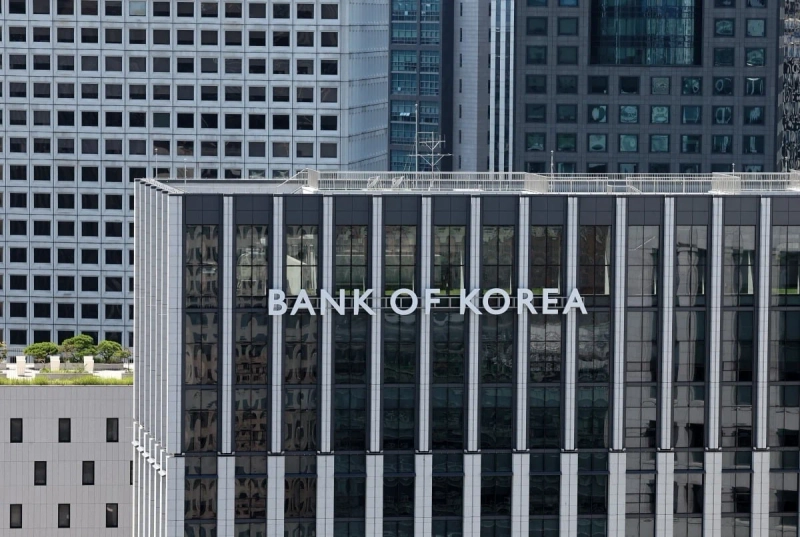
Bigger performance bonuses at Samsung Electronics Co. and SK Hynix Inc. during the semiconductor boom could flow into household spending and lift South Korea’s economic growth rate next year by as much as 0.09 percentage point, according to a Bank of Korea analysis.
A BOK report released on Aug. 31 found that spending in areas with large populations of Samsung Electronics and SK Hynix employees — including Icheon and Hwaseong in Gyeonggi Province and Cheongju in North Chungcheong Province — was as much as 4% higher by month than in other regions after bonus payments began in earnest in January 2025.
The central bank used regional microdata to estimate how much of the bonuses paid by the two companies was actually spent. It excluded the effects of wage increases at other information-technology companies, changes in asset prices and higher government tax revenue. The measure was based not on card spending recorded in those regions, but on actual expenditures by residents living in Icheon, Hwaseong and Cheongju.
The analysis estimated that the chip boom increased consumption by about 1.1 trillion won ($793 million) from last year through June this year. If the current trend continues, the cumulative gain will reach 1.7 trillion won ($1.23 billion) by the end of this year. On an annual average basis for 2025 and 2026, that comes to about 800 billion won ($577 million), or about 2% of last year’s 41.3 trillion won ($29.8 billion) increase in total private consumption.
The so-called consumption spillover rate — the share of bonuses that turns into spending — was estimated at 27% in 2025 and 21% this year. On that basis, GDP levels were 0.01% higher last year and 0.03% higher this year than they would have been without the semiconductor boom.
The effect could widen further next year because bonus payouts by Samsung Electronics and SK Hynix are projected to rise to about five times this year’s level. Depending on how much is converted into spending, the BOK estimated next year’s GDP level could be 0.08% to 0.12% higher, while annual economic growth could be lifted by 0.06 to 0.09 percentage point.
Employment growth will be a key variable in determining whether the semiconductor boom spreads more broadly through consumption. The chip industry tends to generate fewer jobs relative to output growth than other sectors, but domestic companies have recently accelerated facility expansion to meet a surge in demand. The Korea Employment Information Service forecasts semiconductor industry jobs will rise 5.1% in the second half of this year from a year earlier.
Lee Jae-ho, a deputy director at the BOK, said an analysis of past boom cycles in shipbuilding, steel, autos and chemicals showed that consumption effects were larger when growth in total wages came through increased hiring rather than pay raises for existing workers.
Regional effects also depended on whether additional income from bonuses and other sources flowed into consumption or asset markets. A comparison of Icheon and Cheongju, where SK Hynix operates, showed stronger consumption growth among semiconductor workers living in Cheongju. The BOK said Icheon’s easier access to the Seoul metropolitan area meant some of the added income was used to buy homes in nearby regions, while home purchases by Cheongju residents were made relatively more often within the city.
So far, the increase in spending has been concentrated in higher-priced discretionary items such as automobiles and department stores. As a result, the knock-on effect — in which additional consumption raises income in other industries and generates further spending — has so far remained limited.
Still, the BOK said spending could spread to services and other categories after a time lag, as seen in past industrial boom cycles. Lee added that when the auto and chemical industries boomed in Ulsan in the early 2010s, service consumption rose quickly after workers’ wages increased. Consumption driven by the chip boom could likewise extend to a wider range of items over time.

Suehyeon Lee
shlee@bloomingbit.ioI'm reporter Suehyeon Lee, your Web3 Moderator.