PiCK
Trump Pledges $5,000 per Adult if Republicans Hold Congress; Can Bitcoin Repeat a Stimulus-Check Boost?
Summary
- Trump said he would pay a $5,000 “Trump dividend” to each adult US citizen if Republicans maintain their House and Senate majorities.
- Research showing increases in Bitcoin and stock purchases after Covid-19 relief payments is drawing renewed attention.
- But the actual impact on risk assets remains uncertain because of hurdles including the $1.2 trillion funding need, limits on tariff revenue, and the possibility of higher interest rates if the plan is financed through Treasury issuance.
Forecast Trend Report by Period


Payout pledge tied to Republicans holding House and Senate majorities
Bitcoin buying rose during pandemic stimulus payments
$1.2 trillion cost and congressional approval remain hurdles
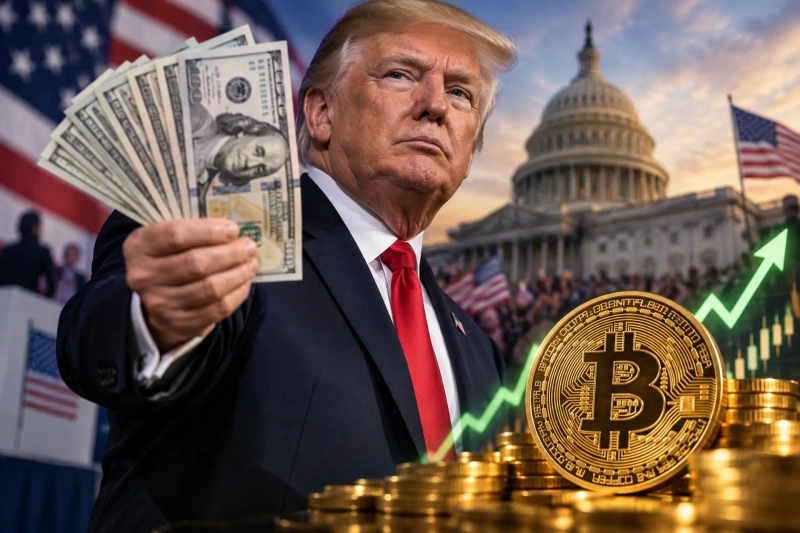
President Donald Trump’s promise to pay $5,000 to each adult American if Republicans retain control of Congress in the midterm elections is drawing attention in the crypto market. Investors are watching whether some of that cash could flow into risk assets such as Bitcoin. Still, it remains unclear whether the campaign pledge would translate into actual investment demand, given the need for congressional approval and a funding source.
Trump made the pledge at a Republican midterm event in Dallas on Sept. 9, saying he would provide a $5,000 “Trump dividend” to adult US citizens if Republicans keep their House and Senate majorities. The amount is a sharp increase from the $2,000 tariff dividend he proposed last year for Americans excluding high-income earners.
The required funding would exceed $1 trillion. Reuters, citing US Census Bureau data, estimated that paying $5,000 each to roughly 240 million adult citizens would cost $1.2 trillion. Details including any income-based restrictions have not been finalized.
Bitcoin Buying Rose on Cash Payouts
What the crypto market is focused on is the possibility that direct cash payments could increase investment demand. If household disposable income rises, more money may be available not only for consumption and debt repayment, but also for stocks and crypto.
A similar pattern was observed during the Covid-19 pandemic. Research published by the Federal Reserve Bank of Cleveland found that purchases of Bitcoin worth $1,200 — the typical size of a US government relief check — rose significantly after the payments were distributed in April 2020. The researchers estimated that the stimulus checks increased dollar-denominated Bitcoin buying volume by about 3.8%.
Even so, Bitcoin purchases tied to the stimulus amounted to only about 0.02% of the total payments, the researchers found. That suggests cash disbursements can spur buying demand, but not that a large share of the money flowed into the crypto market.
The effect was also seen in stocks. Research published by the National Bureau of Economic Research found that the first two rounds of Covid-19 cash payments increased stock purchases by individual investors and contributed to gains in the shares they traded most often.
Some market participants also view the latest pledge as positive for Bitcoin. Anthony Pompliano, chief executive officer of Professional Capital Management, wrote on X on Sept. 10, referring to Trump’s proposal, that “the more money they hand out, the higher Bitcoin, gold, and land prices will go.”
Tariff Revenue Falls Short; Higher Rates Are Another Risk
The key question is whether the pledge can be carried out. Even if Republicans win the midterms, the payments would not automatically be approved. Federal spending requires congressional approval, and lawmakers would still need to determine eligibility and how the program would be financed.
Trump and Vice President JD Vance have pointed to tariff revenue as the funding source. Asked in a Fox News interview on Sept. 10 about how the plan would be funded, Trump said, “We’re taking in $21 trillion,” adding that “it’s all because of tariffs.”
But that figure is far above actual tariff revenue. Reuters, citing estimates from the Congressional Budget Office, reported that tariff revenue for the fiscal year stood at $167 billion as of the time of the report. That is only about 14% of the estimated $1.2 trillion payout cost.
If the shortfall is covered by issuing Treasury debt, that could weigh on financial markets. A larger supply of government bonds, combined with inflation concerns, could push market interest rates higher. Even if cash payments lift investment demand, rising rates could have the opposite effect by pressuring risk assets.
The election result is another variable. In a survey conducted by the Financial Times and Focaldata from Aug. 28 to Sept. 2, Democrats led Republicans by 7 percentage points in support for the House election among likely voters.
Ultimately, the market impact of the proposed $5,000 dividend will depend not only on the midterm outcome, but also on the actual size and timing of any payments and how they are financed. Any boost to Bitcoin buying power would need to be weighed against the risk that fiscal strain could drive interest rates higher.

Suehyeon Lee
shlee@bloomingbit.ioI'm reporter Suehyeon Lee, your Web3 Moderator.