Bitcoin Quantum-Attack Defense Cost Falls 79% to Below $67 Per Transaction
Summary
- StarkWare said the computing cost of preparing Bitcoin transactions against quantum-computer attacks has fallen to below $67.
- StarkWare said the cost reduction makes it more likely that investors with large Bitcoin holdings could use QSB in an emergency.
- StarkWare said a soft fork that changes Bitcoin's consensus rules would be better suited to defending against broad quantum-computer attacks.
Forecast Trend Report by Period


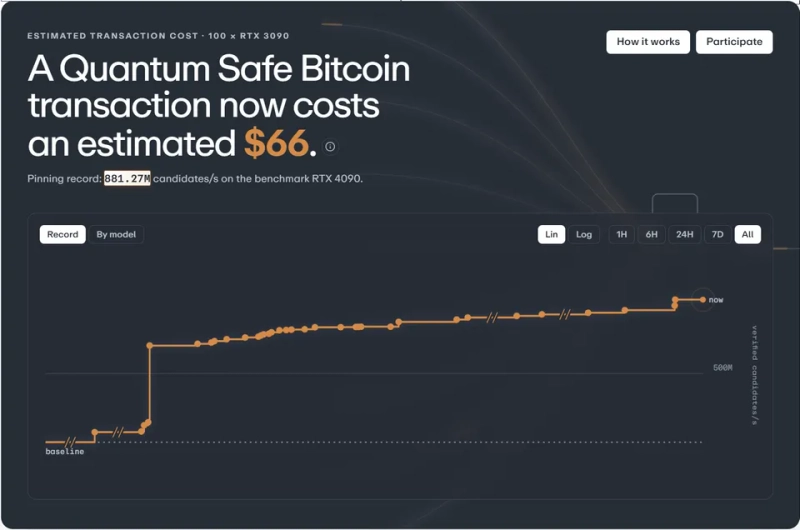
The cost of generating Bitcoin transactions designed to withstand quantum-computer attacks has fallen about 79% in a week through technical optimization.
Cointelegraph reported on Sept. 24 that blockchain technology company StarkWare estimates the computing cost required to prepare Bitcoin transactions against quantum-computer attacks has dropped to below $67. That compares with about $320 for the first live transaction in August.
The improvement came through the Quantum Safe Bitcoin Optimization Challenge, launched on Sept. 16 by StarkWare, Yukon Research and Eigen Labs. Developers, researchers and artificial intelligence agents worked to improve the computing efficiency of the graphics processing units, or GPUs, needed to generate the transactions. A total of 62 optimization methods were adopted.
Quantum Safe Bitcoin, or QSB, is designed to protect against quantum-computer attacks without changing Bitcoin's existing consensus rules. StarkWare researcher Avihu Levy first unveiled the technology in April. It was proposed as an emergency safeguard against the possibility that quantum computers could render Bitcoin's digital signatures ineffective.
On Aug. 26, the first Bitcoin transaction using QSB was processed on the mainnet. It used about 100 GPUs and required a total of 3,100 GPU-hours of computation. The computing cost, excluding Bitcoin network fees, was about $320.
StarkWare said the latest cost reduction increases the chances that investors with large Bitcoin holdings would use QSB in an emergency. Still, the optimization gains so far have been confirmed in performance tests, and the improved technology has not yet been applied to actual Bitcoin mainnet transactions.
Over the longer term, the company said, Bitcoin's network itself will require technical upgrades. StarkWare said QSB could serve as an emergency response tool, but a soft fork that changes Bitcoin's consensus rules would be better suited to defending against broad quantum-computer attacks.

Suehyeon Lee
shlee@bloomingbit.ioI'm reporter Suehyeon Lee, your Web3 Moderator.