PiCK
EastPoint: Seoul 2026 Draws More Than 600 Global Digital-Asset Leaders, Wraps Up in Seoul
Summary
- This year's EastPoint: Seoul 2026 focused on market changes driven by the institutionalization of digital assets and expanding institutional investment.
- The event featured discussions on core digital-asset infrastructure, including tokenization, stablecoins, on-chain capital markets, and digital payment infrastructure.
- Participants explored business cooperation related to the start of the institutional investment era, advances in blockchain infrastructure, and areas including real-world assets (RWA) and digital-asset custody.
Forecast Trend Report by Period


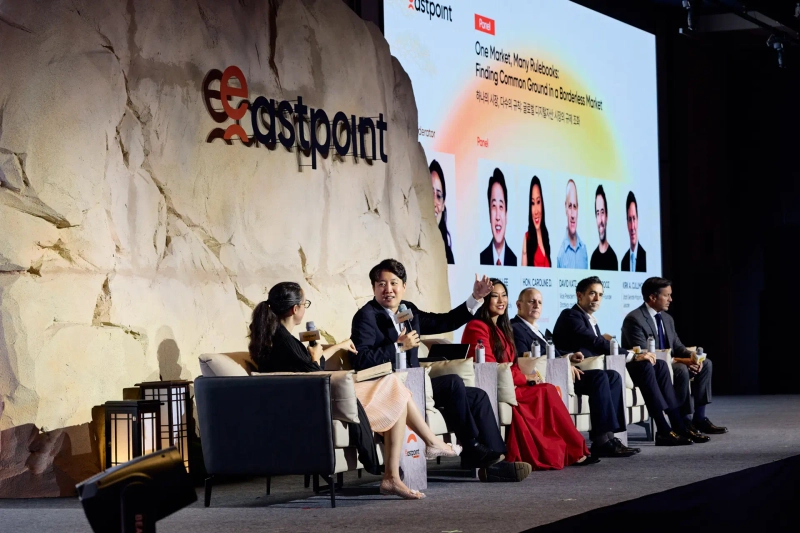
EastPoint: Seoul 2026, a private Web3 conference attended by more than 600 key figures from the global digital-asset industry and financial sector, concluded on September 28 at the Westin Seoul Parnas in Seoul's Gangnam district.
The event was co-hosted by global venture capital firm Hashed, Hankyung Media Group's digital-asset media outlet Bloomingbit and The Korea Economic Daily. More than 270 key decision-makers from institutions in South Korea and overseas attended. Now in its second year, EastPoint was created to examine market changes driven by the institutionalization of digital assets and the expansion of institutional investment, while exploring ways to connect policy, capital and technology.
This year's event was organized around five themes: the start of the institutional investment era, the evolution of stablecoins, the on-chain transformation of capital markets, the age of AI agents and the adoption of blockchain in everyday life. As traditional financial institutions expand their presence in digital assets, tokenization of conventional financial assets such as government bonds, real estate and commodities emerged as a major topic. Blockchain-based trading, clearing and settlement infrastructure was also high on the agenda.
Senior executives from major global financial and digital-asset firms including Franklin Templeton, Andreessen Horowitz, Tether and Circle attended. Chetan Karkhanis, senior vice president at Franklin Templeton, and Guy Wuollet, general partner at a16z Crypto, discussed trends in institutional adoption of digital assets and shifts in investment markets. Joseph Lubin, co-founder of Ethereum, Arthur Hayes, chief investment officer at Maelstrom, and Yuval Rooz, chief executive officer of Canton Network, also discussed the direction of blockchain infrastructure and on-chain capital markets.
Global policy and regulatory specialists also took part as key speakers. Harry Jung, former deputy director of the White House Digital Assets Advisory Council, Caroline Pham, chief executive officer of MoonPay Institutional and former acting chair of the U.S. Commodity Futures Trading Commission, and Kirk Cullimore, Republican majority leader of the Utah State Senate, shared views on U.S. digital-asset policy and the regulatory environment. Wai Lum Kwok, senior executive director of authorization and fintech at Abu Dhabi Global Market, introduced the progress of digital-asset institutionalization in Middle Eastern financial markets.
From South Korea, Democratic Party lawmaker Min Byung-duk, Democratic Party floor deputy leader Ahn Do-geol and Reform Party lawmaker Lee Jun-seok joined as speakers to discuss digital-asset legislation and industry policy. Participants also included representatives from the securities industry, including Mirae Asset Securities, NH Investment & Securities, Meritz Securities and Eugene Investment & Securities, as well as major asset managers and payment companies such as Visa, Samsung Card, Hyundai Card and BC Card. They examined potential uses for security tokens, or STOs, and digital payment infrastructure.
The event was run with a main stage and closed-door roundtables in parallel. Public sessions focused on policy and industry changes in the global digital-asset market. Private roundtables centered on business cooperation related to stablecoins, real-world assets, digital-asset custody and infrastructure for institutional investment. Separate business meetings were also held among participating companies and institutions.
"Digital assets have moved beyond the stage of proving potential and now must prove sustainability," Hashed Chief Executive Officer Kim Seo-joon said. He added that he hopes EastPoint will become a venue where those building markets and those designing rules can learn from one another and decide on the next step together.
"This year's EastPoint was especially meaningful in that key decision-makers from global institutions, policy circles and capital markets gathered in one place for in-depth discussions on the digital-asset market's core issues," Bloomingbit Chief Executive Officer Kim San-ha said. He added that the event focused in particular on discussing the practical challenges facing financial institutions and infrastructure companies, as well as new opportunities for cooperation.
He said EastPoint would continue to grow into a global digital-asset platform linking domestic and overseas policy, capital and technology, while helping design a new financial-market structure.

Suehyeon Lee
shlee@bloomingbit.ioI'm reporter Suehyeon Lee, your Web3 Moderator.