PiCK
South Korean Financial Firms, Stymied by Regulation at Home, Test Tokenization Overseas to Avoid Falling Behind
Summary
- Mirae Asset Global Investments said it wanted to lead the market through Ondo Finance, ETF tokenization and on-chain distribution.
- Hanwha Asset Management said it is preparing domestic ETF tokenization and tokenization of U.S. assets, and sees broader distribution as the next key step.
- Shim Min-seop of Meritz Securities said the tokenization market needs institutional investors, a secure platform and infrastructure tailored to the role of each financial institution.
Forecast Trend Report by Period


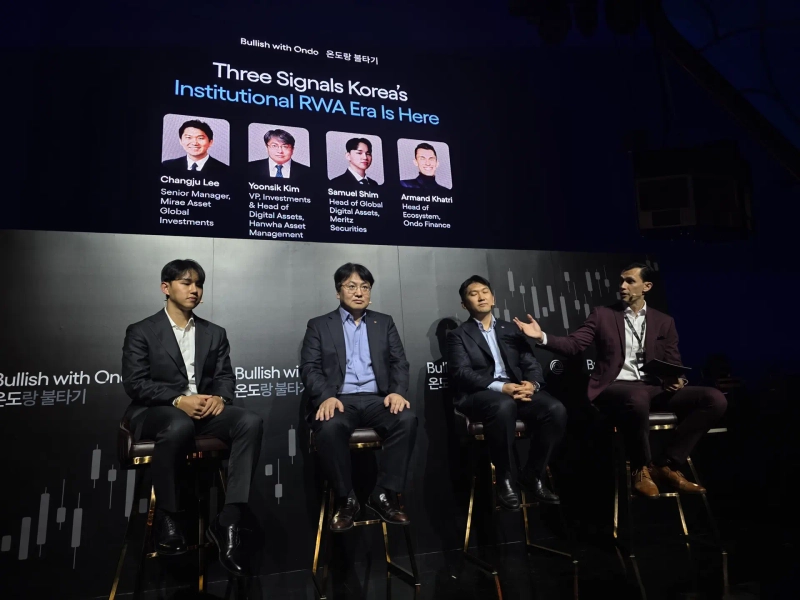
Major South Korean financial companies are accelerating efforts to break into on-chain finance with Ondo Finance, a global real-world asset tokenization platform. With related rules still slow to take shape at home, however, they are making their first moves in overseas markets.
At the "Burning With Ondo" event held on September 29 at the Lion Club in Cheongdam, Seoul, officials from Mirae Asset Global Investments, Meritz Securities and Hanwha Asset Management discussed ways to tokenize Korean financial products and distribute them globally.
Mirae Asset Global Investments is moving fastest, expanding tokenization of financial products through its overseas affiliate Global X. The firm signed a partnership with Ondo Finance in June and is now carrying out a tokenization project for its exchange-traded funds. Fifteen U.S.-listed Global X ETFs are already being distributed on-chain on the Ondo Finance platform.
Lee Chang-joo, a manager at Mirae Asset Global Investments, said the tokenization market remains small compared with traditional finance but will continue to grow. That was why the firm entered the business: it did not want to fall behind and instead wanted to lead the market.
He also stressed that clear U.S. regulations made the business possible. Mirae Asset Global Investments had a U.S. entity on the ground, giving it a basis to pursue the tokenization venture there.
Hanwha Asset Management is also preparing to tokenize domestic ETFs, though it is gaining practical experience in overseas markets first. Kim Yoon-sik, strategy team head for the global bond division at Hanwha Asset Management, said the firm is preparing tokenization of Korean ETFs and is also participating in tokenization of U.S. assets.
Kim said distribution will be the key issue for the market after tokenization itself. Geographically, demand is expanding from regions where traditional finance is less developed to more mature markets. On the investor side, it is broadening from younger retail investors to older generations and institutional investors.
South Korea's tokenization industry hinges on institutional participation
There was also a call for South Korea to move quickly to establish digital-asset rules if the domestic tokenization market is to succeed. Institutional participation is essential for the market to scale in earnest, and institutions may hesitate to enter if regulations remain unclear.
Shim Min-seop, head of global digital assets at Meritz Securities, said the tokenization market is expanding beyond retail investors to institutional investors. Those investors want products that can deliver stable returns through investment on secure platforms.
He added that regulations assign separate roles to asset managers, banks and securities firms. Just as asset managers create products and securities firms handle distribution, the tokenization market also needs infrastructure suited to the role of each type of financial institution.

Uk Jin
wook9629@bloomingbit.ioH3LLO, World! I am Uk Jin.