Dunamu Concludes UIS 2026 in Seoul, Drawing White House and Treasury Officials
Summary
- Dunamu said it had concluded Upbit Institutional Summit 2026, with officials from the White House and the U.S. Treasury, as well as Asian regulators, among those attending.
- The event focused on the convergence of digital assets and traditional finance, while also examining market structure and the direction of regulation related to stablecoins, tokenization and institutional participation in digital-asset markets.
- Dunamu said it discussed the potential on-chain transition of banking, payments and capital markets, introduced infrastructure including GIWA Chain, Dojang and BOJAGI, and would build a new financial infrastructure and ecosystem.
Forecast Trend Report by Period


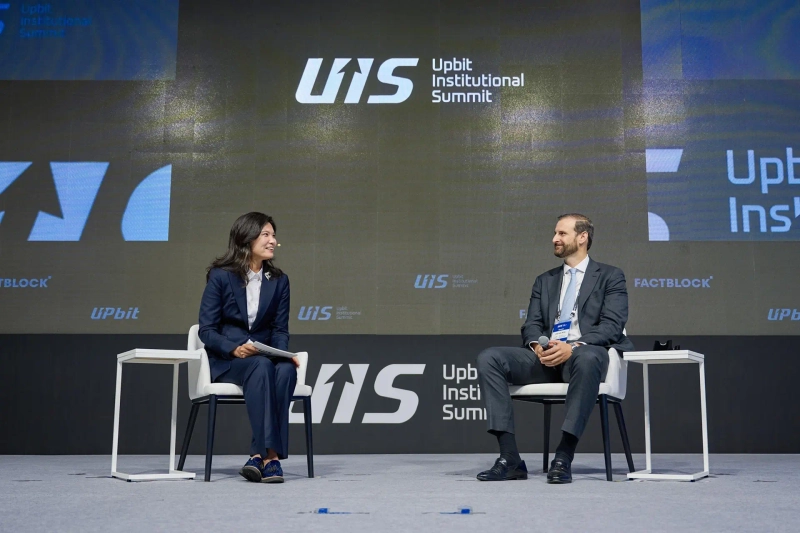
Dunamu, the operator of digital-asset exchange Upbit, said on Sept. 30 that it had concluded Upbit Institutional Summit 2026, or UIS 2026, held on Sept. 29 at Grand Walkerhill Seoul in Gwangjin District, Seoul.
Attendees included Patrick Witt, executive director of the White House President’s Council of Advisers for Digital Assets, and Jonathan Hurovitz, special adviser at the U.S. Treasury’s Office of Digital Asset Policy. Officials from regulators in major Asian markets, along with financial and digital-asset industry participants from South Korea and overseas, also attended.
In South Korea, Rep. Kim Sung-won of the ruling People Power Party and Rep. Min Byung-duk of the Democratic Party offered congratulatory remarks. U.S. Rep. Bryan Steil delivered a prerecorded video message. Steil chairs the House Financial Services Subcommittee on Digital Assets, Financial Technology and Artificial Intelligence and is a co-sponsor of the CLARITY Act.
In a special conversation with Yoon Sun-joo, Dunamu’s chief brand impact officer, Witt discussed U.S. digital-asset policy and market-structure legislation. “Digital assets and traditional finance will ultimately merge,” he said. Ultimately, he said, the two will not remain separate and will instead become part of a single financial system.
Stablecoins, tokenization and institutional participation in digital-asset markets were also key agenda items. Brian Quintenz, a former commissioner at the U.S. Commodity Futures Trading Commission, and Harry Jung, former deputy executive director of the White House President’s Council of Advisers for Digital Assets, discussed changes in the stablecoin market following the GENIUS Act and the direction of market-structure regulation centered on the CLARITY Act.
The event also featured discussion on the regulatory direction for digital assets in major Asian markets. Officials from Indonesia’s Financial Services Authority, Malaysia’s Securities Commission and Thailand’s Securities and Exchange Commission shared their countries’ stages of market development, regulatory priorities and investor-protection measures.
Executives from South Korea’s financial industry discussed the potential on-chain transition of banking, payments and capital markets. Dunamu introduced related infrastructure including GIWA Chain, the on-chain verification system Dojang and the privacy technology BOJAGI.
Chief Executive Officer Oh Kyung-seok said UIS featured wide-ranging discussions on how financial markets and industry could change after the institutionalization of the digital-asset market. Dunamu will work to build new financial infrastructure and an ecosystem linking digital assets with traditional finance, he added.

Uk Jin
wook9629@bloomingbit.ioH3LLO, World! I am Uk Jin.