Dunamu Unveils Global On-Chain Finance Blueprint at KBW 2026, Aiming to Build Infrastructure Linking Korea and the World
Summary
- Dunamu said at KBW 2026 that it presented its business direction and technology and service strategy for building global on-chain financial infrastructure.
- Dunamu said it will expand Upbit’s customer base from individuals to corporations and institutions, widen its business scope from South Korea to the global market, and extend its financial functions beyond trading to custody, transfer and verification.
- Dunamu said it will combine on-chain infrastructure including GIWA Chain, Dojang and BOJAGI and develop them into shared infrastructure that can be used by a wide range of financial-market participants.
Forecast Trend Report by Period


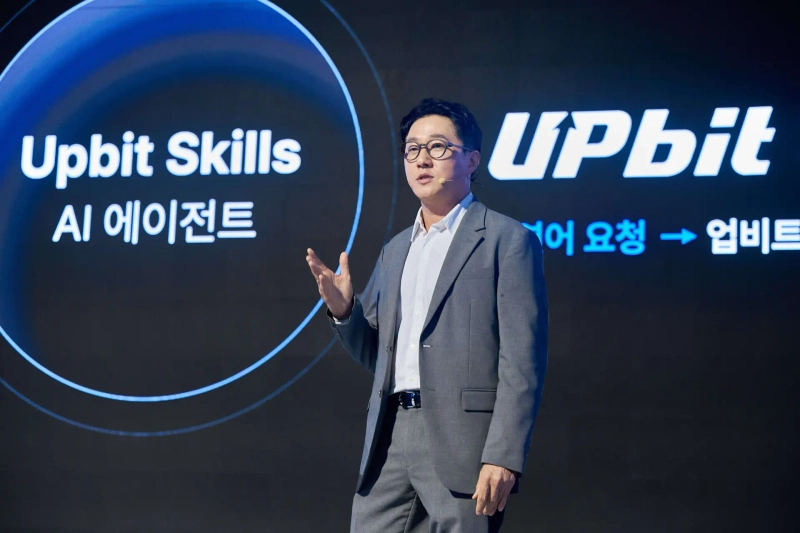
Dunamu, the operator of Upbit, said on Oct. 1 that it had presented its business direction and technology and service strategy for building global on-chain financial infrastructure at Korea Blockchain Week 2026, or KBW 2026.
A presenting partner of KBW 2026, Dunamu has been discussing shifts in the digital-asset industry with global policy and market experts at the event, following the Upbit Institutional Summit, or UIS, held on Sept. 29. While UIS focused on the regulatory framework and future of digital finance with global policy and financial leaders, KBW is being used to flesh out the future financial infrastructure Dunamu envisions, along with the technology, services and ecosystem that would support it.
On Sept. 30, the opening day of KBW, Dunamu Chief Executive Officer Oh Kyung-seok delivered a presentation titled "Beyond Digital-Asset Trading, Toward Financial Infrastructure for Connection." He said the boundaries between traditional finance and digital assets are narrowing, and that as global markets become connected around on-chain networks, competition is increasingly centered on setting the standards and pathways for a new financial system.
Oh cited access, connectivity and exportability as the key conditions for South Korea to grow into a global digital-finance hub. That means linking the country’s large digital-asset user base, liquidity and market operating experience with global markets.
Dunamu also outlined its plan to expand its financial infrastructure. It aims to broaden Upbit’s customer base from individuals to corporations and institutions, while expanding its business scope from South Korea to global markets. At the core of the strategy is a push beyond trading-focused services into custody, transfer and verification.
To do so, Dunamu plans to combine capabilities it has built in trading, custody, travel rule compliance and suspicious transaction detection with on-chain infrastructure including GIWA Chain, Dojang and BOJAGI. The goal is to develop them into shared infrastructure that can be used by a wide range of financial-market participants.
Later the same day, Yoon Sun-joo, Dunamu’s chief brand impact officer, took part in a special discussion with former US Commodity Futures Trading Commission Commissioner Brian Quintenz under the theme, "Beyond Clarity: What’s Next for US Digital Asset Regulation?" Drawing on his experience with US regulation, Quintenz said government leadership is critical during periods of regulatory change. He added that regulation should be designed less to block risk at the source than to create an environment in which market participants can identify and manage risk.
Quintenz also said consistent regulatory standards are needed for domestically regulated operators and offshore firms. If local companies are restricted from offering products and services while consumers can access similar offerings through offshore providers, compliant businesses could be put at a disadvantage and demand and business opportunities could move overseas. "Regulators should take a consistent approach to onshore and offshore businesses," Quintenz said. "Otherwise, they only disadvantage regulated firms that have tried to comply with the law."
Dunamu is continuing its program on Oct. 1 with sessions spanning policy, technology and the broader ecosystem. In a congratulatory speech for the Digital Asset Tracing Competition, or SCAN 2026, Oh is expected to underscore the importance of on-chain data analysis and tracing capabilities for strengthening security and transparency in the digital-asset ecosystem. SCAN 2026 is an event in which participants compete to analyze and trace digital-asset transaction flows using blockchain data.
In the afternoon, the company will host the GIWA GASOK Showcase, which supports the growth of promising dApps built on GIWA Chain. Projects in five areas — decentralized finance, or DeFi, and real-world assets, or RWA; consumer and social services; zero-knowledge proof-based authentication; artificial intelligence and Web3; and mass adoption — will present technology and service use cases built on GIWA Chain.
Dunamu is also participating in a panel session organized by DAXA, the Digital Asset eXchange Alliance. Kim Jae-jin, vice chairman of DAXA, and Hwang Soon-ho, head of external cooperation at Dunamu, are scheduled to discuss changes in South Korea’s digital-asset trading market and the challenges ahead under the theme "Korea’s Next Generation of Digital Asset Venues."
At the venue, Dunamu is also operating the Upbit Zone and the Upbit Live Studio, where visitors can experience Upbit, GIWA and ecosystem projects firsthand. The company also plans to share special KBW content and interviews with key speakers through Upbit’s official YouTube channel.
"The digital-finance era is creating an opportunity for South Korea to grow into a financial center that connects the world," Oh said. "Dunamu will turn that potential into reality through on-chain financial infrastructure linking Korea and the world."

Suehyeon Lee
shlee@bloomingbit.ioI'm reporter Suehyeon Lee, your Web3 Moderator.