BDACS Says KRW1 Can Link Korean, Global Capital and Help Internationalize the Won
Summary
- BDACS said the won-backed stablecoin KRW1 could help internationalize the won by linking global capital with the Korean market.
- Kim Tak-jong, the company's CSO, pointed to capital moving from domestic exchanges to overseas platforms and rising net stablecoin outflows, saying KRW1 could fill the gap in Korea's on-chain won infrastructure.
- Kim said KRW1 could be used alongside tokenized securities, on-chain payments and a 24-hour foreign-exchange market, and said South Korea needs a balanced digital-asset regulatory framework that supports innovation.
Forecast Trend Report by Period


BDACS, a South Korean digital-asset custodian, said its stablecoin KRW1 and other won-backed stablecoins could help internationalize the Korean currency by linking Korean capital with global markets in ways that were previously impossible.
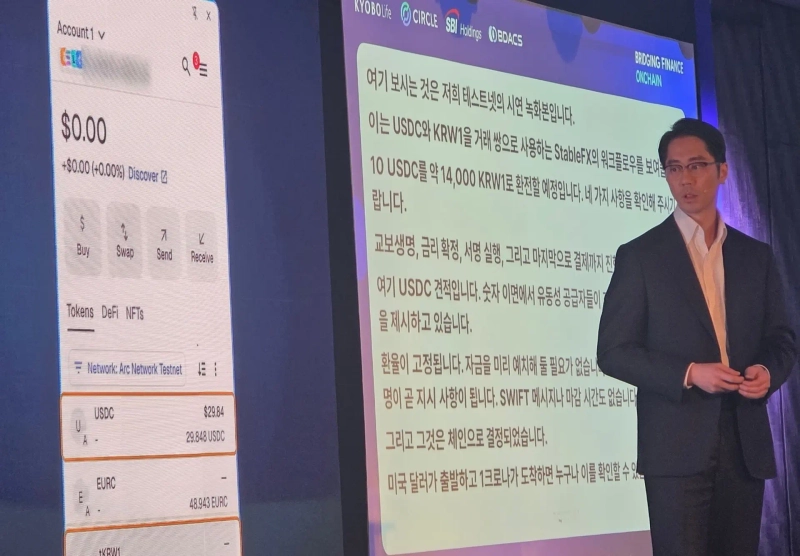
Kim Tak-jong, BDACS co-founder and chief strategy officer, made the remarks at the "Bridging Finance Onchain" event held at the Four Seasons Hotel in Seoul's Jongno district on October 1. "An on-chain economy is being built around the world, but so far it has effectively been built on a single currency, the dollar," Kim said. Won-backed stablecoins are not meant to replace existing payment systems, he added. Instead, they can enable things that were previously impossible.
The remarks appeared aimed at dollar stablecoins, which dominate the market. The global stablecoin market has a capitalization of about $300 billion, and 99.7% of it is made up of dollar-based stablecoins.
Kim said that if that trend continues, rising on-chain investment by Korean users could accelerate capital outflows into dollar stablecoins. "About $33.9 billion moved from domestic exchanges to overseas platforms in the first half of this year alone," he said. "That was not driven by tax evasion. It reflects investment demand that is not being met in Korea."
"Korean capital and users have already entered the on-chain market. They just are not using the won," he said. Net stablecoin outflows from domestic exchanges alone exceeded $360 million in June. If dollars remain the only usable on-chain currency, Koreans' on-chain activity will inevitably become dollar-based, he said, calling that not a user problem but a gap in Korean infrastructure.
Won-Backed Stablecoins Can Drive Won Internationalization
Kim said won-backed stablecoins could fill that gap. BDACS is preparing to launch KRW1, a won-based stablecoin, and build related infrastructure. KRW1 is backed one-to-one by won deposits held at domestic banks.
Kim cited three reasons such tokens are needed: the age of AI agents, the use of tokenized Korean assets in payments and finance, and stronger links between global capital and the Korean market.
"In an era when AI agents make payments on behalf of people, on-chain payment instruments will be necessary," Kim said. He added that if Korea lacks an on-chain won while AI agents increasingly handle payments, those transactions will default to the dollar.
He also said South Korea's tokenized securities market, which is nearing institutionalization, is closely tied to won-backed stablecoins. "Tokenized bonds can move in seconds, but settlement can still take one or two days through banks," Kim said. With won-backed stablecoins such as KRW1, bonds and won could move simultaneously on-chain, he added.
That would also make possible on-chain repurchase agreement transactions. Users could borrow won-backed stablecoins against tokenized bonds as collateral and receive the collateral back immediately upon repayment.
Kim also said won-backed stablecoins could help internationalize the won by strengthening links between global capital and won-denominated markets, laying the groundwork for broader use of the currency internationally.
"If investors in a place like New York, where business hours do not overlap with Korea at all, want to buy won-denominated assets today, they have to wait until Korea's financial markets reopen," Kim said. "But if won-backed stablecoins exist, they could swap dollars for won on-chain and immediately buy Korean bonds."
He added that if Korea moves toward a 24-hour foreign-exchange market and the won can trade on-chain, overseas capital would be able to enter the Korean market without time constraints.
BDACS also demonstrated a foreign-exchange transaction on October 1 that swapped KRW1 for USDC in two seconds using Circle's Arc blockchain.
Balanced Regulation Needed
Regulation remains a key hurdle. South Korea still lacks a basic digital-asset law, leaving no formal issuance standards for won-backed stablecoins.
Kim said policymakers need to strike a balance between regulation and innovation. "If regulation is too strict, related activity will move overseas," he said. "If regulation is too weak, the trust needed for money to function can be lost. In the end, we need to find the point where regulation and innovation meet."
He also said BDACS has no intention of using KRW1 to circumvent regulation. "KRW1 will be issued by a digital-asset custodian regulated in Korea, and the reserves will also be held at domestic banks," Kim said. "Our goal is not to avoid Korean regulation. It is to bring Korean standards on-chain."

Uk Jin
wook9629@bloomingbit.ioH3LLO, World! I am Uk Jin.