Tiger Research Says Monad Could Serve as South Korea’s Stablecoin and RWA Financial Infrastructure
Summary
- Tiger Research said Monad could become financial infrastructure for South Korea’s stablecoin, payments and RWA markets, citing fast settlement, low costs and global liquidity.
- The report said Monad could raise institutional capital efficiency by serving as a hub chain that settles and bridges funds across multiple blockchains, payment networks and CEXs.
- Tiger Research said use of won-denominated stablecoins and RWAs will expand in South Korea’s digital-asset market by 2030, and that domestic financial institutions should pursue both the tokenized securities regime and public chains.
Forecast Trend Report by Period


As South Korea’s digital-asset market shifts from trading toward competition to build real financial-service infrastructure, high-performance Layer 1 blockchain Monad stands to see broader use, according to a new report.
Tiger Research, a Web3-focused research firm, said Oct. 6 in a report titled "Monad’s View on South Korea’s Digital-Asset Market in 2030" that Monad could be used as financial infrastructure for the country’s stablecoin, payments and real-world asset, or RWA, markets. The report cited fast settlement, low costs and links to global liquidity.
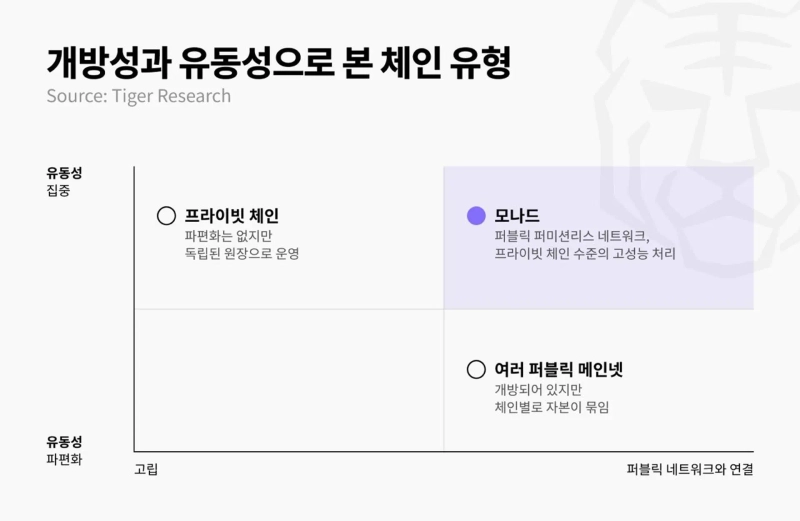
It highlighted Monad’s potential to function as a "hub chain" that settles and bridges fund flows scattered across multiple blockchains, payment networks and centralized exchanges, or CEXs, while reallocating liquidity in one place. That would reduce the need for institutions to disperse capital across multiple chains and improve capital efficiency.
Tiger Research also projected that by 2030, won-denominated stablecoins will establish themselves as payments infrastructure that complements, rather than replaces, existing card and settlement systems. With trade accounting for about 85% of South Korea’s gross domestic product, the firm expects greater use in business-to-business transactions and cross-border settlement than in consumer payments.
The RWA market is also expected to shift away from simple asset issuance toward distribution and management. Because stablecoins, payments and RWAs all require fast settlement, low fees and ample liquidity, high-performance public blockchains such as Monad could see wider use, the report said.
The firm said South Korean financial institutions need to pursue both the domestic institutional market and offshore markets. In South Korea, that means securing account-management institution status and laying the groundwork for stablecoin-related partnerships ahead of the tokenized securities framework scheduled to take effect in February 2027. Overseas, institutions need to build experience distributing Korean assets abroad through global distribution networks and public chains.
Yoon Seung-sik, head of research at Tiger Research, said the South Korean digital-asset market in 2030 will be led by institutions that move into real-world deployment as rules are established and infrastructure is built.
"What is needed is not another study or pilot project, but a decision to operate Korean assets on actual infrastructure," Yoon said.

Suehyeon Lee
shlee@bloomingbit.ioI'm reporter Suehyeon Lee, your Web3 Moderator.