FSS Chief Lee Chan-jin Says Current Oversight Struggles to Keep Up With Fast-Moving Crypto Fraud
Summary
- Lee Chan-jin, governor of the Financial Supervisory Service, acknowledged that the speed of cryptocurrency fraud makes it difficult to respond under the current oversight system.
- Rep. Min Byung-duk said a fake network impersonating Dunamu's blockchain mainnet 'GIWA' caused roughly 2.7 billion won to 2.8 billion won in losses.
- Min cited 7.78 million active crypto users in South Korea and 6 trillion won in average daily trading volume, urging stronger on-chain fraud response systems and supervisory standards.
Forecast Trend Report by Period


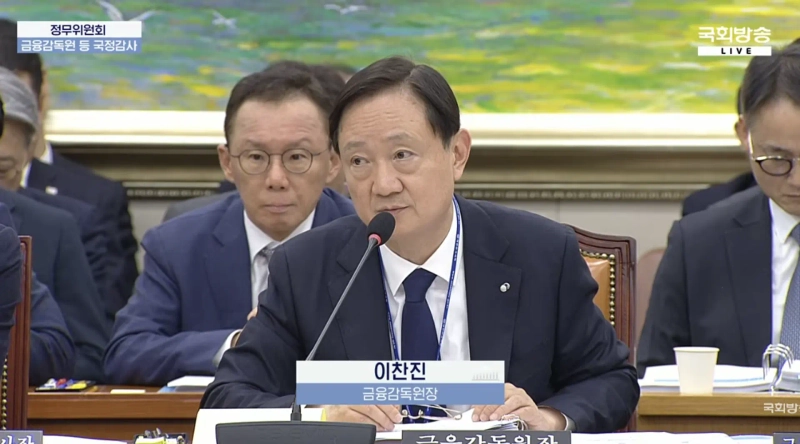
Lee Chan-jin, governor of the Financial Supervisory Service, acknowledged that financial authorities acting under the current supervisory system would struggle to respond quickly to cryptocurrency fraud that moves rapidly across blockchain networks.
At a National Assembly audit by the Political Affairs Committee in Seoul's Yeouido on October 19, Lee testified that "it is difficult to keep up with this speed right now" after Democratic Party lawmaker Min Byung-duk questioned the effectiveness of the response system for on-chain fraud.
Min said investors recently suffered losses of about 2.7 billion won to 2.8 billion won, or roughly $1.96 million to $2.03 million, on a fake network impersonating GIWA, a blockchain mainnet being developed by Dunamu. He said investors were harmed after rumors spread on social media that the GIWA mainnet would be launched without prior notice.
According to Min, about 2.8 billion won, or roughly $2.03 million, tied to the case moved within half a day. Even after GIWA officially denied the rumors, the funds left the network in just 11 minutes. He said that showed crypto scams can unfold far faster than traditional voice-phishing schemes.
Min also criticized the Financial Supervisory Service for taking too long to recognize the case and assess the damage. Financial authorities had failed to properly determine even the scale of losses, he said, urging them to expand forensic staffing capable of tracing blockchain transaction flows and to establish supervisory standards for large cryptocurrency exchanges and blockchain networks.
Min also cited a 2024 study by the Financial Intelligence Unit, saying South Korea had 7.78 million active virtual-asset users and average daily trading volume of about 6 trillion won, or roughly $4.35 billion. He said the market now requires a supervisory framework that matches its size and called for stronger regulatory capacity to quickly detect on-chain crime and prevent losses from spreading.

Suehyeon Lee
shlee@bloomingbit.ioI'm reporter Suehyeon Lee, your Web3 Moderator.