PiCK
Kim Min-seok Says Crypto Tax Rollout Will Hinge on Market Conditions, Institutional Readiness
Summary
- Kim Min-seok said authorities would decide whether to implement the virtual-asset tax system after a comprehensive review of market conditions and institutional preparedness.
- Kim Min-seok said authorities need to review whether next year’s taxation rollout is appropriate by taking into account the Digital Asset Basic Act, inadequate tax infrastructure, fairness issues with overseas exchanges, and concerns from young people.
- Cho Seung-rae and Deputy Prime Minister Lee Hyoung-il said they would conduct additional checks on the existing tax system and the government’s tax-related notice in light of changes in the virtual-asset market and prepare a reasonable approach.
Forecast Trend Report by Period


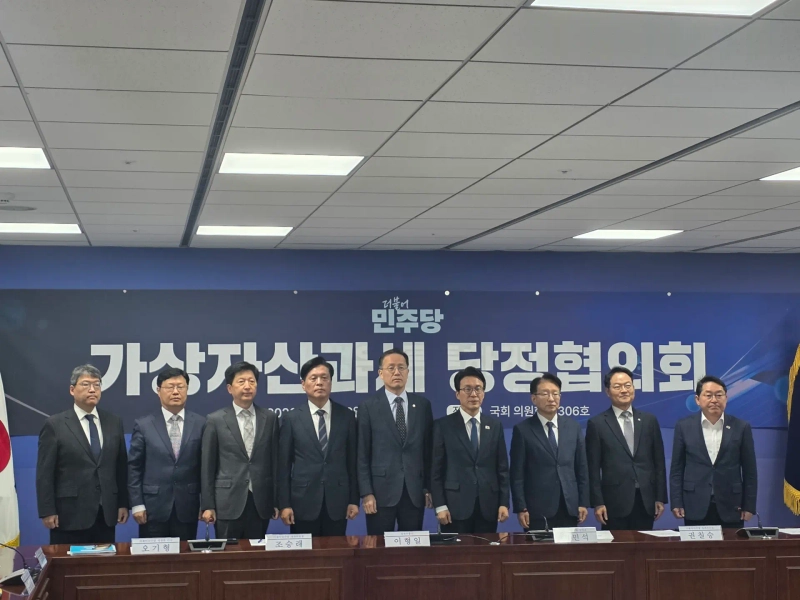
Kim Min-seok, leader of the Democratic Party of Korea, said authorities will decide whether to implement South Korea’s virtual-asset tax regime after comprehensively reviewing market conditions and institutional preparedness.
Speaking at a Democratic Party-government consultation on virtual-asset taxation at the National Assembly Members’ Office Building on Oct. 28, Kim said the principle that income should be taxed where it is earned must be upheld. At the same time, he noted that the Digital Asset Basic Act, which would provide the institutional foundation for the virtual-asset market, has yet to be enacted.
Kim said authorities need to examine whether introducing the tax without sufficiently reflecting the characteristics of the virtual-asset market and its trading environment could cause distrust and confusion among taxpayers. He also stressed that policymakers should take into account inadequate tax infrastructure, fairness issues involving overseas exchanges, and concerns from young people who have looked to the market as a way to build assets.
He added that the meeting was convened to determine whether a tax launch next year could produce side effects, how those issues could be addressed, and whether it would be appropriate to introduce the system as scheduled. A conclusion, he said, should be reached after weighing public concerns and institutional conditions, while also accelerating legislation of the Digital Asset Basic Act.
Cho Seung-rae, chair of the National Assembly’s Public Finance and Economic Planning Committee, also said additional checks are needed on tax preparedness. He said the virtual-asset market has changed significantly during the three postponements of the tax, and authorities need to verify whether the existing tax system can function properly. The decision, he added, should be based on practical conditions rather than taxation philosophy.
Cho also raised the need to hold off on a government notice related to crypto taxation that authorities had planned to prepare by the end of October. He said publication of the notice could be interpreted as a declaration that the government will proceed with the tax. If the notice becomes an obstacle to deciding whether implementation is appropriate, it should be temporarily delayed while the party and the National Assembly conduct further checks on the readiness of the tax system.
Lee Hyoung-il, deputy prime minister and finance minister, said industry participants and experts agree with the principle of taxation but have argued that the framework should reflect market conditions that have changed since the tax system was legislated in late 2020. He added that the government is considering a reasonable approach that the public can accept and that can be implemented smoothly in practice, and will consult closely with the National Assembly.

Uk Jin
wook9629@bloomingbit.ioH3LLO, World! I am Uk Jin.