PiCK
Harvard Model Sees Democrats With 96% Odds of Winning House, 78% Odds in Senate
Summary
- Harvard University’s election model said Democrats have a 96% chance of winning a House majority in the U.S. midterm elections, compared with 4% for Republicans.
- Harvard’s model projected Democrats would win 242 of the House’s 435 seats and 53 of the Senate’s 100 seats, giving the party majorities in both chambers.
- Harvard said the median polling error is about 2 percentage points, meaning the actual election result could still differ.
Forecast Trend Report by Period


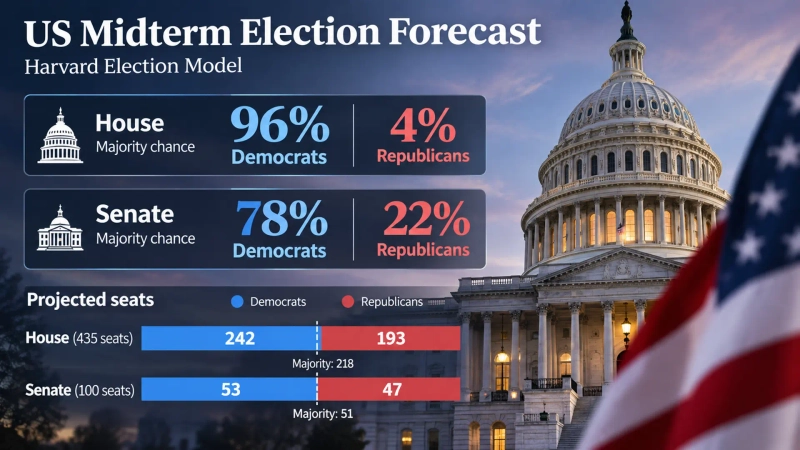
Harvard University’s election forecast shows Democrats are highly likely to win majorities in both the U.S. House and Senate in the midterm elections.
The Hill reported on Nov. 3 that Harvard’s recently updated election model put the odds of Democrats winning control of the House at 96%. The probability of Republicans holding the chamber was estimated at about 4%.
Harvard researchers compared Republicans’ chances of winning the House to the odds of rolling a specific number on a 20-sided die. At that level, an underdog would be expected to win roughly once in every 26 elections. The last comparable upset was in 1952, the researchers said.
A majority in the 435-seat House requires 218 seats. Harvard’s model projects Democrats will win 242 seats. It classified 186 districts as safe Democratic, 36 as likely Democratic and nine as leaning Democratic. Another 10 races were counted as tossups.
In the Senate, Harvard put the odds of Democrats winning the majority at 78%. The university projected Democrats would secure 53 of the chamber’s 100 seats. A majority in the Senate requires 51 seats.
Of the 35 Senate seats up for election this year, seven were classified as highly competitive. Texas, Ohio, Kansas and Alaska were rated as favoring Democrats, while South Carolina and Nebraska were seen as favoring Republicans. Iowa was identified as a tossup.
Harvard said the actual result could still differ depending on polling errors. The forecast model incorporated five scenarios, including one in which polls are accurate and others in which errors break in favor of either party.
The researchers said the median polling error in midterm elections since 1950 has been about 2 percentage points. Out of 19 midterm elections, only three had errors within 0.5 percentage point.

Suehyeon Lee
shlee@bloomingbit.ioI'm reporter Suehyeon Lee, your Web3 Moderator.