PiCK
BOK Says Bank-Led Stablecoin Issuance Is Second-Best Option to Minimize Regulatory Clashes
Summary
- The Bank of Korea said limiting won-denominated stablecoins to bank-led issuance (50%+1 share) is a second-best option to reduce regulatory conflicts.
- The Bank of Korea said it would be desirable to begin with bank-led stablecoin issuance and expand issuer eligibility to non-banks once stability has been confirmed.
- Speakers at the seminar said that for institutionalizing stablecoins, user protection, an accountability framework, and allowing participation by diverse businesses matter more than the identity of the issuer.
Forecast Trend Report by Period


Seminar on 'Tasks After the Digital Asset Basic Act'
"Bank-led stablecoins are preferable in the early stage of adoption"
"Broaden issuer eligibility to non-banks once stability is confirmed"
"A wider range of participants should also be allowed"
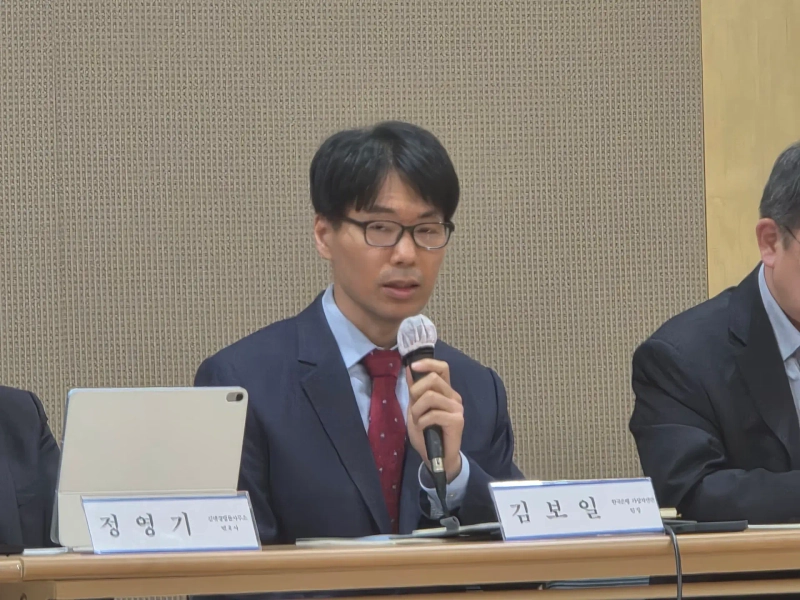
The Bank of Korea said a bank-led issuance structure for stablecoins, with the banking sector holding 50% plus one share, is a second-best option in the debate over who should be allowed to issue stablecoins under the proposed Digital Asset Basic Act.
Kim Bo-il, head of the BOK's virtual asset team, made the remarks on Nov. 10 at a seminar titled "Tasks After the Digital Asset Basic Act" held at the Korea Financial Investment Association's Financial Investment Education Institute.
"Bank-led stablecoin issuance is not the best solution, but a second-best one," Kim said. "It is an alternative proposed in the absence of a perfect answer."
The Financial Services Commission is drafting the Digital Asset Basic Act, and a plan to limit issuers of won-denominated stablecoins to bank-led consortiums is emerging as a leading option.
"Bank-led stablecoin issuance would minimize clashes"
Kim said a bank-led stablecoin model is intended to minimize conflicts with South Korea's existing financial regulatory system.
South Korea's financial regulations are built on anti-money laundering rules based on the real-name system, the separation of industrial and financial capital, and foreign exchange laws, he said. Banks have responded to those rules for years and have the relevant experience, know-how and systems in place.
He described the bank-led approach as a compromise to address concerns that blockchain anonymity could be misused to evade regulation. The idea is to start issuance through banks and then expand issuer eligibility after safety has been verified.
"Central banks and stablecoins can coexist"
Kim said the BOK also highly values blockchain's technological strengths.
He said blockchain technologies such as smart contracts and programmability could help advance financial markets.
Kim also addressed the need for the BOK in a stablecoin system. Even in a tokenized financial system, he said, the monetary system still needs a central anchor. He added that the preferred outcome would be a framework in which settlement assets provided by the central bank and private stablecoins compete with and complement each other.
He struck a more cautious tone on interoperability between won-based stablecoins and global blockchains, an issue the industry has consistently emphasized.
Blockchains such as Ethereum and Solana operate as independent systems, Kim said. Policymakers therefore need to consider how much of a national payment system should be placed on, and rely on, global private networks.
He added that another important task is determining how to define the relationship between the existing financial system and various blockchains and how to secure interoperability among them. Discussion is also needed on how to design those interconnections institutionally.
"Building an accountability framework matters more than who issues"
The seminar also featured the view that if stablecoins are to be introduced, building user protections and an accountability framework matters more than deciding who the issuer should be.
Hwang Seok-jin, a professor at Dongguk University's Graduate School of International Information, said institutionalizing stablecoins requires practical usability and a trustworthy management framework, rather than simply allowing issuance or tightening regulation.
He added that banks have strengths in financial soundness and internal controls, while non-bank institutions and fintech companies are stronger in technological innovation and service development. Rather than centering issuance on a specific sector, he said, it would be preferable to allow participation by a range of businesses that meet defined qualification and accountability requirements.

Uk Jin
wook9629@bloomingbit.ioH3LLO, World! I am Uk Jin.