Tether Market Cap Falls $6.6 Billion in 60 Days, Raising Risk of Further Bitcoin Declines
Summary
- CryptoQuant said a $6.6 billion drop in Tether's USDT market capitalization is tightening crypto-market liquidity and increasing the risk of further Bitcoin declines.
- The firm said a 284,000 BTC drop in Bitcoin's apparent demand over the past 30 days and a negative Coinbase premium for 30 straight days show buying interest is weakening.
- CryptoQuant said that with stablecoin liquidity shrinking and no recovery in spot buying, Bitcoin faces a significant risk of further correction even if it manages a short-term rebound.
Forecast Trend Report by Period


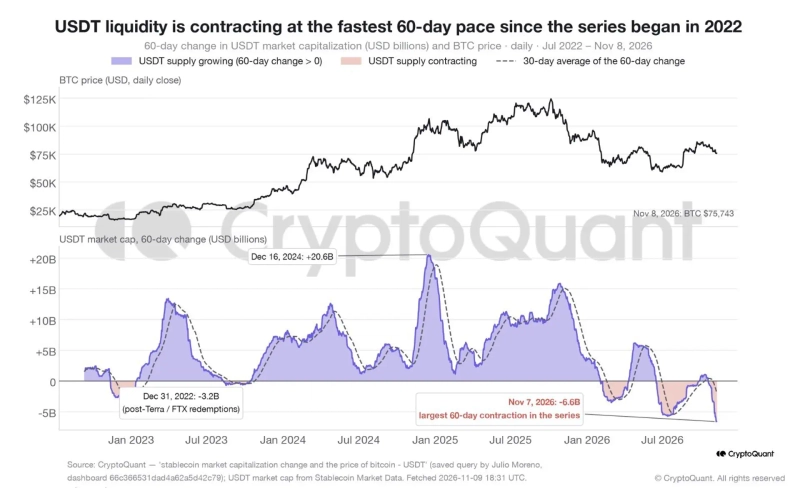
The market capitalization of Tether's USDT stablecoin has fallen sharply, fueling concerns about tighter liquidity in the cryptocurrency market and the potential for further declines in Bitcoin.
According to on-chain analytics firm CryptoQuant on November 10, USDT's market capitalization has dropped by $6.6 billion over the past 60 days. That exceeds the contraction seen during the wave of large redemptions that followed the collapse of crypto exchange FTX in December 2022.
CryptoQuant said stablecoin supply is a key gauge of potential buying power in the digital-asset market. A sustained decline in USDT's market capitalization suggests less capital is available to flow into the market, weakening fresh demand that could support Bitcoin prices.
Bitcoin's own demand indicators have also remained weak. CryptoQuant said Bitcoin's apparent demand fell by 284,000 BTC over the past 30 days, the steepest decline since March last year, signaling a rapid pullback in buying interest.
Spot buying by US investors has yet to recover. The Coinbase Premium Index, which measures the gap between Bitcoin prices on Coinbase and global exchanges, has remained negative for 30 straight days. That suggests relatively weak spot demand for Bitcoin in the US market.
Still, there have been periods in the past when sharp declines in Bitcoin demand coincided with short-term market bottoms. That means the possibility of a rebound after concentrated selling pressure cannot be ruled out entirely.
Even so, CryptoQuant highlighted that stablecoin liquidity is shrinking and there are still no signs of a recovery in spot buying. Without fresh capital inflows, Bitcoin may struggle to avoid the risk of another correction even if it manages a short-term rebound.

Suehyeon Lee
shlee@bloomingbit.ioI'm reporter Suehyeon Lee, your Web3 Moderator.