PiCK
ETF Listings Aren’t Enough to Ignite Altcoin Season
Summary
- Many altcoin ETFs are now trading below their launch-date prices, showing that ETF listings have failed to drive a broader market rebound.
- Institutional money has been concentrated in spot Bitcoin ETFs, while Ethereum, Solana and XRP altcoin ETFs have seen relatively limited inflows.
- Experts said altcoin ETFs could become a channel for capital inflows if the market recovers, though even if an altcoin season returns, gains may be limited to a select group of ETF-linked digital assets.
Forecast Trend Report by Period


Altcoins fall below pre-ETF launch prices
Thin investment narrative holds them back
“Long-term ETF outlook is positive”
“Even if altcoin season comes, gains will be selective”

A wave of exchange-traded funds tied to major altcoins followed the launch of spot Bitcoin ETFs, but they have yet to spark a broader market rebound. Most of those tokens are now trading below where they were when their ETFs debuted.
As of 1:30 p.m. on Nov. 13, Ethereum was trading at $1,931, up 5.93% from a day earlier, according to CoinMarketCap. That was still about 41.5% below its July 23, 2024 level of $3,340, when spot Ethereum ETFs began trading in the US.
Solana has followed a similar path. The token was trading at $79 at the same time, down more than 60% from about $199 on Oct. 28, 2025, when its spot ETF launched.
Other altcoins have also failed to benefit from ETF listings. Hedera was down 66% from its ETF launch price, XRP 58%, Dogecoin 56%, Litecoin 51% and Chainlink 27%.
That marks a sharp contrast with Bitcoin. The largest cryptocurrency traded at $68,640 at the same time, down 6.71% from a day earlier. While that was 45.5% below its record high of $126,000, it remained 48.4% above $46,300, the price when spot Bitcoin ETFs launched. Excluding an initial dip shortly after listing, Bitcoin has not fallen below that level since.
Institutional money crowds into Bitcoin as altcoins lag
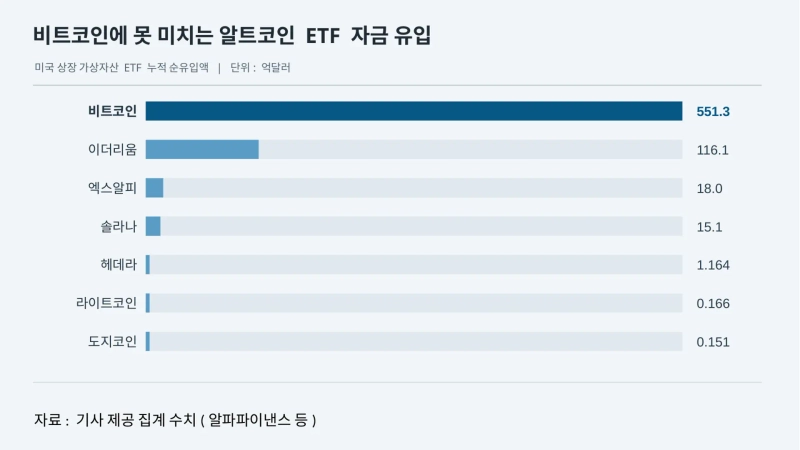
Data from crypto ETF platform Alpha Finance showed cumulative net inflows into US spot Bitcoin ETFs totaled about $55.13 billion as of Nov. 12.
By contrast, spot Ethereum ETFs, which launched the same year, had drawn about $11.61 billion in net inflows. That means institutional money flowing into Bitcoin was roughly five times the amount directed to Ethereum.
The gap is even starker when compared with other altcoin ETFs that are in or near their first year on the market. Spot Bitcoin ETFs pulled in about $36.22 billion of net inflows in their first year after launch. XRP and Solana spot ETFs brought in just $1.8 billion and $1.51 billion, respectively, in their first year.
Hedera posted net inflows of $116.4 million, while Litecoin brought in $16.6 million and Dogecoin $15.1 million.
Unclear narrative and lack of participation from big asset managers

A weak and uncertain investment narrative appears to be one reason altcoin ETFs have failed to attract capital on the scale seen in Bitcoin products.
Bitcoin has a clearer investment case as “digital gold,” underpinned by its fixed supply cap of 21 million tokens. That makes it easier for institutional investors already familiar with gold to approach the asset.
Yoon Seung-sik, a director at Tiger Research, said traditional finance firms and existing investors still have limited understanding of altcoins outside Bitcoin and Ethereum. The lack of information and education needed to generate investment demand is the biggest reason money has flowed only slowly into altcoin ETFs, he said.
Altcoins, by contrast, span projects with different technologies and use cases, making it harder to present a consistent investment thesis. Investors can make their own valuation judgments on stocks because they are widely seen as assets representing companies. Tokens have yet to establish that kind of link. During periods of high economic uncertainty, that limitation can weigh even more heavily, Yoon added.
Limited participation by large asset managers is also a hurdle for altcoin ETF growth. BlackRock, the world’s largest asset manager, runs Bitcoin- and Ethereum-related ETFs but has not entered the market for spot altcoin ETFs tied to assets such as XRP and Solana.
BlackRock said in August 2025 that it had no plans to launch spot XRP or Solana ETFs. At the time, the firm cited limited customer demand for digital assets other than Bitcoin and Ethereum.
Eric Balchunas, a Bloomberg ETF analyst, said BlackRock appears satisfied with just two crypto ETFs for now. There is little incentive to add more products, he said.
ETFs may gain traction when the market recovers
The long-term outlook for altcoin ETFs is not entirely negative. Their launch has at least created a channel for capital from traditional finance to enter the market.
Yoon said ETFs themselves are clearly meaningful. With institutional investors playing a larger role in the crypto market, altcoin ETFs could serve as a route for fresh inflows if the market recovers.
Still, some analysts say it may be difficult to recreate the kind of altcoin season seen in the past, when most tokens rose together.
Blockchain analytics firm Block Scholes said in a recent report that even if another altcoin season emerges, it will likely center on a limited group of digital assets that already have ETFs or are close to getting them.
The firm added that the muted impact of altcoin ETF launches reflected broader market weakness and low investor participation. As the ETF market expands, the gap between altcoins that can attract institutional money and those that cannot may widen further.

Uk Jin
wook9629@bloomingbit.ioH3LLO, World! I am Uk Jin.