Wintermute Says US Crypto Industry Must Rethink Lobbying as Wall Street Gains Edge on Tokenization
Summary
- The report said the US crypto industry needs a full reset of its policy response strategy as it struggles against traditional finance over tokenization rules.
- It said the US Securities and Exchange Commission's (SEC) innovation exemption for tokenized stocks could end up with a much narrower scope because of opposition from traditional finance and Democratic senators.
- It said policy uncertainty in the US and setbacks for the CLARITY Act could leave the industry at a disadvantage in competing with overseas markets, underscoring the need to rethink its political alliances and lobbying strategy.
Forecast Trend Report by Period


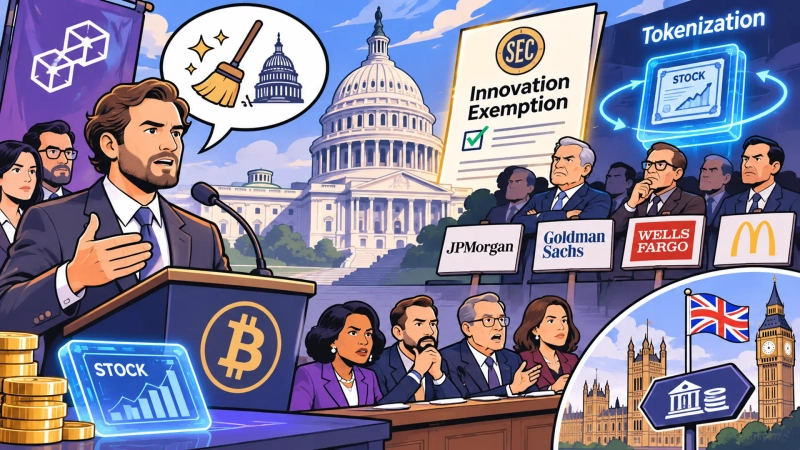
The US crypto industry needs to fully revamp its policy strategy as it struggles against traditional finance in the fight over tokenization rules, The Block reported on November 20.
Ron Hammond, Wintermute's head of policy and advocacy, made the remarks at the Capital Crypto Forum on November 19. He urged the industry to improve its policy response framework, citing internal divisions and the lobbying power of large financial institutions.
"The industry needs to get its house in order on policy," Hammond said. "It became clear that we either were not united enough, or that we cannot win when we are up against bigger forces."
He said the expansion of the tokenization market is deepening conflicts of interest between crypto firms and traditional financial institutions.
A leading example is the US Securities and Exchange Commission's "innovation exemption" for tokenized stocks. The SEC introduced a five-year regulatory exemption in September to allow trading in tokenized US stocks, but the plan has faced resistance from traditional financial firms and some lawmakers.
JPMorgan Chase, Goldman Sachs, Wells Fargo and McDonald's are among the companies opposing a model under which third parties tokenize and trade their shares. Hammond said the industry works with banks in New York while clashing with them in Washington on a range of policy issues.
He added that the innovation exemption could end up being far more limited by the time it is fully implemented. The restrictions are so tight that the measure may offer little practical benefit even for firms like Wintermute. While calling it a good first step, he said there is still a long way to go.
Concerns over the exemption are also surfacing in Washington. Four Democratic senators — Angela Alsobrooks, Ruben Gallego, Mark Warner and Catherine Cortez Masto — recently warned SEC Chair Paul Atkins that tokenized stock trading could create gaps in know-your-customer and anti-money-laundering rules.
Christy Goldsmith Romero, whom President Donald Trump nominated to fill the Democratic seat on the SEC, also indicated at a Senate Banking Committee confirmation hearing that she was open to pursuing a formal rulemaking process, including public comment, in response to opposition.
Hammond also expressed concern that US policy uncertainty could hurt the industry's competitiveness against overseas markets. After the CLARITY Act, a US crypto market structure bill, ran into difficulty, UK officials actively asked how they could attract crypto firms back to Britain, he said.
He also pointed to some politicians who had presented themselves as crypto-friendly but took the opposite stance on tokenization policy, arguing that the industry needs to reassess its political alliances and lobbying strategy.

Suehyeon Lee
shlee@bloomingbit.ioI'm reporter Suehyeon Lee, your Web3 Moderator.