Hana Securities Says Memory Chips to Lead Market Into Physical AI Era
Summary
- Hana Securities analyst Kim Doo-eon said memory semiconductors will retain their market leadership over the medium to long term through the eras of artificial intelligence (AI) and physical AI.
- He said tighter U.S. semiconductor restrictions on China and stronger long-term agreements (LTAs) could create medium- to long-term opportunities for domestic memory chipmakers by helping them preserve their technology gap and profitability.
- Kim said concerns over a slowdown in semiconductor demand are likely to peak in the first half of next year before easing, and that a full-fledged valuation rerating could follow if strong profits at Samsung Electronics and SK Hynix continue.
Forecast Trend Report by Period


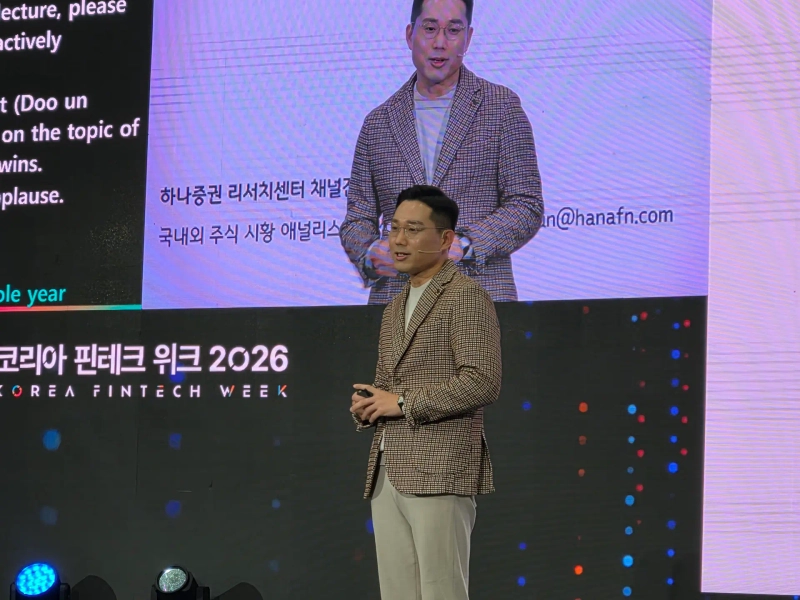
Memory semiconductors are set to remain a market-leading sector over the medium to long term despite the recent correction in South Korean stocks, Hana Securities said.
Speaking at Korea Fintech Week 2026 at Seoul’s aT Center in Yangjae on Nov. 27, Hana Securities analyst Kim Doo-eon, also known as Vincent, said the industry’s structural growth will continue even if the competitive landscape in artificial intelligence changes.
Memory chips will remain a core beneficiary even as the Nvidia-led AI ecosystem becomes more multipolar, Kim said. Whether Nvidia maintains its dominance in AI or global big tech companies including Google expand their own AI ecosystems, memory chips will remain indispensable. He added that the sector’s status as a market leader will hold until physical AI becomes broadly embedded in everyday life.
In the short term, however, deteriorating free cash flow at global big tech companies could weigh on the sector. Heavy investment in AI infrastructure is pressuring cash flow and fueling concerns over a future slowdown in semiconductor demand. Kim said those worries are likely to peak in the first half of next year and gradually ease in the second half.
Kim also said tougher U.S. semiconductor curbs on China could be a short-term headwind for South Korean chipmakers while creating a medium- to long-term opportunity. The measures are a burden for South Korea’s economy because of its heavy trade dependence on China. At the same time, they could slow the technological catch-up efforts of Chinese companies such as CXMT and YMTC, giving South Korean memory chipmakers more time to preserve their technology lead.
He also flagged long-term agreements, or LTAs, as a key variable for memory chipmakers. Unlike in the past, provisions that strengthen the binding nature of supply contracts, including upfront payments, are becoming more common. The key question is whether chipmakers can secure a certain level of profitability even during a downturn in semiconductor prices. Kim said DRAM prices could decline around the middle of next year. If LTAs prove effective in that process, the valuations of South Korean chipmakers could be reassessed.
Kim also highlighted the widening gap between corporate earnings and share prices after the recent market correction. If Samsung Electronics Co. and SK Hynix Inc. sustain their strong profit levels for the next six months to a year or longer, market confidence could recover and trigger a full-fledged valuation rerating, he said.
For investors seeking what he called the "stocks of the era" over the medium to long term, Kim cited three conditions: links to the AI industry, the ability to generate profits consistently, and active shareholder returns. He named Samsung Electronics and SK Hynix as leading candidates that meet those conditions.

Suehyeon Lee
shlee@bloomingbit.ioI'm reporter Suehyeon Lee, your Web3 Moderator.