Summary
- Jeff Park, a partner at Pantera Capital, said Bitcoin has become less appealing as an investment asset because it failed to distinguish itself from other risk assets.
- He said that even if the Fed eases monetary policy, many assets offer lower risk than Bitcoin while still providing similar upside, and that institutional adoption could remain difficult if average annual returns are 9% and volatility reaches 40%.
- He added, however, that Bitcoin still promises core value: its supply cannot be arbitrarily increased, transactions cannot be censored, and ownership cannot be taken away.
Forecast Trend Report by Period


Bitcoin has become less attractive as an investment because it has failed to distinguish itself from other risk assets, according to Jeff Park, a partner at Pantera Capital.
On November 28, Park wrote on X, formerly Twitter, that this cycle was a historically important moment for Bitcoin to deliver returns differentiated from other risk assets.
He wrote that falling trust in existing institutions and a broader push toward tighter surveillance had created an environment in which Bitcoin’s value proposition could have stood out. Instead, Bitcoin fell in tandem with other risk assets.
Park said that could lead investors, including institutions, to seek alternatives. Even if the Federal Reserve eases monetary policy, he wrote, many assets offer similar upside with less risk than Bitcoin. If average annual returns are limited to 9% while volatility reaches 40%, institutional adoption could remain difficult.
Still, Park said Bitcoin’s fundamental value remains intact. Bitcoin has never promised a specific price, a particular correlation with other assets or a catalyst for gains. What it does promise, he said, is that no one can arbitrarily increase its supply, censor transactions or strip holders of ownership.
Bitcoin Trails Nasdaq and Gold in Returns
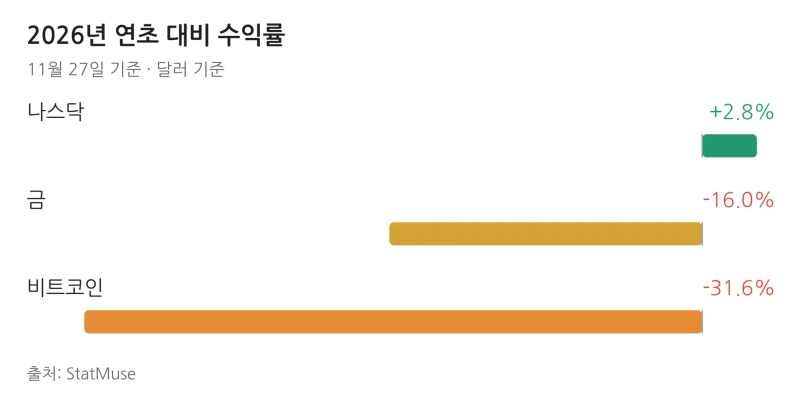
Bitcoin’s returns this year have lagged both US technology stocks and gold, a leading safe-haven asset.
According to StatMuse, the Nasdaq Composite closed at 24,129.50 on November 27, up 2.31% from the previous session. That left the index up about 2.8% from the start of the year.
Over the same period, international gold prices fell about 16%.
Bitcoin, by contrast, was trading at $59,250 as of 10:30 p.m., down 3.36% from the previous day. That marks a decline of about 32.3% from its January starting price of $87,508, roughly double the drop in international gold prices.

Uk Jin
wook9629@bloomingbit.ioH3LLO, World! I am Uk Jin.