

PiCK
'Impeachment Failure' KOSPI·KOSDAQ, Plunge to Yearly Lows…Exchange Rate Soars to 1,437 KRW [Comprehensive]
Summary
- It was reported that the appeal of KRW-USD exchange rate has declined due to a surge in political instability.
- It was announced that the KOSPI and KOSDAQ indices have both plummeted, hitting new yearly lows.
- The government is preparing proactive measures to stabilize the stock and exchange rate markets.
Even Individuals Who Endured Political Instability Dump 880 Billion KRW
KOSDAQ Index Hits Lowest in 56 Months
Decline in Appeal of KRW-Based Assets…Approaching 1,440 KRW Range
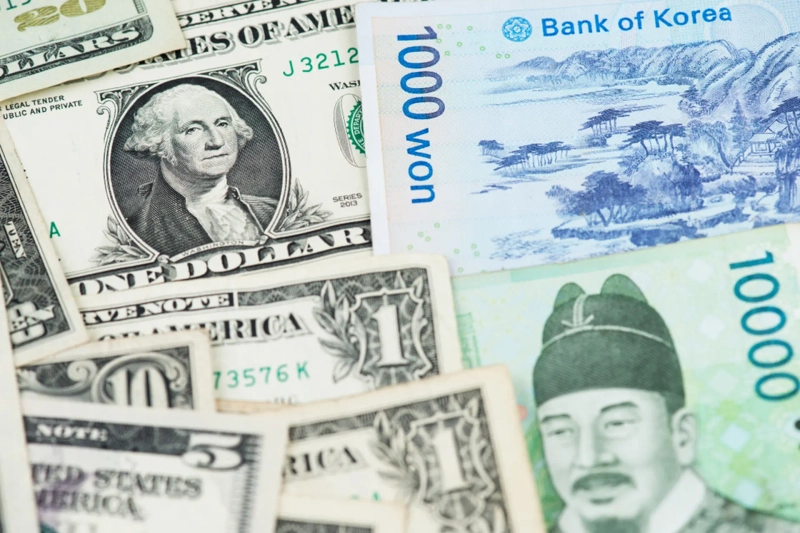
The KRW-USD exchange rate has entered the 1,440 KRW range as political uncertainty grows due to the 'impeachment situation.' This has increased the aversion to KRW-based assets. Both the KOSPI and KOSDAQ indices have hit new yearly lows, reminiscent of the 'Black Monday' crisis on August 5. In particular, the KOSDAQ plummeted over 5%, marking its lowest point in 56 months.
At 3:30 PM on the 9th, the KRW-USD exchange rate in the Seoul foreign exchange market recorded 1,437.0 KRW, up 17.8 KRW from the previous day.
The KRW-USD exchange rate has entered the 1,440 KRW range as political uncertainty grows due to the 'impeachment situation.' This has increased the aversion to KRW-based assets. Both the KOSPI and KOSDAQ indices have hit new yearly lows, reminiscent of the 'Black Monday' crisis on August 5. In particular, the KOSDAQ plummeted over 5%, marking its lowest point in 56 months.
The KOSPI and KOSDAQ both hit new yearly lows.
On this day, the KOSPI closed at 2,360.58, down 67.58 points (2.78%) from the previous trading day. This is lower than the 2,386.96 recorded during the 'Black Monday' on August 5. The index fell for four consecutive trading days from the first trading day after the martial law situation on the 4th.
The decline in the index is interpreted as being due to concentrated selling by individuals. In the stock market, individuals net sold 886 billion KRW alone. Institutions and foreigners net bought 690.7 billion KRW and 100.6 billion KRW, respectively, absorbing the volume.
Most of the top market cap stocks fell. Korea Zinc, embroiled in a management rights dispute, plummeted 15.33%, closing at 1,535,000 KRW. Compared to the previous trading day's peak of 2,407,000 KRW, it fell by 900,000 KRW in just one day.
Additionally, POSCO Holdings (-4.52%), Samsung C&T (-3.81%), Kia (-2.95%), KB Financial (-2.93%), Celltrion (-2.78%), NAVER (-1.47%), Samsung Electronics (-1.29%), and Hyundai Motor (-1.23%) also declined.
The KOSDAQ closed at 627.01, down 34.32 points (5.19%) from the previous session. This is the lowest level since April 2020, when the COVID-19 pandemic occurred. Like the KOSPI, the KOSDAQ also fell for four consecutive trading days after the martial law situation.
In the KOSDAQ market, individuals net sold 301.3 billion KRW. Foreigners and institutions net bought 204.9 billion KRW and 100.1 billion KRW, respectively.
All top market cap stocks in KOSDAQ turned red. Pearl Abyss (-7.92%), Enchem (-7.74%), Classys (-7.72%), JYP Entertainment (-7.32%), Rainbow Robotics (-7.3%), Alteogen (-6.86%), Hugel (-6.79%), HPSP (-6.32%), Ligachem Bio (-5.44%), and LIG Nex1 (-3.83%) all declined.
In response to the financial market emergency, the government announced proactive measures.
Choi Sang-mok, Deputy Prime Minister and Minister of Economy and Finance, held a macroeconomic and financial issues meeting (known as the 'F4' meeting) before the market opened, attended by Bank of Korea Governor Lee Chang-yong, and agreed to sufficiently supply foreign currency liquidity through foreign exchange repurchase agreements (RPs) if necessary.
They also announced plans to improve the structural foreign exchange supply and demand to promote foreign exchange inflows within this month.
Lee Bok-hyun, Governor of the Financial Supervisory Service, also stated, "We will immediately implement market stabilization measures according to the emergency response plan prepared for increased financial market volatility," and "We have strengthened real-time monitoring of foreign currency fund trends and guided financial companies to secure sufficient foreign currency liquidity." He also said, "We will closely examine and prepare for the impact on capital ratios due to the rise in exchange rates and the increase in risk-weighted assets."
Experts believe that if the KRW-USD exchange rate rises further, the authorities will intervene more actively, making it unlikely to soar above 1,450 KRW.
Kim Byung-yeon, a researcher at NH Investment & Securities, said, "It is necessary to consider that the financial authorities have sufficient willingness to intervene, and at the end of last month, the foreign exchange swap transaction limit with the National Pension Service was expanded to 50 billion USD," and "In addition to expanding the National Pension Service's foreign currency pre-funding limit, the willingness to supply unlimited liquidity after the martial law situation suggests that additional upward pressure may be limited."
He continued, "1,450 KRW was the peak of the exchange rate during the Russia-Ukraine war in 2022," and "Considering the difference between assets (domestic residents' overseas investments) and liabilities (foreigners' domestic investments) in terms of supply and demand, the upper limit is expected to remain at the 1,450 KRW level."
Jung Dong-no, Hankyung.com reporter dong2@hankyung.com
Jin Young-ki, Hankyung.com reporter young71@hankyung.com

Korea Economic Daily
hankyung@bloomingbit.ioThe Korea Economic Daily Global is a digital media where latest news on Korean companies, industries, and financial markets.