

Breaking
Yoon: "Many serious issues that couldn't be disclosed until the martial law decision" [Full Text of National Address]
Summary
- President Yoon Suk-yeol stated that he declared martial law based on the paralysis of state affairs and social disorder.
- The president emphasized that the martial law measures were to warn against the anti-state behavior of the opposition party.
- Regarding this emergency measure, the president added that he would not avoid political responsibility.
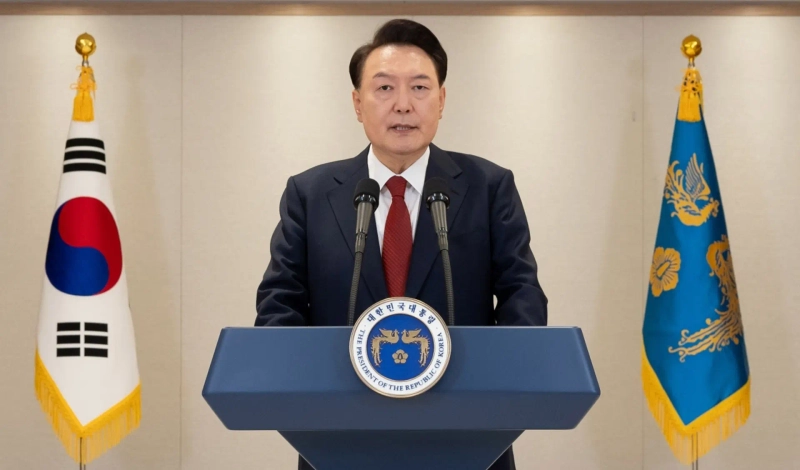
President Yoon Suk-yeol stated on the 12th, through a national address regarding the martial law situation, that "there were many serious issues that couldn't be disclosed until the decision to declare martial law was made."
The following is the full text of the national address
Dear citizens,
I stand here today to express my position on martial law.
The opposition party is currently claiming that the declaration of martial law constitutes treason, engaging in a frenzy of accusations.
Is that really the case?
Who is truly causing the paralysis of state affairs and constitutional disorder in South Korea today?
For the past two and a half years, the major opposition party has not recognized the president elected by the people and has continuously incited resignation and impeachment to remove him.
They have not accepted the election results.
Since the presidential election, there have been as many as 178 rallies calling for the president's resignation and impeachment from the early days of the term.
To paralyze the president's administration, they have pursued the impeachment of dozens of government officials since our administration took office.
Even if the impeached officials have done nothing wrong, they are suspended from their duties for a long time from the time of impeachment to the verdict.
Many officials have voluntarily resigned before impeachment was initiated and prosecution was carried out.
They have paralyzed state affairs by abusing impeachment.
They have reached the point of impeaching ministers, the chairman of the Korea Communications Commission, and even the chairman of the Board of Audit and Inspection and prosecutors who investigated their misconduct, and intimidating judges.
This is a shield impeachment to cover up their misconduct, completely undermining public office discipline and the rule of law.
Moreover, they have proposed unconstitutional special prosecutor bills 27 times, launching political agitation offensives.
They have even pushed for self-shielding legislation that grants immunity to criminals themselves.
The National Assembly, dominated by the major opposition party, has become a monster that destroys the constitutional order of liberal democracy rather than its foundation.
If this is not a paralysis of state affairs and a national crisis, then what is?
This is not all.
The major opposition party is now threatening national security and social safety.
For example, last June, there was an incident where three Chinese nationals were caught flying drones to photograph a U.S. aircraft carrier docked in Busan.
Their smartphones and laptops contained photos of South Korean military facilities taken over at least two years.
Last month, a Chinese man in his 40s was caught photographing the National Intelligence Service with a drone.
It was confirmed that he went straight to the National Intelligence Service to do this as soon as he entered the country from China.
However, under current law, there is no way to punish foreigners' espionage activities as espionage crimes.
To prevent such situations, we tried to amend the espionage crime provisions of the Criminal Act, but the major opposition party is adamantly blocking it.
They are not satisfied with stripping the National Intelligence Service of its counterintelligence investigation authority during the previous administration, and are even attempting to abolish the National Security Act.
Isn't this telling us not to catch spies threatening national security?
Despite North Korea's illegal nuclear armament and missile threats, GPS interference, and waste balloons, and the Korean Confederation of Trade Unions spy case, the major opposition party not only sympathizes with this but also sides with North Korea, only trying to undermine the government struggling to respond.
They even argue that UN sanctions against North Korea due to its illegal nuclear development should be lifted first.
I cannot tell which country's party and which country's National Assembly they belong to.
They have slashed the special activity and special investigation budgets of the prosecution and police for next year to zero.
These are essential budgets used for investigating financial fraud cases, crimes targeting social minorities, drug investigations, and counterintelligence investigations.
They have also drastically cut budgets for responding to drug and deepfake crimes.
They are not only obstructing investigations targeting themselves but also blocking investigations into civil crimes such as drug and gang investigations. Are they trying to turn South Korea into a haven for spies, a drug den, and a gangster country?
Aren't these people the anti-state forces trying to ruin the country?
Yet, they have increased the National Assembly budget to maintain their privileges.
The economy is also in a state of emergency crisis.
The major opposition party is trying to extinguish South Korea's growth engines.
You can see this clearly from the details of next year's budget cuts by the Democratic Party.
They have cut the budget for supporting the nuclear power plant ecosystem and slashed the budget for supporting nuclear power plant exports to the Czech Republic by a whopping 90%.
They have almost entirely cut the budget related to the development of next-generation nuclear power plants.
They have drastically cut budgets for basic science research, quantum, semiconductors, and bio, which are future growth engines.
They have essentially cut the entire budget for the East Sea gas field drilling project, the so-called Great Whale project.
They have even touched the youth job support project, the asset formation support project for children from vulnerable groups, and the childcare allowance for children.
They have cut the innovation growth fund for creating an industrial ecosystem and the budget for fostering small and medium-sized enterprises.
They have slashed the disaster response reserve by a whopping 1 trillion won and cut the R&D budget related to vaccine development for pandemic preparedness.
As such, South Korea is currently in a situation where state affairs are paralyzed and social order is disrupted due to the parliamentary dictatorship and tyranny of the major opposition party, making normal administration and judicial performance impossible.
Dear citizens,
Up to this point, many of you may already be aware.
However, until I made the grave decision to declare martial law, there were many more serious issues that I could not directly disclose.
In the second half of last year, there were hacking attacks by North Korea on constitutional institutions and government agencies, including the National Election Commission.
The National Intelligence Service discovered this and wanted to check for information leaks and the safety of the computer systems.
All other institutions agreed to have the National Intelligence Service check under their supervision, and the system checks were conducted.
However, the National Election Commission, citing its status as a constitutional institution, stubbornly refused.
Then, when a large-scale hiring corruption case broke out at the National Election Commission, leading to audits and investigations, they took a step back and agreed to the National Intelligence Service's checks.
However, they only responded to checks on a very small part of the entire system equipment, refusing the rest.
Even though only a part of the system equipment was checked, the situation was serious.
When a National Intelligence Service employee attempted hacking as a hacker, data manipulation was possible, and there was virtually no firewall.
The passwords were very simple, like '12345'.
The system security management company was a very small company with very little expertise.
As president at the time, I was shocked to receive the report from the National Intelligence Service.
How can the people trust the election results when the computer system managing elections, the core of democracy, is so flawed?
The National Election Commission also observed the National Intelligence Service's security checks but only repeated excuses that they had not directly manipulated the data.
The National Election Commission is a constitutional institution, and with judicial officials as members, search and seizure by warrant or forced investigation is virtually impossible.
If they do not cooperate voluntarily, it is impossible to uncover the truth.
Even before the general election in April 2024, we demanded improvements on problematic parts, but we do not know if they have been properly improved.
Therefore, I instructed the Minister of National Defense to check the National Election Commission's computer system this time.
When the major opposition Democratic Party announced that they would impeach the chief prosecutor of the Seoul Central District Prosecutors' Office and prosecutors investigating their corruption, as well as the chairman of the Board of Audit and Inspection, a constitutional institution, I decided I could no longer just watch.
I thought I had to do something.
It was clear that they would soon wield the sword of impeachment against the judiciary as well.
I began to consider declaring martial law.
Although the major opposition party continued to abuse its constitutional powers to repeat unconstitutional measures, I decided to exercise the president's authority within the framework of the constitution.
I judged the current disastrous paralysis of state affairs as a collapse of national functions due to social disorder and decided to declare martial law, with the purpose of informing the people of the anti-state atrocities of the major opposition party and warning them to stop.
By doing so, I aimed to prevent the collapse of the constitutional order of liberal democracy and normalize national functions.
In fact, after the martial law was lifted on December 4th, the Democratic Party announced that they would postpone the impeachment of the chairman of the Board of Audit and Inspection and the chief prosecutor of the Seoul Central District Prosecutors' Office, so I thought the message through a short period of martial law had some effect.
However, two days later, they simply proceeded with the impeachment they said they would postpone.
It was an attempt to eliminate the justification for martial law.
From the beginning, I told the Minister of National Defense that, unlike past martial law, I would take emergency measures to inform the people of the current crisis situation by borrowing the form of martial law.
Therefore, I said I would deploy only a small number of troops necessary to maintain order, not conduct actual operations, and withdraw troops immediately if the National Assembly decided to lift martial law.
In fact, when the National Assembly decided to lift martial law, I called the Minister of National Defense, who was in the Ministry of National Defense building, to my office and ordered the immediate withdrawal of troops.
The emergency measures I issued as president were not to destroy the constitutional order and national constitution of South Korea, but to inform the people of the crisis situation and protect and restore the constitutional order and national constitution.
Although small, the reason for deploying troops to the National Assembly was to symbolically inform the people of the disastrous behavior of the major opposition party and to maintain order in anticipation of a large influx of National Assembly officials and citizens who watched the martial law announcement broadcast.
It is clear that it was not to dissolve or paralyze the National Assembly.
With less than 300 troops not conducting actual operations, it is impossible to occupy the vast National Assembly space for a significant period.
To conduct martial law like in the past, tens of thousands of troops would be needed, and extensive prior discussions and preparations would be required.
However, I instructed the Minister of National Defense to move troops after informing the people through a martial law announcement broadcast.
Therefore, the broadcast was made at 10:30, and the troop deployment took place a little after 11:30 to a little after 12, and when the National Assembly's resolution to lift martial law was made a little after 1, I immediately ordered the military withdrawal.
In the end, the time the troops were deployed was only about an hour or two.
If I intended to paralyze the National Assembly's functions, I would have declared martial law on a weekend, not a weekday.
I would have taken measures such as cutting off electricity and water to the National Assembly building and restricting broadcast transmissions.
However, none of that was done.
Normal deliberations took place in the National Assembly, and the entire nation watched the situation in the National Assembly through broadcasts.
Although I took unavoidable emergency measures to appeal to the people about the disastrous situation to restore and protect the liberal democratic constitutional order, I took all precautions to prevent safety accidents and ordered only elite troops above the rank of non-commissioned officer to be moved.
While preparing for this martial law, I discussed it only with the Minister of National Defense and informed some officials in the presidential office and cabinet just before the declaration at the cabinet meeting.
There were many opposing opinions expressed from the perspective of their respective responsibilities.
I explained that from the president's perspective, overseeing the entire state affairs, such measures were inevitable in the current situation.
Military officials followed the president's orders to move troops after the martial law announcement, so they are not at fault at all.
And let me be clear, I did not prevent National Assembly officials from entering the National Assembly.
Therefore, a large number of National Assembly members and people entered the National Assembly yard, main building, and main hall, and the deliberation on the martial law lifting agenda was conducted.
Despite this, they are creating numerous false accusations to fabricate a treason charge to remove the president.
Is there such a thing as a two-hour treason?
Is temporarily deploying a small number of troops for order maintenance a rebellion?
What is the reason the major opposition party is rushing to impeach with false agitation?
There is only one.
As the guilty verdict for the major opposition party leader is imminent, they are trying to avoid it through the president's impeachment and hold an early presidential election.
They are trying to cover up their crimes and seize control of state affairs, even if it means destroying the national system.
Isn't this an act of constitutional disorder?
Whether they impeach or investigate me, I will face it confidently. I have already stated that I will not avoid the legal and political responsibility related to this martial law declaration.
Since my inauguration as president, I have never once been preoccupied with personal popularity or preserving my term or position.
If I were only concerned with preserving my position, I would not have fought against the forces of constitutional disorder and certainly would not have declared martial law like this.
I could not ignore the state and the people by clinging only to the five-year term position.
I could not betray the will of the people who elected me.
I was trying to protect South Korea's liberal democracy and constitutional order against the parliamentary dictatorship of the major opposition party, which engages in legislative tyranny with the power of the majority and is obsessed only with shielding.
How can the constitutional decision and governance act of the president, made with the judgment that there was no other way, be considered treason?
The exercise of the president's martial law declaration authority is a governance act that is not subject to judicial review, like the exercise of pardon authority and diplomatic authority.
Dear citizens,
The opposition party is trying to portray me as a major criminal and remove me from the presidency immediately.
What will happen if the forces of constitutional disorder and national ruin dominate this country?
Unconstitutional laws, self-immunity laws, and economic ruin laws will indiscriminately pass through the National Assembly and completely destroy this country.
The future growth engines, including the nuclear power industry and semiconductor industry, will wither, and Chinese solar facilities will destroy forests across the country.
The ROK-U.S. alliance and ROK-U.S.-Japan cooperation, the foundation of our security and economy, will collapse again.
North Korea will advance its nuclear and missile capabilities, posing a more serious threat to our lives.
What will be the future of this country, South Korea?
Won't it become a country where spies are rampant, drugs ruin future generations, and gangs run rampant?
We must prevent at all costs the forces that have led the paralysis of state affairs and constitutional disorder and the criminal groups from seizing control of state affairs and threatening the future of South Korea. I will fight to the end.
Dear citizens,
The emergency measures of martial law exercised with the president's legal authority to protect the country and normalize state affairs in the disastrous emergency situation of state paralysis are the president's high-level political judgment and can only be controlled by the National Assembly's demand for lifting.
Many people know that this is the precedent of the judiciary and the majority opinion of constitutional scholars.
I immediately accepted the National Assembly's demand for lifting.
Although there are those who have different thoughts about the conditions for declaring martial law, seeing the emergency measures to save the country as treasonous acts that ruin the country, as many constitutional scholars and legal experts point out, puts our constitution and legal system in serious danger.
I want to ask.
What were the people who are now frantically accusing me doing until the country reached this state?
Are they saying they never thought that South Korea's situation was precarious and in crisis?
I urge public officials.
Please devote yourself unwaveringly to protecting the safety and livelihood of the people in the grave security situation and global economic crisis.
Dear citizens,
For the past two and a half years, I have fought against injustice and tyranny disguised as democracy, looking only at the people to protect and rebuild liberal democracy.
I earnestly appeal for everyone to unite on the path of protecting South Korea, which has been defended with blood and sweat, and our liberal democracy.
I will fight with you until the last moment.
Once again, I apologize to the citizens who were surprised and anxious due to this martial law, even for a short time.
Please trust my sincere loyalty to the people.
Thank you.
Seulkee Lee, Hankyung.com Reporter seulkee@hankyung.com

Korea Economic Daily
hankyung@bloomingbit.ioThe Korea Economic Daily Global is a digital media where latest news on Korean companies, industries, and financial markets.