

PiCK
OECD "South Korea's Martial Law Declaration is a Black Swan... Growth Rate May Decline if Political Conflict and Protests Prolong"
Summary
- The OECD stated that the declaration of martial law could pose a crisis to South Korea's growth rate.
- Prolonged political turmoil could negatively impact the economy due to uncertainty and trust issues.
- South Korea is advised to swiftly respond to external environments with structural reforms and chain diversification.
"Polarized Politics Make Structural Reforms Difficult... Cooperation Between Parties Needed"
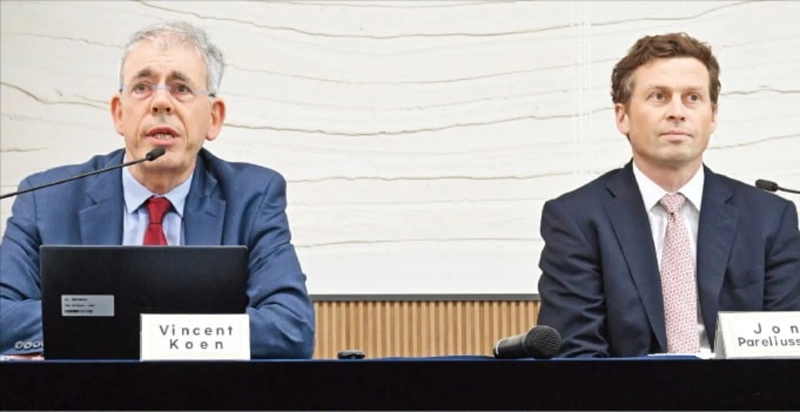
"The declaration of martial law and the military's entry into the National Assembly was a 'Black Swan' (an entirely unexpected crisis) event. If political conflict, protests, and strikes prolong, it could lower South Korea's growth rate forecast."
Jon Pareliussen, OECD's Korea-Sweden Desk Officer, said in a written interview with Korea Economic Daily on the 12th, "The economic impact of the martial law situation will depend on how quickly the political situation is resolved," he said.
Pareliussen commented on President Yoon Suk-yeol's declaration of martial law on the 3rd, saying, "It made people and financial market participants reassess some fundamental assumptions they had about South Korea," and "It is not surprising that there was an immediate reaction in the currency market." He continued, "Nevertheless, the parliamentary vote and the lifting of martial law, as stipulated in the constitution, helped stabilize the situation and restore trust in South Korea as an open democracy with strong political checks and balances."
He hinted that the growth rate forecast for South Korea could be adjusted downward depending on the duration of the martial law aftermath. Previously, the OECD had forecasted South Korea's economic growth rate for this year at 2.3%, down 0.2 percentage points from three months ago. Next year's growth rate was lowered by 0.1 percentage points to 2.1%. This forecast did not reflect the impact of martial law. Pareliussen pointed out, "Continued political turmoil can negatively affect the economy in terms of uncertainty and trust," and "If political conflict, protests, and strikes prolong, demand may shrink, and supply disruptions may occur, leading us to lower our growth rate forecast next."
However, he added, "If the political situation is resolved quickly and with full respect for democratic institutions, trust will be restored, and the direct impact of public unrest will be limited." He explained, "When the candlelight protests in 2016-2017 led to the impeachment of President Park Geun-hye, demand was suppressed for a while, but it rebounded once the situation was resolved."
Pareliussen emphasized the need to respond swiftly to rapidly changing domestic and international environments, such as the rise of protectionism. He advised, "South Korea should actively work bilaterally and multilaterally to limit the impact of strengthened protectionism (due to Trump's re-election) while continuously securing and diversifying value chains." He also called for structural reforms to boost potential growth rates. He said, "Reforms to increase competition and make the labor market more inclusive and family-friendly will improve South Korea's economic growth, welfare, and resilience to external shocks," adding, "This should be a top priority on the agenda of both parties."
He also offered advice to the political sphere. He said, "Polarized politics make it difficult to address these tasks (structural reforms)," and "Both parties can benefit from better cooperation in the future."
Huh Se-min, Reporter semin@hankyung.com

Korea Economic Daily
hankyung@bloomingbit.ioThe Korea Economic Daily Global is a digital media where latest news on Korean companies, industries, and financial markets.