

"China Considers Weakening Yuan" Report Followed by Yellen's Warning Against Currency Manipulation
Summary
- The U.S. government has warned that it will respond strongly to currency manipulation by trading partners.
- This warning came shortly after reports that China might respond to U.S. tariff policies by weakening the Yuan.
- The depreciation of the Japanese Yen and the interest rate cuts by Canada and the European Union could be interpreted as measures against U.S. tariffs.
Reuters: "China Preparing for Tariff Bomb"
Canada and EU Lower Interest Rates, Weakening Currencies
Japan's Rate Hike Expectations Shattered, Yen Plummets
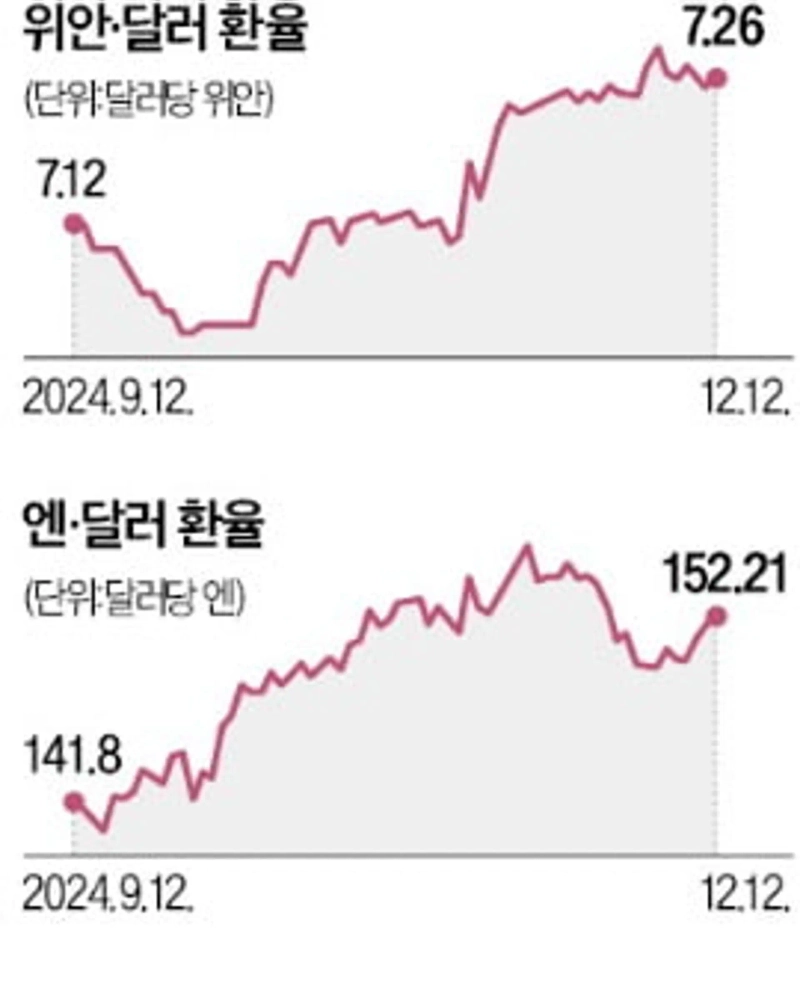
The U.S. government has warned that it will not tolerate currency manipulation by its trading partners. This comes as President-elect Donald Trump is expected to implement a 'tariff bomb' policy after taking office, which may lead countries like China to devalue their currencies.
On the 11th (local time), U.S. Treasury Secretary Janet Yellen stated in an interview with Bloomberg TV, "If there are countries attempting to manipulate their currencies to gain a competitive edge, the U.S. will respond strongly." However, Yellen noted, "So far, there have been no instances of market intervention to manipulate currency," and added, "There are no other currencies that threaten the dollar's status as the world's reserve currency."
Yellen's remarks came shortly after Reuters reported that China might devalue the Yuan next year in response to potential U.S. tariffs. Although Yellen did not specify any country, her comments were interpreted as targeting China. The U.S. has designated China as a currency manipulation watchlist country due to its large trade surplus with the U.S. and lack of transparency in its foreign exchange policies.
According to Reuters, Chinese authorities are considering devaluing the Yuan to counter the high tariffs from Trump's second-term administration. A source mentioned that the People's Bank of China is reviewing the possibility of lowering the Yuan's value from the current 7.25 per dollar to 7.5 per dollar. A weaker Yuan would reduce the export prices of Chinese companies, offsetting the impact of tariffs. During his campaign, Trump stated he would impose a 60% tariff on Chinese imports and warned of an additional 10% tariff after his election.
Besides China, countries with significant trade with the U.S., such as Canada and the European Union (EU), are lowering interest rates, leading to weaker domestic currencies. While these measures aim to stimulate the economy, they are also seen as preparations for potential U.S. tariffs. The Bank of Canada implemented a big cut (0.5 percentage points) in its key interest rate today, marking the fifth cut this year. Tiff Macklem, Governor of the Bank of Canada, pointed out in a press conference that Trump's threat to impose a 25% tariff on all Canadian imports is "highly disruptive and a source of great uncertainty." The European Central Bank (ECB) lowered its key interest rate by 0.25 percentage points in June, followed by additional cuts in September (0.6 percentage points) and October (0.25 percentage points).
The Japanese Yen's value fell as expectations for a rate hike were dashed. On the 12th, the Yen-Dollar exchange rate rose from the 151 Yen range to the 152 Yen range (indicating a weaker Yen) in the Tokyo Foreign Exchange Market. This resulted from the growing expectation that the Bank of Japan would hold off on further rate hikes.
Reporter Im Dayeon allopen@hankyung.com

Korea Economic Daily
hankyung@bloomingbit.ioThe Korea Economic Daily Global is a digital media where latest news on Korean companies, industries, and financial markets.