

'610 Trillion Foreign Debt' Corporations and Banks Fear High Exchange Rates
Summary
- It was reported that the burden of foreign debt on corporations and banks is rapidly increasing due to the rise in the won-dollar exchange rate.
- It was stated that small and medium-sized enterprises (SMEs) with a high proportion of foreign debt are likely to suffer severe impacts first.
- It was reported that the net profits of major companies like LG Chem and Asiana Airlines are expected to show a significant decline due to exchange rate changes.
Borrowed Dollars in Preparation for Uncertainty
'Interest Bomb' Boomerang as Exchange Rates Soar
Corporate Profits of Hundreds of Billions 'Vaporize' Emergency
Low Credit SMEs Likely to Collapse First
The soaring won-dollar exchange rate has put not only intermediate and consumer goods importers but also export companies and banks on alert. The foreign debt of corporations and banks has exceeded 610 trillion won for the first time, rapidly increasing the burden of principal and interest repayment. Concerns are rising that small and medium-sized enterprises (SMEs) with high foreign debt ratios and weak credit ratings will be the first to falter.
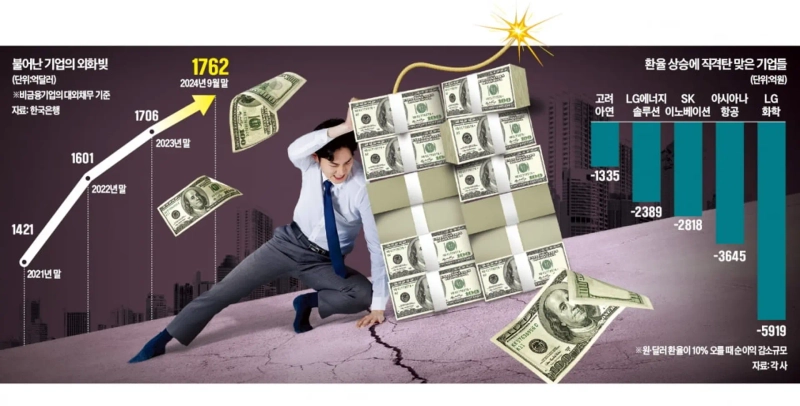
According to the Bank of Korea on the 12th, the total external debt of domestic companies and the financial sector at the end of September was $429.864 billion (approximately 614.7 trillion won). This is an increase of $9.752 billion (approximately 13.95 trillion won) compared to the end of last year. External debt refers to the foreign debt (foreign loans, foreign bonds, usance, etc.) that companies and financial institutions must repay.
Corporations and banks have significantly increased foreign currency procurement this year in preparation for internal and external uncertainties, including the U.S. presidential election. However, there are observations that the increased foreign debt, coupled with soaring exchange rates, will erode corporate performance.
The won-dollar exchange rate closed at 1,402.90 won per dollar in the weekly market on the 3rd, just before the impact of the emergency martial law situation. It continued to rise after the martial law situation, soaring to 1,438.30 won during the session on the 9th, marking the highest since October 24, 2022 (1,439.70 won).
When exchange rates rise, the burden of repaying the principal and interest costs of corporate foreign debt converted into won increases. This reduces net profits accordingly. LG Chem, which has a high dependency on raw material imports, is estimated to see its net profit decrease by about 591.9 billion won if the won-dollar exchange rate rises by 10%. Asiana Airlines and SK Innovation are also expected to see their net profits decrease by approximately 364.5 billion won and 281.8 billion won, respectively, if the exchange rate jumps by 10%.
As major export companies like LG Energy Solution increase overseas funding to expand overseas production facilities, high exchange rates are seen as a burden rather than a boon.
The impact on SMEs, which do little foreign debt hedging (risk avoidance), is expected to be more severe.
Reporters Ik-Hwan Kim and Seok-Cheol Choi lovepen@hankyung.com

Korea Economic Daily
hankyung@bloomingbit.ioThe Korea Economic Daily Global is a digital media where latest news on Korean companies, industries, and financial markets.