

"Another Foreign Exchange Crisis Coming"...KDI's Puzzling Warning [Focus on Financial Authorities]
Summary
- KDI warned that a foreign exchange crisis could occur if the exchange rate reaches 1,500 won.
- However, with substantial foreign reserves and domestic residents' dollar holdings, some view this as a premature warning.
- Experts emphasize strong economic fundamentals and see the possibility of a foreign exchange crisis as low.
Representative Hyun-jung Kim and KDI Warn of "Exchange Rate at 1500 Won, Risk of Foreign Exchange Crisis"
"Selling Foreign Reserves to Defend Exchange Rate...Another IMF Crisis Looms"
Net External Financial Assets Nearing 1 Trillion Dollars...Strong Economic Fundamentals
Analysis Stirring Anxiety...Throwing Cold Water on Efforts by Foreign Exchange Authorities
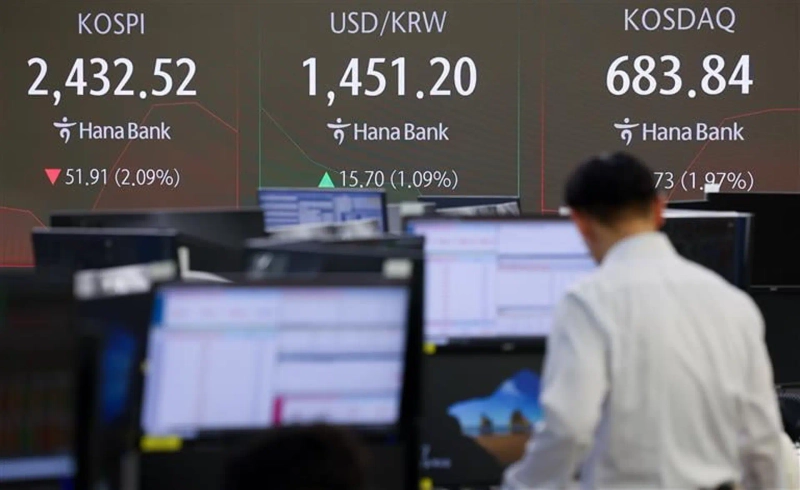
"In many emerging countries, foreign exchange crises occurred after depleting foreign reserves to defend the exchange rate."
On the 31st, the Korea Development Institute (KDI) issued a chilling warning. In a response sent to Representative Hyun-jung Kim of the Democratic Party of Korea, it was observed that the government's and the Bank of Korea's failure in foreign exchange policy could directly lead to a foreign exchange crisis in the worst-case scenario. However, with foreign reserves exceeding 400 billion dollars and domestic residents, including retail investors, holding over 125.9 billion dollars in U.S. stocks and bonds, some argue that the warning of a foreign exchange crisis is premature given the strong 'foreign currency safety net.' Criticism is also growing that such warnings could fuel market anxiety.
On this day, Representative Hyun-jung Kim released a press release titled 'Exchange Rate Expected to Strengthen to 1500 Won by September Next Year, Concerns of Foreign Exchange Crisis.' In the press release, Representative Kim explained, "It is predicted that the exchange rate will continue to rise, surpassing 1,500 won by September next year," and "there is a warning that selling foreign reserves to defend the exchange rate could trigger another foreign exchange crisis."
This warning came from KDI. Through a response sent to Representative Kim, KDI pointed out the potential for a foreign exchange crisis. In the response, KDI evaluated, "If foreign reserves are used to maintain an exchange rate level that deviates from economic fundamentals to prevent exchange rate increases, the foreign exchange market could become unstable," and "it is necessary to recall the experiences of many emerging countries where foreign exchange crises occurred after depleting foreign reserves to defend the exchange rate."
The Bank of Korea and the government may sell dollars they hold and buy won to stabilize the foreign exchange market, including the soaring exchange rate. However, if foreign reserves are depleted in this process, the country could face a sovereign default, similar to the 1997 IMF foreign exchange crisis, due to the inability to repay dollar debts.
KDI's analysis stems from the forecast that the exchange rate will continue to rise. Exchange rate forecasts by overseas investment banks (IB) such as Citigroup and Standard Chartered are 1,435 won for the first quarter, 1,440 won for the second quarter, and 1,445 won for the third quarter of next year. Japan's Nomura predicts the exchange rate will reach 1,500 won in the third quarter of next year.
However, considering the current economic fundamentals, the prevailing evaluation is that this is an excessive leap.
According to the Bank of Korea, net external financial assets at the end of the third quarter this year were 977.8 billion dollars. This is an increase of about 119.4 billion dollars from the previous record high at the end of the second quarter (858.5 billion dollars). Net external financial assets are calculated by subtracting foreign liabilities, which are foreign investments in domestic assets, from external financial assets, such as residents' overseas investments.
As for foreign reserves, they recorded 415.4 billion dollars at the end of November, ranking 9th in the world. This is more than 12 times the amount in 1996 (33.2 billion dollars), the year before the foreign exchange crisis. Additionally, the amount of dollars held by the public is substantial. According to the Korea Securities Depository, as of the 27th, domestic residents (retail investors) held 114.6 billion dollars in U.S. stocks and 11.2 billion dollars in bonds, totaling 125.8 billion dollars. Domestic residents' dollar deposits amounted to 82.6 billion dollars. Experts assess that the criticism that a foreign exchange crisis could occur is premature given the solid foreign currency soundness and liquidity. There is also criticism that such half-baked analysis, which only stirs anxiety, is throwing cold water on the efforts of foreign exchange authorities to stabilize the foreign exchange market.
Reporter Ik-hwan Kim lovepen@hankyung.com

Korea Economic Daily
hankyung@bloomingbit.ioThe Korea Economic Daily Global is a digital media where latest news on Korean companies, industries, and financial markets.