

Summary
- One of the reasons for Bitcoin's surge is its connection to Trump's election, and the expectation for Bitcoin's continued rise remains.
- Key indicators for Bitcoin's price direction include stablecoin issuance, Bitcoin dominance, and the Kimchi premium.
- Attention should be paid to Bitcoin's volatility, and caution is needed regarding potential price fluctuations due to external adversities.
High Volatility of Bitcoin
Three 'Must-See' Factors
With Trump's Election
163% Surge Last Year
Stablecoin Issuance
Bitcoin's Market Cap Share
Domestic and International Price Differences
Larger 'Rally' Potential
U.S. Fed Resistance & Quantum Computing
May Fluctuate Due to Unexpected Adversities
This year, there is a growing expectation that Bitcoin will establish itself as a global representative asset, coinciding with the inauguration of Donald Trump as the U.S. President-elect. This is because Trump has declared that he will stockpile Bitcoin as a strategic asset. There are also movements by countries like Russia to use Bitcoin for trade settlements to escape the influence of dollar hegemony. It remains to be seen whether Bitcoin, which surpassed $100,000 globally and 150 million won domestically 15 years after its debut in 2009, will continue its upward trend.
Expectation for U.S. Crypto-Friendly Policies
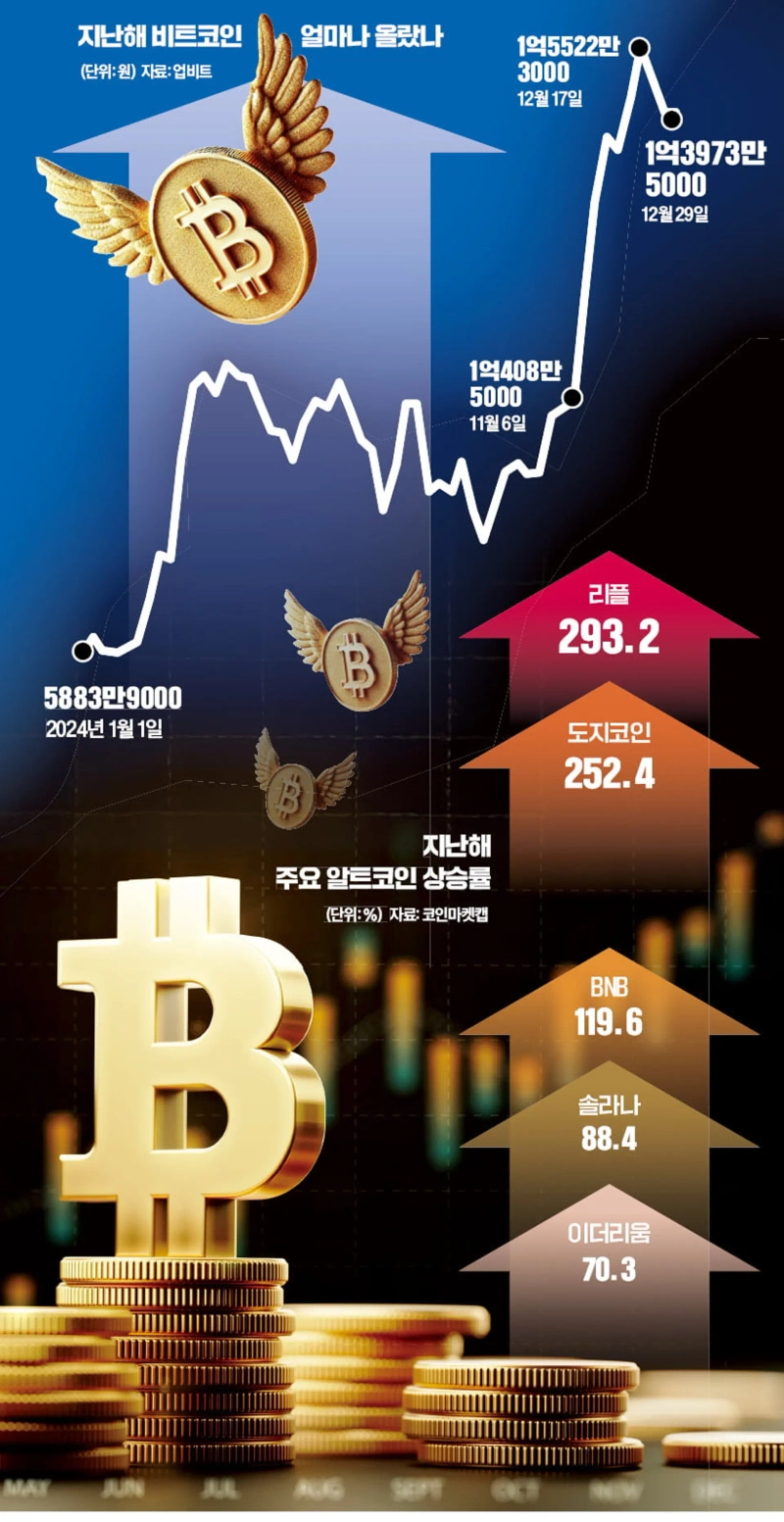
According to Upbit, a domestic cryptocurrency exchange, Bitcoin surpassed 150 million won last year, rising 163.8% over the year. In overseas markets, it soared to $108,249, marking an all-time high. Major altcoins (cryptocurrencies other than Bitcoin) such as Ethereum (70.3%), Ripple (293.2%), BNB (119.6%), Solana (88.4%), and Dogecoin (252.4%) also saw steep increases.
Bitcoin's explosive rise last year was due to the approval of a Bitcoin spot ETF in the U.S. As institutional investors expanded their investments, there was a significant influx of funds into the Bitcoin market.
Trump's victory in the U.S. presidential election also influenced the rise in Bitcoin prices. Trump nominated Paul Atkins, a pro-cryptocurrency advocate and former SEC commissioner, as the head of the SEC, which oversees the U.S. cryptocurrency market. Currently, Gary Gensler, the SEC commissioner, is considered an anti-cryptocurrency advocate, viewing cryptocurrencies as securities. The market cheered when Trump nominated Atkins as the next SEC chairman. Additionally, Trump pledged to strategically stockpile Bitcoin.
Russia has also recently allowed its domestic companies to use Bitcoin for trade payments. This is seen as an effort to escape dollar hegemony and find a breakthrough against Western financial sanctions. Consequently, there are predictions that the power struggle over Bitcoin between the U.S. and Russia will intensify.
"Expect a Rise to $200,000 This Year"
The market also expects Bitcoin to rise to the $200,000 range this year. Given that Trump's victory last year drove Bitcoin's upward trend, there is an expectation that a new opportunity for growth will open when the Trump administration officially launches. Bern Lunde, head of K33 Research, claimed, "If Trump's inauguration as U.S. President coincides on the 20th, Bitcoin could rise from $146,000 to $212,500."
However, given Bitcoin's high volatility, it's important to be mindful of the potential for significant shocks from external adversities. Although Trump has announced plans to pursue crypto-friendly policies, he may face opposition both inside and outside the administration. If this happens, Bitcoin prices could fluctuate. For instance, when Jerome Powell, chairman of the U.S. Federal Reserve, stated on the 18th of last month that "the Fed cannot own Bitcoin," Bitcoin fell below the $100,000 mark.
Recently, Google announced the quantum computer 'Willow,' which impacted Bitcoin. Quantum computers are known to have powerful computational capabilities that can neutralize existing encryption methods. Concerns that quantum computers could decrypt Bitcoin's encryption have affected price declines. However, the market expects it will take 10 to 20 years for quantum computers to reach a level that poses a direct security threat to Bitcoin.
Indicators for Bitcoin Price?
Key indicators that serve as gauges for Bitcoin's price direction include the issuance of stablecoins like Tether, Bitcoin dominance, and the Kimchi premium. When the issuance of stablecoins, which are pegged 1:1 to the dollar, increases, cryptocurrency prices tend to rise. Conversely, when stablecoin issuance decreases, there is a tendency for funds to exit the cryptocurrency market.
Since the U.S. presidential election on November 8 last year, the issuance of Tether, the world's largest stablecoin, increased by about 16.7% from $120 billion to $140 billion. Recently, as Bitcoin and other cryptocurrency prices have weakened, Tether issuance has also fallen to the $138 billion range.
Bitcoin dominance, which indicates the proportion of Bitcoin in the total cryptocurrency market capitalization, is also a key indicator for predicting cryptocurrency price directions. When Bitcoin reached its all-time high in 2021, Bitcoin dominance was 43.9%. After Bitcoin rose, funds flowed into altcoins, bringing it down to the 40% range. Currently, Bitcoin dominance is at 55.8%.
The Kimchi premium, which indicates the price difference between domestic and international markets, is also used as a key indicator in the Bitcoin market. In past bull markets, the Kimchi premium sometimes exceeded 50%. This means that Bitcoin was more expensive in the domestic market, indicating high investment demand. Currently, it stands at around 1%.
Reporter Mi-hyun Cho mwise@hankyung.com

Korea Economic Daily
hankyung@bloomingbit.ioThe Korea Economic Daily Global is a digital media where latest news on Korean companies, industries, and financial markets.