

Early Year Rise in International Oil Prices... WTI Futures Nearing $80 per Barrel
Summary
- The rise in international oil prices was reported to be due to reduced supply caused by sanctions on Russian energy companies.
- It is expected that if Chinese and Indian refineries shift their supply sources from Russia to the Middle East and Europe, oil prices will likely rise further.
- Domestic refineries are expecting improved performance due to the ability to increase product prices with rising oil prices.
US Sanctions on Russian Energy Companies
China and India Likely to Shift to Middle Eastern Sources
Domestic Refineries Expect Profitability Recovery
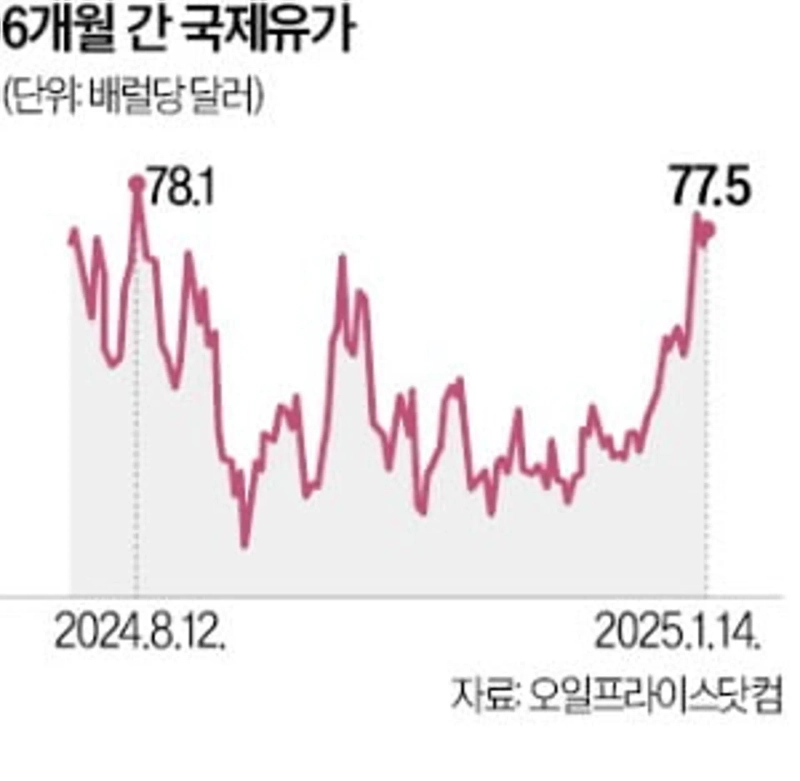
International oil prices have hit a five-month high, continuing their upward trend. The main reason cited is the reduction in supply following the US government's sanctions on Russian energy companies. If Chinese and Indian refineries, which used to rely on Russian crude, switch their supply sources to the Middle East, the upward trend in oil prices is expected to accelerate.
Early Year Rise in International Oil Prices... WTI Futures Nearing $80 per Barrel On the 14th (local time) at the New York Mercantile Exchange (NYMEX), the price of West Texas Intermediate (WTI) futures (February contracts) closed at $77.5 per barrel, down $1.32 (1.67%) from the previous session. Brent Crude futures (March contracts) closed at $79.92 per barrel, down $1.09 (1.35%) from the previous session. This is attributed to the base effect following the sharp rise in international oil prices the previous day.
Despite the decline on this day, international oil prices have risen to their highest level in five months since August last year. The market is concerned about a decrease in supply as the US government imposes sanctions on Russian energy companies. On the 10th, the US State Department announced sanctions on Russia's largest energy companies, Gazprom Neft and Surgutneftegas. These two companies exported 970,000 barrels per day from January to October last year, accounting for 30% of the world's tanker traffic.
Experts generally expect international oil prices to rise further unless the US government lifts these sanctions. This is because the likelihood of Chinese and Indian refineries shifting their supply sources from Russia to the Middle East and Europe is increasing. These were the places that used the most Russian crude before the sanctions.
Exchange rate increases are also having an impact. The dollar index, which shows the value of the dollar against the currencies of six major countries, exceeded 110 at one point on the 13th, surpassing 110 for the first time since November 2022. The won-dollar exchange rate also fluctuated around 1,460 won, soaring to levels seen during the 2009 global financial crisis.
The refining and chemical industries, which are recording large deficits, are expecting improved performance due to rising oil prices. This is because they can increase product prices in line with rising oil prices, leading to improved sales and profits. The operating loss of the four major refineries, S-Oil, SK Innovation, HD Hyundai Oilbank, and GS Caltex, totaled 1.5 trillion won in the first to third quarters of last year. Analysts suggest that refineries succeeded in turning a profit in the fourth quarter of last year due to improved refining margins. Daishin Securities researcher Wi Jeong-won predicted, "The improvement in refining margins will continue through the first quarter of this year."
Reporter Oh Hyun-woo ohw@hankyung.com

Korea Economic Daily
hankyung@bloomingbit.ioThe Korea Economic Daily Global is a digital media where latest news on Korean companies, industries, and financial markets.