

On the First Day of Inauguration, "Not Ready for Universal Tariff"... Exchange Rate Drops to 1430 Won in a Month
Summary
- It was reported that the won-dollar exchange rate fell to the 1430 won level in a month due to the delay in imposing the universal tariff by President Donald Trump.
- Lee Ju-won, an economist at Daishin Securities, stated that the delay in imposing the universal tariff somewhat eased the anxiety in the foreign exchange market, but there could be increased volatility as policies are specified.
- If radical tariff policies like the universal tariff are not implemented, there is also a forecast that the exchange rate could fall to the 1300 won level in the second half.
Tariff Bomb Less Radical Than Expected
"Forecast of Drop to 1300 Won in Second Half"
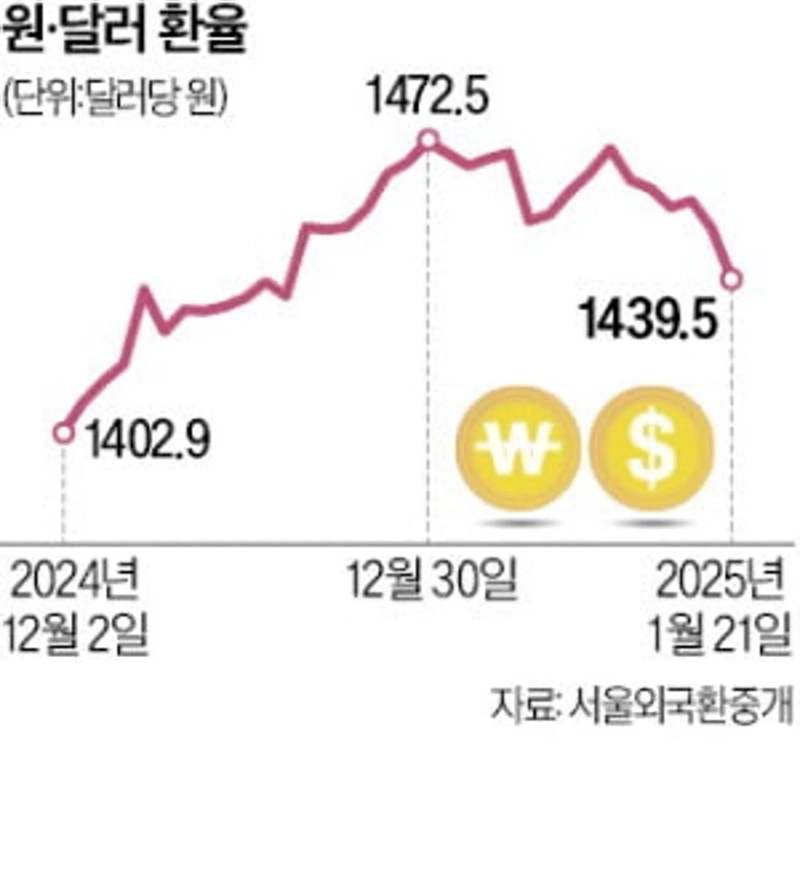
The won-dollar exchange rate fell to the 1430 won level (rise in won value) in a month. The dollar showed a weak trend as U.S. President Donald Trump did not impose tariffs on his first day in office.
On the 21st, the won-dollar exchange rate (as of 3:30 PM) in the Seoul Foreign Exchange Market ended weekly trading at 1439 won 50 jeon, down 12 won 20 jeon. It is the first time in about a month since the 18th of last month (1435 won 50 jeon) that the exchange rate has entered the 1430 won range.
The exchange rate fell to 1432 won 90 jeon early in the session as it was confirmed that there were no tariff-related executive orders. However, it reversed to rise after a mention of imposing a 25% tariff on Mexico and Canada on the 1st of next month during a press Q&A session, reaching 1443 won 90 jeon at one point in the morning. Later, as dollar selling from exporters flowed in and it became known that President Trump's remarks were not definitive, it closed at the 1430 won level per dollar.
The Dollar Index, which shows the value of the dollar against the currencies of six major countries, showed a similar trend. The Dollar Index, which fell to 107.86 early in the session, surged to 108.75 and then fell back to 108.43. Lee Ju-won, an economist at Daishin Securities, said, "The fact that the universal tariff was not imposed on the first day of inauguration eased the anxiety in the foreign exchange market," but added, "There is a possibility of increased volatility as policies such as the investigation of unfair trade practices are specified."
There is an assessment that the possibility of the exchange rate soaring again has decreased. Nomura of Japan, which predicted that the won-dollar exchange rate would rise to 1500 won around May, changed its stance, stating in a report that "the probability of reaching 1500 won per dollar has decreased compared to before." If radical tariff policies such as universal tariffs are not implemented, there is also a forecast that the won-dollar exchange rate could fall to the 1300 won level in the second half.
As the exchange rate shows a calming trend, the possibility of the Bank of Korea cutting interest rates in February has increased. The Bank of Korea recently froze rates on the 16th due to the sharp rise in the exchange rate. In line with this forecast, government bond yields fell across the board that day. In the Seoul bond market, the yield on the 3-year Treasury bond fell by 0.044 percentage points to 2.579% per annum.
Kang Jin-kyu/Ryu Eun-hyuk reporters josep@hankyung.com

Korea Economic Daily
hankyung@bloomingbit.ioThe Korea Economic Daily Global is a digital media where latest news on Korean companies, industries, and financial markets.