

"We Won't Repeat Trump's First Term Failures"... US Moves to Block Yuan Depreciation
Summary
- The US is reportedly moving to block yuan depreciation to prevent offsetting tariff effects.
- With the possibility of currency manipulation rising amid China's economic recession, the US is wary of a decline in price competitiveness in its market.
- US Treasury Secretary Besant emphasized maintaining a strong dollar policy, stating that they do not want other countries to weaken their currencies and manipulate trade.
Tariff Effects May Be Offset... To Surplus Countries: "Don't Manipulate Exchange Rates"
During Trump's First Term US-China Trade War
Failed to Reap Tariff Effects Due to Yuan Depreciation
Instead, US Companies' Price Competitiveness Fell
"China Will Respond Similarly in the Second Term"
Yuan Exchange Rate Has Been High Since Last Year
Besant: "China, the Most Imbalanced Economy"
US Treasury Secretary Scott Besant's suggestion of 'currency manipulation' by countries with large trade surpluses with the US is analyzed to stem from painful memories of 'Trump's first term.' At that time, US President Donald Trump ambitiously imposed high tariffs on China, but China absorbed the tariff shock through yuan depreciation, offsetting the tariff effects. Instead, the price competitiveness of US goods in the Chinese market fell, narrowing the position of US companies.
○ Trump's First Term, Yuan Fell as Tariffs Rose
Secretary Besant particularly sees a high possibility of exchange rate intervention given China's current economic recession. He said, "The clear point is that China's economy is the most imbalanced in history and is currently experiencing a severe recession," adding, "China is experiencing deflation and is trying to make up for it through exports."
Moreover, the US has already experienced yuan depreciation in past trade wars with China. During the Trump administration's first term, the US began a tariff war with China in March 2018 by imposing high tariffs on Chinese steel and aluminum. China immediately responded with retaliatory tariffs and yuan depreciation. In fact, the exchange rate, which was about 6.3 yuan per dollar in early April 2018, surpassed 7 yuan in August 2019. The yuan's value against the dollar depreciated by about 11%. In effect, the tariff effects were offset.
The depreciation of the yuan, which lowered the price competitiveness of US goods, was an unexpected blow for the US. A representative example is the French aircraft manufacturer Airbus widening its market share gap with US Boeing. Feeling the seriousness, the US immediately designated China as a currency manipulator when the yuan exchange rate exceeded 7 yuan per dollar.
○ Yuan Value Has Fallen Since Last Year
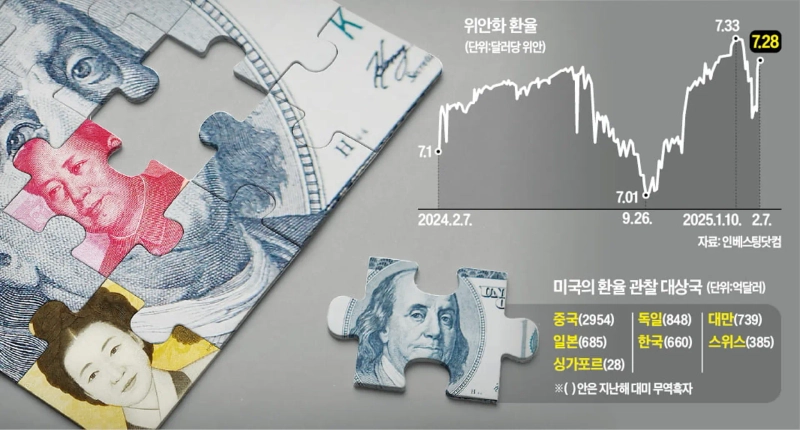
Experts believe that China will respond to US tariff measures with yuan depreciation this time as well. The yuan exchange rate, which was 7.01 yuan per dollar last August, has risen to 7.28 yuan as of the 7th. The yuan's value has depreciated. The Financial Times reported that concerns that the People's Bank of China might depreciate the yuan to offset tariff impacts have acted as pressure on the yuan's value.
Secretary Besant, however, made it clear that a strong dollar must be maintained. He said, "The strong dollar policy is in complete alignment with President Trump," adding, "We want the dollar to remain strong." He further stated, "What we don't want is for other countries to weaken their currencies and manipulate trade."
○ Vietnam, South Korea, etc., Could Be Targets
The US government evaluates the macroeconomics and exchange rate policies of the top 20 countries with large trade volumes (goods and services) with the US twice a year. Based on these results, countries are classified as currency manipulators, monitoring countries, or general countries. Currently, no countries are included as currency manipulators. Instead, seven countries, including China, Japan, South Korea, Singapore, Taiwan, Vietnam, and Germany, are included as monitoring countries. If a country meets three criteria—trade surplus of over $15 billion, current account surplus of over 3% of GDP, and net purchases of US dollars exceeding 2% of GDP for more than eight months—it is classified as a currency manipulator. If it meets two criteria, it is classified as a monitoring country.
The US government is particularly keeping a close watch on Vietnam. US Secretary of State Marco Rubio urged the resolution of trade imbalance issues in a phone call with Vietnamese Deputy Prime Minister and Foreign Minister Bui Thanh Son last month. According to the US Department of Commerce, the US trade deficit with Vietnam is projected to reach $123.5 billion in 2024, an 18.1% increase from the previous year, marking a record high.
New York Correspondent Park Shin-young nyusos@hankyung.com

Korea Economic Daily
hankyung@bloomingbit.ioThe Korea Economic Daily Global is a digital media where latest news on Korean companies, industries, and financial markets.