

"Will History Repeat Itself"...The Similarities Between 19th Century Port Opening and the Crypto Revolution [Hankyung Koala]
Summary
- The article reports that dollar stablecoins are expanding their influence in institutional finance, with the US government actively supporting them.
- Bitcoin is gaining attention in the US stock market, and the US government is showing intentions to secure dominance in digital assets through it.
- The article suggests that domestic companies and financial institutions should prepare for the market by developing blockchain technology and crypto services.
Kim Min-seung's ₿fficial
History doesn't repeat itself, but it rhymes - Mark Twain
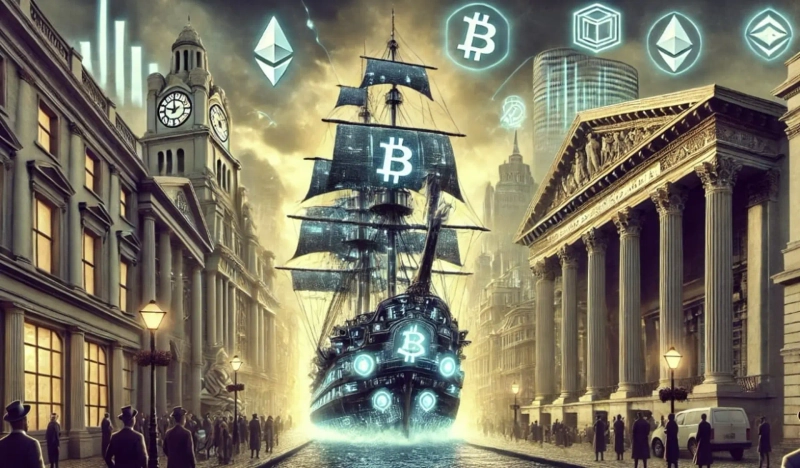
A crypto "foreign ship" has appeared in the financial world where old order has been maintained.
The iron-clad steamships that appeared in 19th century East Asia, where only wooden sailboats existed, made it impossible to ignore the presence of Western foreigners that had been deliberately overlooked.
In 2024, Bitcoin spot ETFs, Trump's election, and the spread of dollar stablecoins have made it impossible for institutional finance to ignore crypto any longer.
The strange-looking foreign ships, also called "absurd ships," initially requested food and friendship, but soon demanded large-scale trade and port opening. They were followed by warships carrying overwhelmingly powerful weapons with state support, leading to disturbances caused by foreigners, known as "yang-yo" (foreign disturbances).
"Coins," which are difficult to comprehend from a traditional finance perspective, were initially treated as speculation or gambling when used for Initial Coin Offerings (ICOs) or Decentralized Finance (DeFi), but in 2024, they became a massive hit in the US stock market and showed their presence in the US presidential election. Stablecoins, with overwhelming convenience compared to existing banking networks, are spreading worldwide, and the new US government actively supports dollar-based stablecoins, while legislation to establish a legal foundation for stablecoins is being rapidly pushed forward in the US Congress.
The process of the crypto fleet from the West influencing the financial world of the three East Asian countries is remarkably similar to the port opening process of these countries in the 19th century. Let's take a closer look.
The Qing Dynasty had exchanges with the West early on, but trade was only allowed in a limited way through people called "gong-hang" (authorized merchants) in specific regions approved by the government, and foreigners were strictly prohibited from entering inland areas. The upper class of the Qing Dynasty was deeply immersed in Sinocentrism and rejected foreign powers. Emperor Qianlong reportedly issued an edict to the British delegation stating, "The Celestial Empire has everything it needs and does not require foreign goods." After being defeated in the Opium War, the Qing Dynasty ceded Hong Kong to Britain and launched the Self-Strengthening Movement under the slogan "Chinese learning for fundamental principles, Western learning for practical application."
China was once familiar with virtual assets, handling most of Bitcoin mining, but the Chinese central government took a strong prohibitive stance around 2013, banning financial institutions from Bitcoin trading, ICOs, and eventually Bitcoin mining altogether. As virtual assets grew in significance over time, China allowed virtual asset trading and related businesses in Hong Kong and accelerated the development of the digital yuan (CBDC).
In Japan's case, when Commodore Perry's "Black Ships" appeared, the shogunate lacked the resources to counter the new threat. Japan opened its ports with little resistance and, under the slogan "Japanese spirit, Western technology," began a major national reform that accelerated modernization through the Meiji Restoration.
Japan was the first country in the world to recognize Bitcoin as a legal payment method through the 2016 amendment to the Payment Services Act, issued stablecoin guidelines in 2022, and the Ministry of Economy, Trade and Industry officially approved the "Web 3.0 White Paper" published by the Liberal Democratic Party in 2023. The Japanese government, suffering from prolonged recession and low growth, desperately needed ways to promote the startup ecosystem and chose the national development of blockchain and virtual asset industries as one of those methods. Currently, a stablecoin called JPYW is already circulating in Japan, and major banks such as MUFG, SMBC, and Mizuho have formed a consortium to pursue blockchain-related businesses.
Joseon (Korea) resisted interaction with the unfamiliar world most intensely. Although they suffered great damage during the French and American expeditions, they eventually prevailed, and the ruling class embraced the ideology of "defending orthodox learning and rejecting heterodox teachings," which meant protecting Neo-Confucianism and rejecting Western learning. The Gapsin Coup, launched by the enlightenment faction advocating "Eastern ethics, Western technology," lasted only three days.
In South Korea, ICOs were banned and corporations and financial institutions were blocked from accessing virtual asset exchanges due to the government's "emergency measures" in late 2017 and early 2018, and the amendment to the Act on Reporting and Using Specified Financial Transaction Information in 2021. The Minister of Justice at the time even considered a "complete shutdown of cryptocurrency exchanges," which caused Bitcoin prices worldwide to plummet. Around 2017, many domestic conglomerates created their own "mainnets" and explored blockchain businesses, but these efforts did not lead to significant results.
Joseon, Qing, and Japan resisted Western culture and learning, but what actually neutralized their resistance was the Western steamships and powerful naval guns. While it was Western missionaries and merchants who requested exchanges, behind them were the most powerful navies of the time, dispatched by imperialist governments.
The reasons why the Qing Dynasty was defeated in the Opium War, Joseon suffered great damage in the American and French expeditions, and the Edo Shogunate hurried to open ports without even thinking of fighting were not because the United States and Britain were right and the three East Asian countries were wrong. It was because they lacked the weapons and supplies to fight against the forceful demands for opening, and furthermore, they lacked the industries to produce them. The wooden ships, matchlock guns, and spirit of defending orthodoxy in East Asia were not wrong, but they could not overcome the naval guns of iron-clad steamships made with advanced technology.
'Crypto President' Trump has been quickly and strongly supporting virtual assets since taking office in January. The White House's 'Crypto Czar,' who declared that the US is now entering a 'Golden Age of Digital Assets,' clearly stated at an official press conference that "Our goal is to secure American dominance in digital assets" and that "Stablecoins play a key role in US dollar dominance and Treasury demand, and can drive trillions of dollars in economic activity related to US Treasuries and financial innovation in the United States." The US Securities and Exchange Commission (SEC), which has strongly hindered the growth of the virtual asset industry in the US through lawsuits, has recently been canceling various investigations and lawsuits, and US crypto companies that have long been suppressed are now breaking free from their shackles and developing global services. The US federal and state governments are pushing to legislate Bitcoin as a 'strategic reserve asset,' while Europe has already completed the Markets in Crypto-Assets Regulation (MiCA), a basic law for virtual assets, and practical guidelines in 2023, implementing them in 2024.
It seems imminent that fast, powerful, and inexpensive crypto will come to our payment and financial markets requesting 'exchange.' BlackRock, Franklin Templeton, and WisdomTree are issuing and circulating Treasury tokens that automatically accrue interest just by holding them. From a user's perspective, these are dollar stablecoins whose balance grows automatically. Visa is operating a stablecoin issuance platform, and Bank of America (BoA) is also reportedly considering issuing stablecoins. The PayPal representative recently posted a video of buying goods with Bitcoin through the PayPal app.
When they come asking for our domestic payment and financial markets, will we be able to counter them? What should we do when iron-clad steamships armed with rifles and naval guns several generations ahead of our matchlock guns and wooden sailboats come demanding market opening?
Japan opened its ports just 10 years before us in the 19th century, and that directly led to Japan forcing Joseon to open its ports by military means. Japan, known for still not abandoning fax machines and floppy disks and using wooden stamps on approval documents, recognized Bitcoin as a payment method through legal amendments nine years ago, is nationally supporting the Web3 industry, and its 'Big 3' banks have formed a consortium to pursue 'Project Pax,' a global stablecoin payment business. The use of the word 'Pax,' which originally means 'peace' but often symbolizes 'empire,' is noteworthy.
Conglomerates and financial institutions must take the lead in preparation. We must revive the domestic crypto industry ecosystem that develops and operates blockchain technology and services. We must prepare new weapons before the new weapons of payment and finance challenge us. Before our country's companies and people's assets are absorbed into dollar stablecoins or PayPal wallets, we need crypto service alternatives made in our country.
How little do humans learn from experience if they always fail to predict history repeating itself? -George Bernard Shaw

Kim Min-seung, Head of Korbit Research Center
About Kim Min-seung, Head of Korbit Research Center...
He is a founding member and head of the Korbit Research Center. He works to explain complex events and concepts in the blockchain and virtual asset ecosystem in an accessible way, helping people with different perspectives understand each other. He has experience in blockchain project strategic planning and software development.
▶This article is a column by an external contributor introduced to provide diverse perspectives to cryptocurrency investment newsletter subscribers and does not represent the position of The Korea Economic Daily.
Cho Mi-hyun, Reporter mwise@hankyung.com

Uk Jin
wook9629@bloomingbit.ioH3LLO, World! I am Uk Jin.