

Summary
- Most experts said that despite short-term volatility, the US stock market is expected to rise as the second half of the year approaches.
- The increased possibility of US interest rate cuts could provide an opportunity for a market rebound as liquidity increases.
- AI investment remains valid, but software, especially traffic optimization companies, will be more promising than hardware.
Cover Story
Short and Long-term Outlook for US Stock Market
"US Market Normalization in Second Half"
US Government Debt Restructuring
Likely to Conclude Around June
Rate Cuts to Resume in Second Half
Possibility of 3+ Cuts This Year
AI Investment Still Valid
Corporate Earnings Not Declining
Just Lower Expectations
AI Software Stocks Like
Salesforce and Microsoft Promising
Traffic Solution Stocks Like
Cloudflare and F5 Also Notable
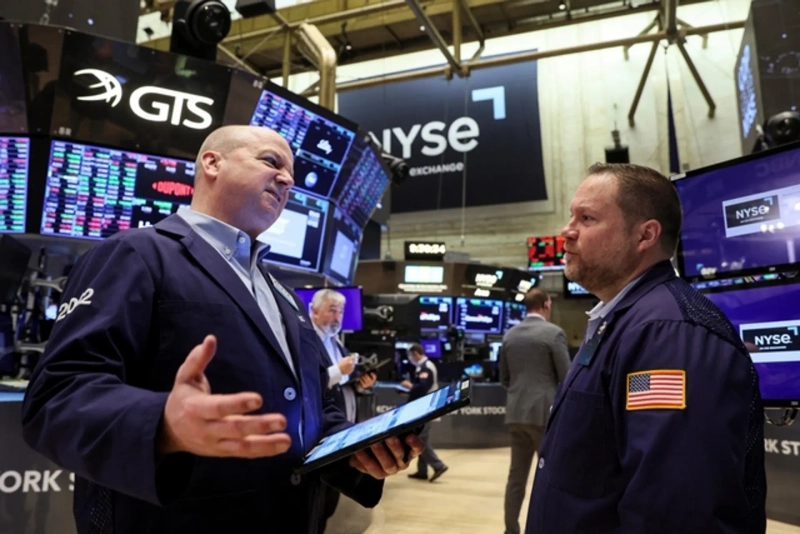
As the US stock market that has been running non-stop begins to falter this year, debates about its future direction are intensifying. The US market turned downward as uncertainty increased due to President Donald Trump's tariff policies and Chinese AI company DeepSeek emerged, impacting AI-related stocks. Meanwhile, non-US markets like Europe, China, and Korea are on an upward trend, creating cracks in the belief of "American exceptionalism."
Will the US stock market continue to decline? Most experts say 'no.' While short-term volatility is unavoidable, many forecast that the market will strengthen its foundation and trend upward as the second half of the year approaches after passing through Q2. The expectation is that as tariff policies that increase uncertainty become difficult to maintain, conflicts will settle and the market will regain vitality when liquidity increases through interest rate cuts.
US Stock Market Losing Strength
According to Investing.com on the 9th, the Nasdaq Composite has fallen 6.8% and the S&P 500 index has dropped 4.24% over the past month. In contrast, Korea's KOSPI and China's Shanghai Composite indices have risen 1.65% and 2.09% respectively. The US market, which has boasted superior returns among global markets since 2010, has lost face. The decline was particularly sharp for big tech stocks that have been driving the US market, such as Nvidia (-15.63%), Palantir (-27.22%), and Tesla (-25.11%).
Experts diagnose that volatility in the US stock market is inevitable for the time being. They predict that President Trump's "tariff blade" will stimulate inflation in the US and drag down the economy, causing short-term pain. The Department of Government Efficiency (DOGE), headed by Tesla CEO Elon Musk, laying off numerous federal employees is also fueling concerns about employment. Goldman Sachs noted that "recent market sentiment has deteriorated, with risk preference indicators turning negative for the first time since October 2023."
"Strong Q1 Earnings Will Trigger a Rebound"
Very few predict that the US stock market will break and enter a long-term downtrend. The argument is that the negative factors arising from 'Trump's second term' policies are not enough to fundamentally overturn the market. First, the growth of US listed companies remains solid. Regarding Nvidia's Q4 results last year, the prevailing assessment is that they "did as much as they could." Although recent forecasts have been slightly lowered, earnings growth for S&P 500 companies this year still maintains around 10%.
Yoon Yeo-cheol, head of Yuanta Securities Research Center, said, "The US stock market is being adjusted, but it's not that corporate profit growth has broken, but that expectations have been lowered," adding, "The US is still the country with the best economy in the world, and I don't think the stock market is at its peak." Lee Jin-woo, head of Meritz Securities Research Center, predicted that "corporate earnings for Q1 this year, which will be announced from the end of next month, will be an opportunity for a rebound."

Some even interpret the recent US stock market adjustment as a result intended or at least tolerated by President Trump. The US government needs to refinance debt approaching $7 trillion over the next six months, and to do so, it needs to lower Treasury yields, which still significantly exceed 4% annually based on 10-year maturities. In this case, there are forecasts that the market could normalize around June when refinancing is completed. Kim Sang-hoon, a bond research analyst at Hana Securities, analyzed, "The Trump administration's strategy is to endure short-term market pain to refinance debt at lower interest rate levels in the long term."
The possibility that the Federal Reserve (Fed) will resume interest rate cuts from the second half of the year is also cited as a key to the stock market rebound. Nomura Securities analyzed, "Concerns about US economic slowdown due to Trump administration policies have solidified the possibility of three rate cuts within the year," adding, "Some are even reflecting the possibility of four or more cuts."
Kim Tae-hong, CEO of Growth Hill Asset Management, advised, "(Due to short-term uncertainty) the Fed may implement rate cuts earlier than expected," adding, "As liquidity increases, the stock market will rebound, so the buying timing is approaching."
AI Popularization... "Traffic Efficiency Companies Promising"
However, the consensus is that even if the US stock market rebounds, it's unlikely to repeat the pattern led by AI hardware stocks like Nvidia. Yoon explained, "At the end of 2023, Nvidia's share of net profit and market capitalization among S&P 500 companies was 2.4% and 2.9% respectively, but by the end of last year, it had rapidly risen to 3.5% and 6.5%," analyzing that "there was an aspect of overheating."
While investment ideas for AI-related stocks are still valid, many diagnose that software fields will be more promising than hardware. Kim said, "Until now, we've been in the stage of building AI infrastructure, but recently, software companies that directly use AI are gaining attention." Representative companies include Salesforce (CRM), which provides AI-based customer management solutions, and Microsoft (MSFT).
Companies that optimize the explosively increasing traffic as AI usage grows are also evaluated as promising. While the winners in the business-to-consumer (B2C) AI field have not yet clearly emerged, there is a need to invest in line with the trend of AI popularization. Hwang Su-wook, a researcher at Meritz Securities, advised, "DeepSeek's website traffic increased by 5700% as of the 1st compared to January 27, and ChatGPT's paid traffic doubled during the same period," adding, "We should pay attention to traffic solution companies whose performance will improve with increased traffic." Cloudflare (NET) and F5 (FFIV) are representative examples. Among ETFs, 'Amplify Cybersecurity ETF' (HACK) is evaluated as having significantly included traffic optimization companies.
Reporters Park Han-shin/Yang Hyun-ju phs@hankyung.com

Korea Economic Daily
hankyung@bloomingbit.ioThe Korea Economic Daily Global is a digital media where latest news on Korean companies, industries, and financial markets.