

China, Canada, and now Europe with 'Retaliatory Tariffs'... Trump: "Could Raise Them Higher"
Summary
- As the United States began imposing 25% tariffs on steel and aluminum, the European Union announced it would impose retaliatory tariffs worth 26 billion euros on American products.
- President Trump has warned of additional tariffs on automobiles, semiconductors, and other items, emphasizing that companies will build factories in the United States.
- While President Trump acknowledged that tariffs could cause an economic recession, he expressed the positive view that tariff measures would lead to job creation.
25% Tariffs on Steel and Aluminum... Trade War Spreading Worldwide
Hit Harder If You Stand Against the US
Canada Imposes Surcharge on Electricity to the US
Trump Withdraws "50% Tariff" Threat
Steel and Aluminum Are Just the Beginning
Tariffs on Semiconductors and Cars Also Warned
Difficult to Respond Due to Fear of US Retaliation
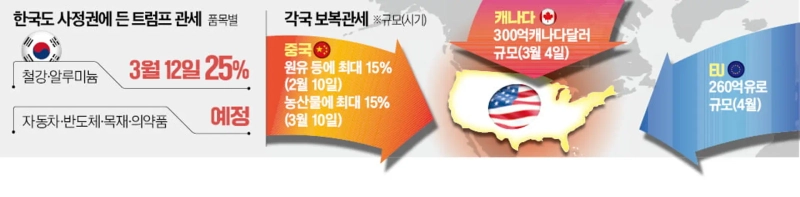
Just about 50 days after Donald Trump took office as US President, the world has fully plunged into a tariff war. The European Union (EU) immediately announced it would impose retaliatory tariffs on US products worth 26 billion euros (about 41 trillion won) after the United States began imposing 25% tariffs on steel and aluminum worldwide on the 12th. China and Canada are already imposing retaliatory tariffs on US products.
Steel and aluminum are just the beginning. President Trump has already warned of tariffs on automobiles, semiconductors, pharmaceuticals, and timber. He has directed the Department of Commerce to investigate imposing tariffs on copper. On the 2nd of next month, he plans to impose reciprocal tariffs considering each country's tariff and non-tariff barriers.
Until early last month, there were considerable expectations that President Trump's tariff threats were just negotiation tactics. These observations gained strength when he promised to impose 25% tariffs on Mexican and Canadian products but then delayed them after receiving promises to strengthen enforcement against illegal immigration and drug influx into the United States.
The atmosphere is different now. President Trump recently stated in a media interview that he would proceed with tariffs even at the risk of economic recession. At a business roundtable with American entrepreneurs today, Trump said, "Companies are increasing investments such as building factories in the United States," adding, "They don't want to pay tariffs whether it's 25% or whatever." He also emphasized, "Tariffs could be higher (than 25%)," and "The higher they are, the more companies will build (factories in the US), but ultimately the biggest achievement is not tariffs but creating jobs." Regarding growing market concerns and plummeting stock markets, he dismissed them as "a momentary snapshot" and "transitional."
There seems to be little regard for existing trade agreements such as the United States-Mexico-Canada Agreement (USMCA). Although there are considerable concerns about 'Trump tariffs' in the US Congress, it's not easy to put the brakes on due to the strong momentum of lawmakers with 'MAGA' (Make America Great Again) tendencies. House Speaker Mike Johnson and the Republican House leadership have included provisions in the federal budget bill to prevent Congress from terminating the 'state of emergency' declared by President Trump under the International Emergency Economic Powers Act (IEEPA) for imposing tariffs.
With unilateral and impromptu decisions continuing, even factual errors aren't being filtered internally. President Trump recently publicly criticized South Korea in a congressional speech, claiming that South Korea's tariff rate on US goods is four times higher than US tariffs on Korean products. This completely ignores the fact that under the Korea-US Free Trade Agreement (FTA), Korea applies zero tariffs to most US products. White House spokesperson Caroline Levitt presented data today claiming Japan applies a 700% tariff rate on US rice, which is also incorrect.
However, President Trump is threatening to impose even higher tariffs if other countries respond with retaliatory tariffs, making it difficult to respond. When Ontario, Canada imposed a 25% additional tax on electricity supplied to the United States in response to the 25% tariffs on steel and aluminum, President Trump said he would apply 50% tariffs on Canadian steel and aluminum. After Ontario suspended the additional tax, President Trump also canceled the 50% tariff plan. The White House self-evaluated this as "an American victory."
Washington=Lee Sang-eun Special Correspondent selee@hankyung.com

Korea Economic Daily
hankyung@bloomingbit.ioThe Korea Economic Daily Global is a digital media where latest news on Korean companies, industries, and financial markets.