

PiCK
Democratic Party Criticizes Coin Exchanges… "Delisting Authority is a Conflict of Interest"
Summary
- The Democratic Party of Korea announced that it is reviewing measures to strengthen regulations to resolve the conflict of interest issue of virtual asset exchanges.
- It was pointed out that the domestic virtual asset industry has a distorted structure and that transparency and fairness need to be enhanced.
- It was emphasized that clear guidelines and regulation based on self-disclosure are needed to enhance the transparency of listings on virtual asset exchanges.
Democratic Party Hosts 'Digital Asset Basic Law' Forum
Criticism of "Authority Concentrated in Exchanges"
U.S. SEC Aims for Self-Disclosure Regulation
Authorities "Will Enhance Global Consistency"
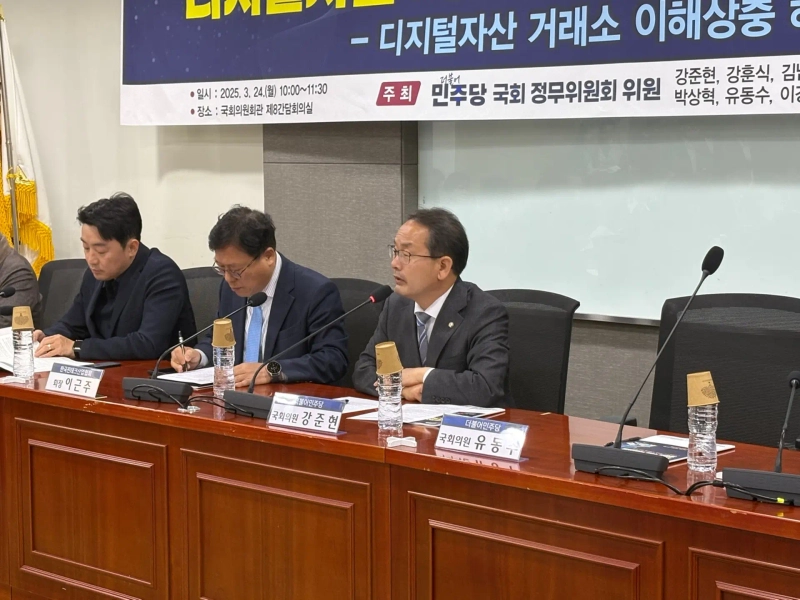
The Democratic Party of Korea has criticized virtual asset exchanges. The party is reviewing measures to strengthen regulations to resolve concerns about conflicts of interest in virtual asset exchanges.
Min Byung-deok, a member of the Democratic Party of Korea, attended the 'National Assembly Forum for the Enactment of the Digital Asset Basic Law' held at the National Assembly Members' Office on the 24th and said, "The delisting authority held by (virtual asset) exchanges is a conflict of interest," adding, "It is questionable whether it can function properly if the delisting authority is given to (virtual asset exchanges)." Min also said, "There are five (virtual asset) exchanges in Korea, but I can only remember two," adding, "The concentration on certain exchanges is also a problem."
The consultative body of the top five virtual asset exchanges in Korea, 'DAXA', was also mentioned. Min said, "There is a sense of problem about whether DAXA is functioning properly as a self-regulatory organization," adding, "Considering these aspects, we need to create a harmonious structure to protect virtual asset users." He continued, "(The Digital Asset Basic Law) is not about regulation but about clarifying guidelines," adding, "Speed is also important in enacting the law, so it should not be delayed too much."
"Korean Virtual Asset Industry is Distorted"
There was also criticism that the structure of the domestic virtual asset industry is distorted. Kang Jun-hyun, a member of the Democratic Party, said at the forum, "(The virtual asset industry) is formed in a distorted structure," adding, "In Korea, individual investment in (virtual assets) is currently limited, and a lot of authority is concentrated in exchanges."
Min said, "In advanced countries, the (virtual asset) industry ecosystem, including stablecoins, is already active," adding, "I hope the (virtual asset) market will be operated more stably by enhancing transparency and fairness."

Kang Hoon-sik, another member of the Democratic Party, also supported the initiative. Kang said at the forum, "Digital asset exchanges integrate the functions of various institutions such as securities companies, the Korea Exchange, and the Korea Securities Depository into one place," adding, "Conflicts of interest may arise, so the National Assembly cannot neglect oversight or monitoring."
Kang added, "In overseas countries like the United States or the European Union (EU), various laws are already being introduced, such as mandating the separation of customer assets," adding, "As many young people consider virtual assets as future food, we will seek ways to enhance (market) vitality while being cautious with the law."
Authorities "Consensus on Self-Disclosure"
There was also an opinion that the transparency of the listing process of virtual asset exchanges should be enhanced. Since there is no content related to listing standards in the Virtual Asset User Protection Act (Virtual Asset Act), it was pointed out that more specific guidelines should be prepared.
Ryu Kyung-eun, a professor at Korea University's School of Law, said, "Currently, (virtual asset) listings are left to self-regulation according to the guidelines of individual exchanges," adding, "(In contrast) Japan has an association based on law that prepares listing standards and conducts reviews." He continued, "(In Korea) there is a way to prepare the legal basis for DAXA and give it the obligation of listing review," adding, "The administrative sanction plan to impose responsibility for poor listings on exchanges should also be included in the (Digital Asset) Basic Law."
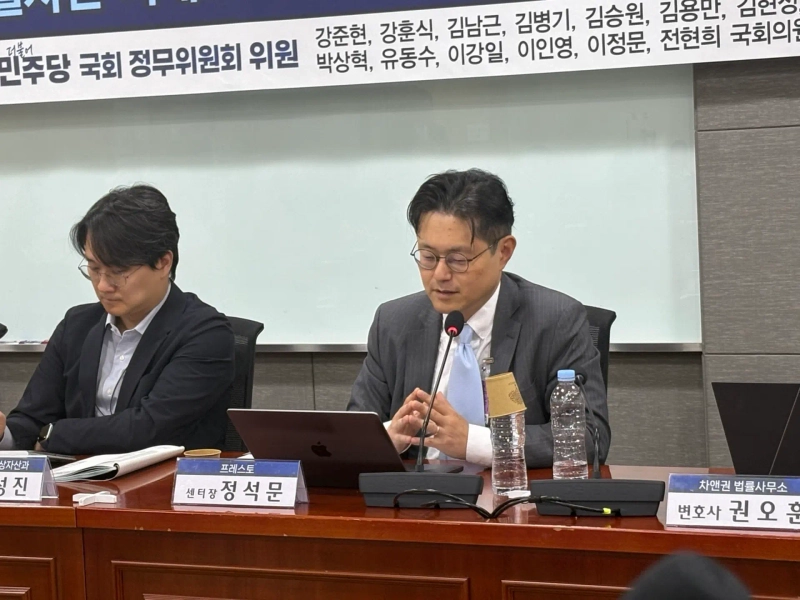
The industry argued that regulation based on self-disclosure is necessary. Jung Seok-moon, Director of Presto Research Center, said, "The United States aims for regulation based on disclosure by creating the Securities and Exchange Commission (SEC)," adding, "After recognizing the limits of public power intervention, the intention is to secure fairness through market principles." Jung added, "The purpose of regulation is not to prevent investor losses but to enhance (market) fairness," adding, "It is necessary to refer to the U.S. case where securities laws are developed."
Financial authorities also mentioned the need for self-disclosure. Kim Sung-jin, head of the Virtual Asset Division at the Financial Services Commission, said at the forum, "There is an (internal) consensus on the basic direction of regulation through the market's self-disclosure," adding, "These elements are being discussed while reviewing the second phase of (virtual asset) legislation." Kim added, "The allowance of (virtual asset) corporate accounts was promoted with the intention of matching global consistency," adding, "In the second phase of legislation, the focus is on enhancing global consistency."

JOON HYOUNG LEE
gilson@bloomingbit.ioCrypto Journalist based in Seoul