

Asian Markets Cheer 'Trump Put'... "Too Early for a Trend Rebound"
Summary
- It was reported that Asian stock markets surged due to President Donald Trump's announcement of a 90-day suspension of reciprocal tariffs.
- Experts stated that despite the tariff suspension, it is difficult to see it as a trend rebound as the U.S.-China trade conflict continues.
- While the risk of a financial system crisis has been avoided, the stock market may still be volatile, so caution is needed.
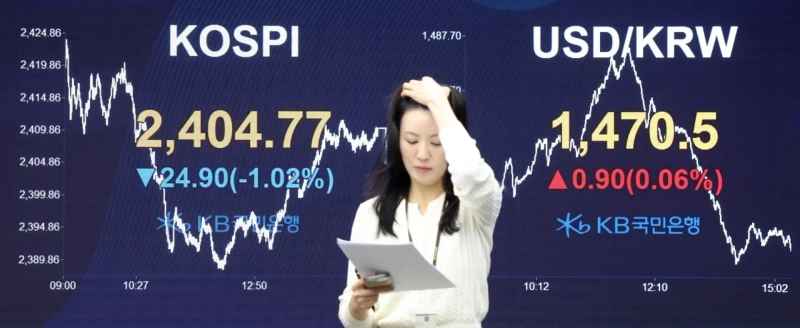
Asian stock markets cheered as U.S. President Donald Trump dramatically announced a 90-day suspension of reciprocal tariffs. In particular, 'tariff-affected stocks' such as semiconductors, which had plunged more than 20% after the reciprocal tariff issue arose, rebounded significantly. However, experts unanimously stated that it is difficult to see this rally as the beginning of a trend rebound, as the spark of the U.S.-China trade conflict is still alive.
Surge Triggers Sidecar
On the 10th, the KOSPI index surged 6.60% to close at 2445.06. The KOSDAQ index rose 5.97% to close at 681.79. Other Asian stock markets also surged. Japan's Nikkei 225 index, which had plunged more than 23% from its previous high, soared 9.13% on the day. Taiwan's TAIEX also surged 9.25%. China's Shanghai Composite Index rose 1.16%.
In the domestic stock market, a buy sidecar (program buy order suspension) was triggered at 9:06 a.m. in the KOSPI market, and a buy sidecar was triggered at 10:46 a.m. in the KOSDAQ market. It was the first time in about eight months since August 6 last year that buy sidecars were triggered simultaneously in both the KOSPI and KOSDAQ markets.
The reason Asian stock markets surged on this day was that President Trump's decision to suspend reciprocal tariffs imposed on countries around the world for 90 days rapidly alleviated fears of a global economic recession. During this period, the tariff rate imposed on Korea was lowered from 25% to 10%. U.S. investment bank Goldman Sachs significantly lowered the probability of a U.S. recession from 65% to 45%.
Foreign investors, who had consistently been net sellers for nine consecutive trading days, selling more than 10 trillion won, net bought 328.6 billion won worth of stocks on this day. They also purchased 109.5 billion won worth in the KOSDAQ market and 809.9 billion won worth in the KOSPI 200 futures market.
Export-related stocks such as semiconductors and automobiles, whose prices had fallen since the high-intensity tariff issue surfaced, surged. SK Hynix, which had plunged about 27% from its high this year after President Trump declared that he would impose individual tariffs on the semiconductor sector, rebounded sharply by 11.03% on this day. Samsung Electronics also rose 6.42%. Hyundai Motor and Kia, whose stock prices had plummeted due to a 25% tariff on the automobile sector, rose 5.06% and 5.25%, respectively.
The previous day, Tesla surged 22% in the U.S. stock market, bringing a favorable wind to secondary battery stocks such as LG Energy Solution (11.31%) and EcoPro BM (9.29%). The shipbuilding sector also rebounded. Expectations for cooperation with the Korean shipbuilding industry grew as President Trump signed an executive order on the 9th (local time) to promote the reconstruction of the U.S. shipbuilding industry.
'Trend Rebound' Expectations Are Premature
Although Asian stock markets staged a relief rally due to the tariff suspension, the securities industry unanimously states that it is still difficult to expect a 'trend rebound.' This is because the conflict between the U.S. and China is still far from finding a clue to resolution. China has raised the tariff rate on U.S. imports to 84%, and the U.S. has raised the tariff rate on China to 125%. The 10% universal tariff on each country is still in place. Automobiles and steel are still subject to item tariffs (25%).
KB Securities estimates that even if the tariff imposed on 57 countries excluding China is lowered to 10%, the second-quarter net profit of U.S. S&P 500 companies will decrease by 6.4%. Lee Jin-woo, head of the research center at Meritz Securities, diagnosed, "If the U.S.-China trade dispute intensifies, the structural costs of Korean export companies will also increase sharply," adding, "Today's stock market rebound is closer to a temporary rebound due to relief rather than a trend rise."
The fact that President Trump could change his mind again is also considered a weakness of the stock market. There is a precedent during the first Trump administration. After the U.S.-China tariff war began in early 2018, the two countries agreed to suspend tariffs for 90 days in December of that year, causing the KOSPI index to surge about 12% from January to mid-April 2019. However, in May 2019, President Trump reversed the agreement and imposed additional tariffs on China. As a result, the KOSPI index fell by about 7% in a month.
However, the evaluation is that the downside of the stock market has been somewhat solidified in that the 'worst-case scenario' of an economic recession has been avoided for now. Kim Min-guk, CEO of VIP Asset Management, said, "This tariff suspension avoided the risk of escalating into a financial system crisis," adding, "As Korea is ahead of the presidential election, it is time to pay attention to stocks related to policies brought by candidates."
Reporter Seong-mi Shim smshim@hankyung.com

Korea Economic Daily
hankyung@bloomingbit.ioThe Korea Economic Daily Global is a digital media where latest news on Korean companies, industries, and financial markets.