

The Korean Won Struggles Amidst US-Korea Interest Rate Gap and Weak Yuan
Summary
- The gap in market interest rates between Korea and the US and the weak yuan are reported as the main factors sustaining the high exchange rate of the won.
- The won-dollar exchange rate has reached its highest level since the 1998 foreign exchange crisis.
- Experts predict that the high exchange rate in the 1,400 won range could persist for a considerable period.
April's Average Exchange Rate Hits 27-Year High
Complex Factors Including Yuan and Overseas Investors
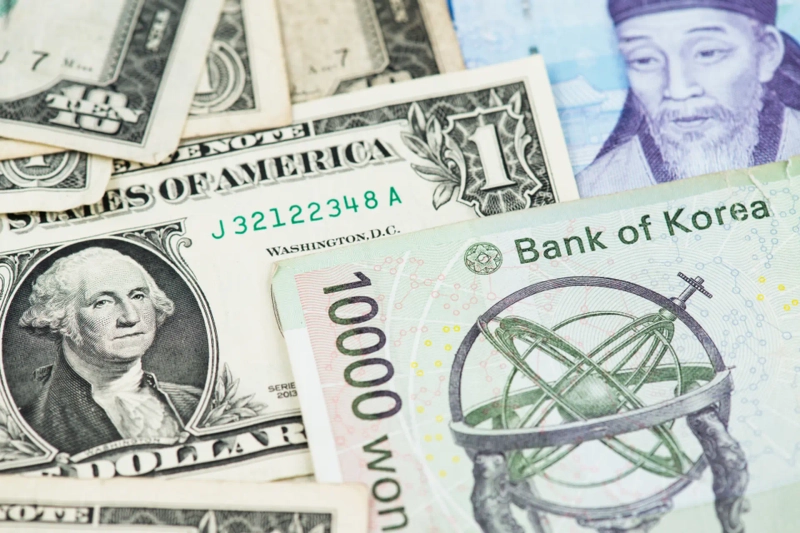
Since Donald Trump became the President of the United States, the US dollar has been weakening, but the won-dollar exchange rate remains high. The gap in market interest rates between Korea and the US is not narrowing, and factors such as the expansion of overseas investments by Korean retail investors, the weak yuan, and weakened corporate fundamentals are acting in combination.
According to the Bank of Korea on the 11th, the average exchange rate in April so far is 1,464.44 won, which is about 100 won higher than April last year (1,369.25 won). On a monthly basis, it is the highest level since March 1998 (1,488.87 won) right after the foreign exchange crisis 27 years ago. While major currencies like the euro and yen have strengthened against the dollar due to the Trump administration's tariff policies, the won alone continues to weaken.
Experts predict that the high exchange rate in the 1,400 won range could persist for a considerable period. First, the interest rate gap between Korea and the US is not narrowing. According to Investing.com, as of today, the US 10-year Treasury yield is 4.429% per annum, which is 1.722% points higher than Korea's 10-year government bond yield (2.707%) on the same day. The Korea-US bond spread has widened by about 0.7% points from 1.039% points a year ago. Global investors have less incentive to invest in the Korean market, where growth rates are slowing and interest rates are low.
Hagun Hyeong, a researcher at Shinhan Securities, explained, "The US long-term Treasury yield is rising due to concerns about economic recession and inflation caused by the Trump administration's tariff policies, while Korea's yield is declining due to the outlook for a slowdown in potential growth."
The increase in overseas investments by individuals and institutional investors, leading to higher demand for dollar exchange, is also a factor that depreciates the won. The risk-averse tendency in financial markets due to the unprecedented tariff war and the Chinese government's moves to devalue the yuan are also cited as factors causing the won's weakness.
Reporter Jwa Dong-wook leftking@hankyung.com

Korea Economic Daily
hankyung@bloomingbit.ioThe Korea Economic Daily Global is a digital media where latest news on Korean companies, industries, and financial markets.