

PiCK
Trump Steps Back... "Excludes Smartphones and Computers from Reciprocal Tariffs"
Summary
- President Trump decided to exclude mobile phones and computers from reciprocal tariffs, and it is expected that Apple, Samsung, and HP will benefit.
- The U.S. announced that out of a total of $390 billion worth of imports, $101 billion are Chinese products, and 20% of these are included in the tariff exemption.
- The exception to reciprocal tariffs is largely influenced by lobbying from big tech like Apple, and it could act as a positive factor for tech stock investors.
Changing Words Again Due to Consumer Complaints
A Quarter of Tariff Exemptions are Chinese Products
"Apple, Samsung, HP Likely to Benefit"
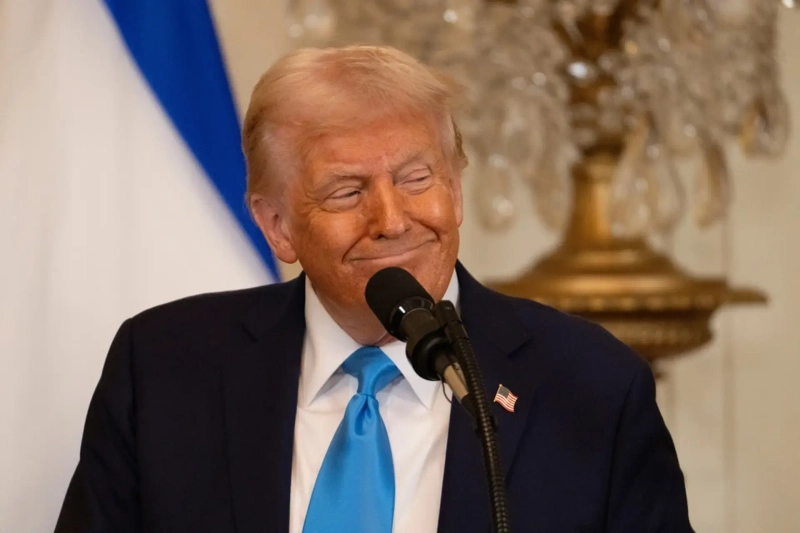
U.S. President Donald Trump has decided to exclude electronic products such as mobile phones, computers, and digital cameras from reciprocal tariffs. President Trump, who has been pushing a tariff 'chicken game' targeting China, has taken a step back. It is interpreted that lobbying by big tech industries in the U.S. and consumer complaints have influenced this decision.
On the 11th, President Trump announced a 'Memorandum to Clarify Exceptions to Reciprocal Tariffs' on the White House website. According to the memo, eight items including smartphones and laptops were added to the 'semiconductor' category, which was excluded from the reciprocal tariff measures on the 2nd. The U.S. Customs and Border Protection (CBP) announced that 20 items, including memory chips and semiconductor manufacturing equipment, are excluded from reciprocal tariffs. These items are not subject to the 125% tariff imposed on China, nor the 10% basic tariff applied to all other countries. However, Chinese products are subject to a 20% fentanyl-related tariff, and if other types of tariffs have already been imposed, they are combined.
Bloomberg News explained, "The tariff exemption applies to $390 billion worth of U.S. imports, of which more than $101 billion are Chinese products." The Wall Street Journal (WSJ) predicted that Apple, Samsung, and HP, which produce electronic devices outside of the U.S., will benefit. In particular, Apple, which has an 80% manufacturing share in China, is considered the biggest beneficiary. Last week, when President Trump raised the additional tariff rate on China to 145%, consumers flocked to Apple stores in the U.S. to purchase products in advance.
Chinese Phones, Laptops, and Memory Exempt from Tariffs... "A Hole in Trump's Trade Barrier"
Trump Applies 145% Tariff on China, Decides Exceptions in a Day
U.S. President Donald Trump decided on a large-scale exception just a day after implementing reciprocal tariff deferral measures and raising reciprocal tariff rates on China.
The U.S. Customs and Border Protection (CBP) announced 'Notice of Exclusion of Certain Goods from Reciprocal Tariffs' on its website on the 11th. The excluded items are 20 categories, including computers and data processing equipment, computer parts (such as GPU-related parts), semiconductor manufacturing equipment, smartphones and communication equipment, semiconductor devices, and integrated circuits. Smartphones and laptops were newly included along with semiconductor chip-related items, which were announced as exceptions during the reciprocal tariff announcement on the 2nd. This measure is retroactively applied to imports from 0:00 on the 5th.

◇"A Hole in the U.S. Tariff Barrier"
According to Bloomberg News, the U.S. import scale of the 20 items amounted to $390 billion last year. Of this, $101 billion worth are Chinese products. The import scale of Chinese smartphones is about $41.7 billion, accounting for 9% of the total volume imported from China. The import amount of computers and similar devices also reaches $36.7 billion. Overall, the tariff exemption target accounts for about 22% of last year's Chinese imports. One-fifth of the 125% reciprocal tariff plan imposed on China has already been 'excluded'.
Jared DiFiore, deputy director of the Rand China Research Center, explained, "It creates a big hole in the U.S. tariff barrier," but also "allows companies like Apple and consumers to escape price shocks." Dan Ives, an analyst at Wedbush Securities, evaluated it as "the biggest good news over the weekend" and "a dream scenario for tech stock investors."
President Trump did not specifically explain the reason for the exception, but it is highly likely that lobbying by U.S. big tech companies like Apple had a significant influence. After the announcement of reciprocal tariffs, Apple's stock price fluctuated greatly. Apple produces 87% of iPhones, 80% of iPads, and about 60% of Mac laptops in China. If the high tariff of 145% is applied as it is, the price of iPhones could jump 2-3 times. As market anxiety grew, Apple's market capitalization dropped by $700 billion in just a few days, and consumers flocked to stores fearing price hikes, causing chaos.
Tim Cook, CEO of Apple, has experience working with Trump to waive tariffs, such as obtaining an exemption from the Trade Act 301 tariff (25%) on Chinese Apple products during the first Trump administration. However, the exception granted this time is for reciprocal tariffs, and the fentanyl tariff (20%) still applies.
◇"Growing Criticism of Reckless Policy"
As China still imposes a 125% retaliatory tariff on the U.S., criticism that the U.S. has embarked on an 'unprepared game' is gaining strength as President Trump takes a step back first. Adam Posen, president of the Peterson Institute for International Economics (PIIE), emphasized in a Foreign Affairs article that "China has the escalation advantage in this trade war." He argued that simply trying to reduce dependence on China without preparing alternative routes is "a method that almost certainly leads to defeat at enormous cost." In particular, since electronic products have complex supply chains and require advanced technology, it is not easy to suddenly move factories to the U.S. Evan Feigenbaum, deputy director of the Carnegie Endowment for International Peace, pointed out that this tariff war "seems like a national suicide attempt."
Even if semiconductors and electronic products are partially exempted, the prices of various home appliances such as fans, air conditioners, and microwaves are likely to rise sharply. According to the New York Times, Chinese toys, which were previously duty-free, are now subject to a 145% tariff. If wool sweaters are imported from China, the existing tariff (23.5%) is added, resulting in a 168.5% tariff.
Washington Correspondent Lee Sang-eun selee@hankyung.com

Korea Economic Daily
hankyung@bloomingbit.ioThe Korea Economic Daily Global is a digital media where latest news on Korean companies, industries, and financial markets.