

Powell, 3 consecutive rate holds... Market says "Rate cut not until July at the earliest"
Summary
- The Federal Reserve (Fed) announced that it decided to hold the benchmark interest rate at 4.25~4.5% at the May FOMC.
- The market is looking at a delayed rate cut, with the expected timing pushed to July.
- Despite the risks of economic slowdown and stagflation, the Fed stated it will continue a cautious approach to rate cuts.
May FOMC held on the 7th (local time)
Rates held at 4.25~4.5%
Fed "Risks of unemployment and inflation are rising"... Concerns about stagflation
Cautious approach to rate cuts due to solid real indicators
Market pushes expected rate cut timing from June to July
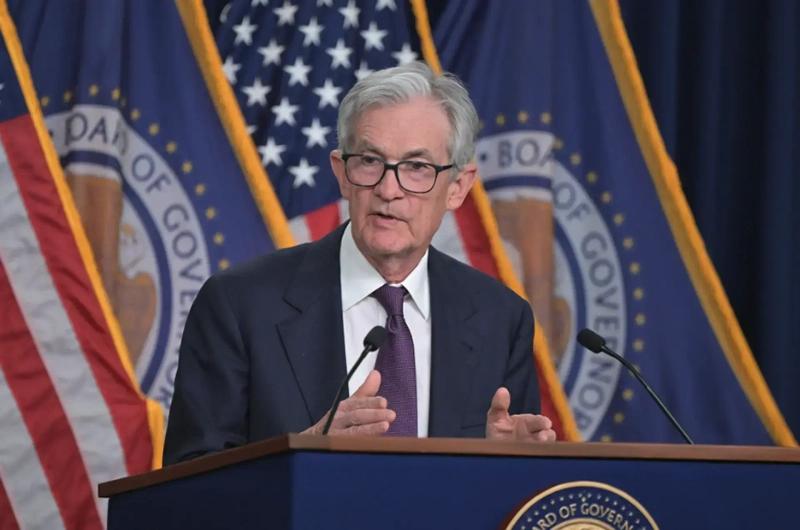
Amid growing economic uncertainty due to the Trump administration's tariff policies, the U.S. Federal Reserve (Fed) held the May Federal Open Market Committee (FOMC) on the 7th (local time) and kept the benchmark interest rate at 4.25~4.5%. Despite U.S. President Donald Trump's pressure for a rate cut, conscious of the tariff-induced slowdown, the Fed, led by Chairman Powell, appears to be preparing for stagflation. In the statement announcing the rate hold decision, the Fed diagnosed that "the risks of higher unemployment and inflation have increased."
First FOMC after Trump tariffs
Thus, the Fed has held three FOMC meetings since President Trump's inauguration in January, and all three times, the benchmark interest rate was held steady.
This FOMC was particularly notable as it was the first rate decision after President Trump's reciprocal tariffs took effect last month. Although President Trump has been pressuring for a rate cut due to concerns about economic slowdown from his tariff policies, the Fed did not respond. The possibility of both economic slowdown and rising prices has increased. The signs of stagflation have also contributed to the decision not to hastily cut rates.
JP Morgan Chase assessed that "this FOMC statement did not indicate a hawkish or dovish shift but highlighted the risk of stagflation due to trade policies."
With this decision by the Fed, the interest rate gap between South Korea (2.75%) and the U.S. remains at 1.75 percentage points at the upper end. Market participants believe that given the uncertainty of prolonged tariff effects, the Fed's resumption of rate cuts will not occur until at least after July. During the March FOMC, the market had predicted a rate cut in June, but this has been delayed. UBS also analyzed that "the possibility of a delayed rate cut by the Fed has increased with this statement."
Real indicators still solid
The solid state of U.S. real economic indicators is also analyzed as a reason for the rate hold. In the FOMC statement, the Fed stated, "Although fluctuations in net exports have affected the data, recent indicators suggest that economic activity continues to expand at a solid pace."
The reason for the -0.3% contraction in the U.S. GDP in the first quarter was mentioned as a result of companies advancing import volumes to avoid tariffs. The FOMC also noted that "the unemployment rate has remained stable at low levels in recent months, and labor market conditions are still solid."
Chairman Powell also diagnosed at a press conference that "even after removing the distorted figures of the first quarter GDP (temporary import increase due to tariffs), the economy is still showing solid growth."
The U.S. Department of Labor announced on the 2nd (local time) that U.S. non-farm jobs increased by 177,000 in April compared to the previous month. This is significantly above the expert forecast of 133,000 compiled by Dow Jones. The April unemployment rate was 4.2%, unchanged from the previous month, and met expert expectations.
Powell "Let's wait and see"
Chairman Powell is aware that although it cannot be confirmed in real data, the possibility of a slowdown is increasing. He stated, "Considering the scale and scope of tariffs, the risks of inflation and rising unemployment have certainly increased," and "My intuition is that the uncertainty about the future path of the economy is extremely high, and downside risks have increased."
Nevertheless, he continued to emphasize a cautious approach to monetary policy. He reiterated that there is no need to rush and that it is appropriate to wait at the moment. The most frequently used expression at this meeting was also "Wait and see."
Chairman Powell said, "It's hard to say how this situation will unfold," and "There is considerable uncertainty about how tariff policies will settle and what impact they will have on the economy, growth, and employment."
The current interest rate level of 4.25~4.5% gives Chairman Powell confidence that there is ample room for future cuts. Chairman Powell said, "We think our policy rate is in a good position while we wait for more clarity on tariffs and their impact on the economy."
He added, "I don't feel the need to rush (rate cuts) and think it's appropriate to be patient."
New York = Park Shin-young, Correspondent nyusos@hankyung.com

Korea Economic Daily
hankyung@bloomingbit.ioThe Korea Economic Daily Global is a digital media where latest news on Korean companies, industries, and financial markets.