

"Will People Use This?"... The Reason for Criticism in the Bank of Korea's Experiment
Summary
- The Bank of Korea announced that it has collaborated with major banks to respond to the proliferation of stablecoins through a CBDC experiment.
- However, there is criticism among consumers that there is little incentive to use CBDC over existing payment methods.
- A cryptocurrency industry official stated that excessive central bank-led licensing of stablecoins could hinder ecosystem development.
Invasion of Stablecoins (9) Korea Lacks Countermeasures
Bank of Korea Embarks on Digital Currency Experiment... Criticized as "Half-Baked"
Bank of Korea Responds to Stablecoin Proliferation
Issued CBDC with Major Banks Last Month
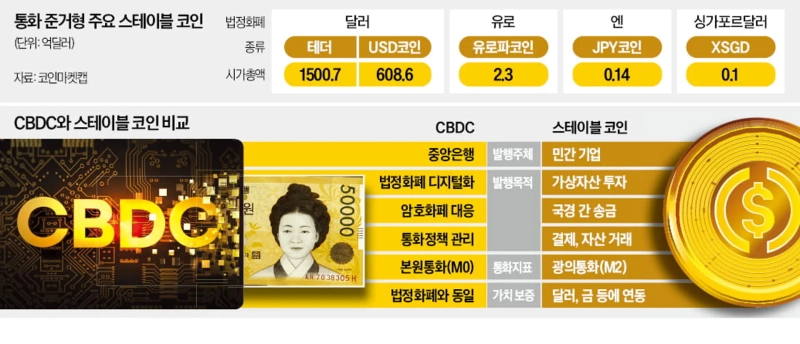
The Bank of Korea is responding to the proliferation of stablecoins through its central bank digital currency (CBDC) experiment. The Bank of Korea has expressed the opinion that it may need to intervene directly in the issuance of won-based stablecoins. However, there is criticism in the market that excessive central bank-led movements could hinder the autonomous development potential of the related ecosystem.
◇ Pros and Cons of CBDC
According to the financial sector on the 13th, the Bank of Korea and commercial banks have been conducting a retail CBDC experiment based on deposit tokens under the name 'Project Han River' since April. Seven major banks, including Kookmin, Shinhan, Hana, and Woori, participated. About 100,000 consumers who applied for participation are using CBDC converted from their deposits for online and offline payments. Users pay via QR code through the bank app, and merchants can settle in real-time.
Although the Bank of Korea has taken a difficult step, there is criticism that there is little incentive for general consumers to use CBDC instead of credit cards or debit cards linked to bank accounts. This is because it is not more convenient than existing payment methods and does not offer additional benefits such as interest payments or point accumulation. The benefits currently offered by Project Han River are only temporary incentives to attract participants.
The fact that all transactions are traceable is considered a risk factor of CBDC. Since it is issued and managed by the central bank, personal transaction information can be recorded in real-time in the central system. While it is positive in terms of tracking illegal funds, preventing tax evasion, and money laundering, there are also concerns about excessive state intervention and privacy infringement. For these reasons, the US Federal Reserve is negative about CBDC. China is a representative country conducting CBDC experiments. The People's Bank of China is experimenting with the digital yuan, a CBDC, in 26 cities including Beijing.
Some analyze that CBDC would be most efficient when operated as 'wholesale' for payments between central banks and banks, reserve ratio adjustments, and short-term liquidity management. Since CBDC is directly issued by the central bank, it is similar to 'base money (M0)'. Banks endure complex transactions and costs in the short-term money market to meet the reserve ratio daily. In this process, there are sometimes phenomena where ultra-short-term interest rates abnormally rise. A source familiar with the money market said, "Utilizing a blockchain network based on CBDC could significantly reduce operating costs and greatly enhance the transparency and efficiency of short-term fund management."
◇ "Focus on Supporting the Ecosystem"
The need for won-based stablecoins is raised for these reasons. Unlike CBDC, won-based stablecoins do not directly affect the money supply because they are used as a means of circulation within the already existing won. In terms of monetary indicators, it corresponds to broad money (M2), which includes cash and deposits. The US Treasury views stablecoins as a type of digital money market fund (MMF).
For this reason, there is also criticism of the Bank of Korea's claim to be in charge of licensing won-based stablecoins. It is pointed out that compared to advanced countries, the stablecoin-related ecosystem has not been formed, and it is preventing even the sprout from growing. In the US, venture capital funds are flocking to the stablecoin ecosystem, but in Korea, related investments are still limited due to institutional uncertainty and regulatory risks.
A cryptocurrency industry official said, "Stablecoins can be seen as gift certificates, and it doesn't make sense for the central bank to license gift certificates," adding, "The Bank of Korea and the government should focus on policy support to allow private businesses to conduct stablecoin-related businesses within the legal framework by revising the Foreign Exchange Management Act and others."
Reporter Mi-hyun Cho mwise@hankyung.com

Korea Economic Daily
hankyung@bloomingbit.ioThe Korea Economic Daily Global is a digital media where latest news on Korean companies, industries, and financial markets.