

"High Possibility of Early Implementation of Virtual Asset Taxation After Presidential Election… Positive Outlook for ETF Introduction"
Summary
- An analysis has emerged suggesting a high possibility of early implementation of domestic virtual asset taxation after the presidential election.
- The introduction of virtual asset ETFs is expected to gain support from multiple parties, leading to substantial discussions soon.
- The report indicated that implementing the taxation policy could negatively impact domestic virtual asset trading volume, based on foreign cases.
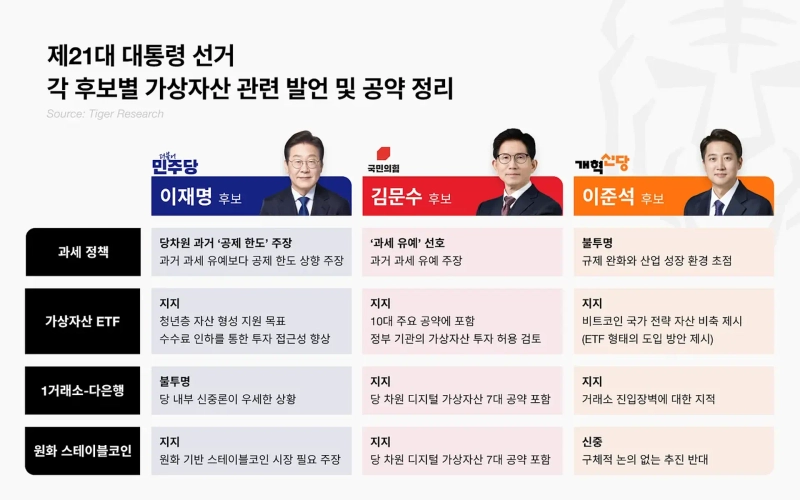
An analysis has emerged suggesting a high possibility of early implementation of domestic virtual asset (cryptocurrency) taxation after the presidential election.
On the 27th (local time), Tiger Research forecasted changes in the Korean virtual asset (cryptocurrency) industry after June 3rd (local time) through the report 'Four Changes the Korean Presidential Election Will Bring to the Global Web3 Market'. These changes include △the end of tax deferral △introduction of virtual asset exchange-traded funds (ETFs) △change in the '1 Exchange-1 Bank' system △launch of a Korean won stablecoin.
Particularly, the analysis related to virtual asset taxation drew attention. The domestic virtual asset taxation bill, which imposes a 20% tax (22% including local tax) on annual virtual asset income exceeding 2.5 million KRW, is currently deferred until 2027. However, Tiger Research assessed a high possibility of early implementation of domestic virtual asset taxation.
Tiger Research stated, "According to the 'Corporate Virtual Asset Market Participation Roadmap', corporate participation in virtual asset investment is expected. A reorganization of the tax system will be inevitable," adding, "The government is likely to cancel the deferral through additional legal amendments and advance the taxation timeline." According to the roadmap, virtual asset investments by listed companies and professional investors will be allowed from the second half of this year. Therefore, it is explained that extending the tax deferral for corporate virtual asset income again would be challenging.
The report also mentioned the positions of both parties on taxation. Previously, the Democratic Party advocated raising the deduction limit to 50 million KRW instead of deferring virtual asset taxation. The report stated, "The Democratic Party ultimately agreed to the deferral during the virtual asset taxation controversy," adding, "Depending on the election results, the direction of the taxation policy could change to raising the deduction limit again."
However, considering foreign cases, it is expected that the implementation of the taxation policy will negatively impact domestic virtual asset trading volume. In the cases of India and Indonesia, where virtual asset taxation was implemented, trading volumes plummeted by 10% to as much as 70%. The report analyzed, "Korea does not impose excessive taxes like those countries," but added, "There is a possibility of a decrease in trading volume by about 20%, and funds may flow out to overseas exchanges."
The possibility of introducing virtual asset ETFs is also expected to increase. The report stated, "Virtual asset ETFs are the only pledge commonly supported by multiple parties," adding, "Substantial discussions are expected to take place soon." It further explained, "If a spot ETF is introduced, a fee competition with existing exchanges will begin," adding, "This could lead to improved service quality for virtual asset users." Furthermore, it predicted that various virtual asset financial products could be developed starting with ETFs.
Regarding the change in the '1 Exchange-1 Bank' system, it was evaluated that the People's Power is leaning towards abolishing the principle, while the Democratic Party is becoming more cautious, indicating long-term discussions. However, the report argued, "The claim that the '1 Exchange-1 Bank' principle is effective in preventing monopolies lacks persuasiveness," adding, "Changing this system could provide greater benefits to virtual asset users."
Regarding the Korean won stablecoin, it stated, "Although immediate implementation after the presidential election is unlikely, continuous discussions in the political sphere will take place," adding, "Since legal and institutional arrangements are essential before actual introduction, there will be no rapid policy changes."

Son Min
sonmin@bloomingbit.ioHello I’m Son Min, a journalist at BloomingBit