

PiCK
US-China Tensions Take a Breather...Possible Re-escalation Amid Diverging Perspectives
Summary
- The US and China reaffirmed their intentions to resume trade negotiations, raising the prospect of a leaders' summit.
- China's rare earth export controls opened the pathway for dialogue, and tensions between the two countries have entered an eased phase.
- However, many experts note that this is not a fundamental relaxation of tensions, and that resuming talks may only be a temporary pause.
90-Minute Call Between the Two Leaders...A Breakthrough in Trade Negotiations?
Trump: "Delegations of Both Countries to Meet Soon"
Following Restart of Tariff Working-Level Talks
Prospect of a Swift Leaders' Summit
Sudden Resolution of Issues Like Student Bans
Rare Earth Export Controls Triggered the Dialogue
Divergent Responses on Taiwan Issue
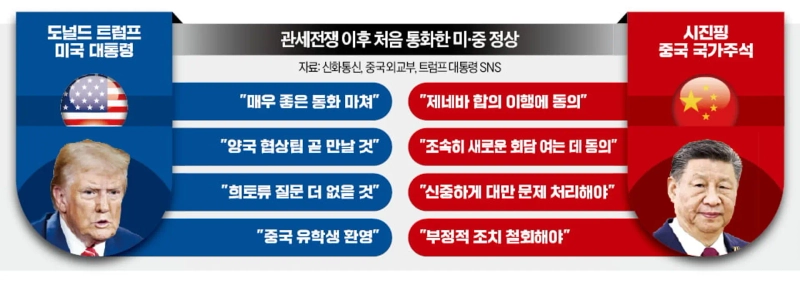
After a tariff war truce and deepening tensions without concessions, the US and China have opened a channel for dialogue. The two countries reaffirmed their intention to resume trade negotiations, and speculation is mounting over a possible summit, suggesting that the high-stakes confrontation shaking the global economy has somewhat eased. Although urgent hot-button issues—such as US export controls on semiconductors to China and the attempted ban on Chinese students—appear to be on track for resolution, some remain cautious, arguing that fundamental tensions have not been resolved. On the surface, US-China tensions may be taking a brief respite, but there is concern that a clash could erupt at any time during this process of 'reshuffling the board.'
◇Subtly Different Stances Between the Two Countries
According to the Chinese Foreign Ministry and Xinhua News Agency on the 6th, the previous day's call between US President Donald Trump and Chinese President Xi Jinping was the first since January 17, right before the start of Trump's second administration. The call reportedly focused on the key issue of China's restrictions on rare earth exports, which has been at the center of the ongoing US-China trade conflict reminiscent of tariff war round two.
Immediately after the call, President Trump indicated via Truth Social that "there will be no further questions about the complexity of the rare earth issue," suggesting that a satisfactory agreement had been reached. The US has strongly criticized China for failing to implement the Geneva agreement regarding rare earths.
During the call, President Xi said, "Both countries should make good use of the already established economic and trade negotiation mechanisms, respect each other's concerns with an attitude of equality, and achieve win-win results," and added, "China is sincere and principled." Addressing the US's continuous demands, he remarked, "After the Geneva talks, China has participated earnestly and sincerely in the consultations," and emphasized, "The US should look objectively at the progress made so far and withdraw its negative measures against China."
The New York Times (NYT) described the call as "a potential signal of a thaw in US-China relations." Before the call, the second Trump administration had moved to suspend various supports for Harvard University due to cooperation with Chinese students and scholars and considered revoking student certifications. However, following the call, President Trump made a complete turnaround, declaring that "Chinese students are welcome."
The first direct talk between the two leaders in about 130 days heightened the possibility of a summit. On Truth Social, President Trump noted, "President Xi graciously invited the First Lady and me to China during our call, and I reciprocated by inviting him to the US."
However, the US and Chinese official statements were delivered from their respective national perspectives and had discrepancies. Regarding the invitation, Xinhua News Agency only stated, "President Xi welcomed President Trump to visit China again, and President Trump expressed his sincere gratitude."
While President Trump said there was little discussion outside of trade, China announced that the Taiwan issue had been discussed. According to Xinhua, President Xi said during the call, "The US should prudently handle the Taiwan issue to prevent a handful of 'Taiwan independence' separatists from dragging the two countries into a dangerous situation of confrontation." Xinhua also reported that President Trump stated, "The US will continue to uphold the 'One China' policy."
◇Rare Earth Controls Triggered the Dialogue
Experts pointed to China's rare earth export controls as the driving force behind the call. Jin Canrong, Professor at the School of International Studies, Renmin University of China, said on the 6th, "Last week, President Trump threatened China for breaching promises, but he was actually the one urgently seeking dialogue." He added, "Rare earths are China's hidden ace," and emphasized, "The US wanted to resolve the rare earth issue quickly."
With the leaders' call boosting the chances for an early summit, concerns over a military conflict between the two powers have subsided. However, some see the resumption of trade talks as a temporary pause rather than a fundamental resolution of conflict. Gabriel Wildau, Senior Vice President at Teneo, commented, "This call prevented the derailment of trade negotiations but failed to offer any clear breakthrough on core issues."
Beijing = Kim Eun-jung / Washington = Lee Sang-eun, Special Correspondents kej@hankyung.com

Korea Economic Daily
hankyung@bloomingbit.ioThe Korea Economic Daily Global is a digital media where latest news on Korean companies, industries, and financial markets.