

PiCK
Political Uncertainty Removed... Gradual Downward Pressure on Exchange Rate
Summary
- The KRW-USD exchange rate dropped to the 1,350 KRW range for the first time in 7 months, and it is expected that the gradual downward trend will continue this week.
- It was stated that foreign capital inflows are increasing in the FX and stock markets as political uncertainty has eased and foreign investor sentiment recovered after the presidential election.
- There is an expectation that the second supplementary budget will fall below 35 trillion KRW, while the rising trend of long-term government bond yields may reverse, with a possibility of decline in the medium to long term.
Weekly Exchange Rate & Bond Outlook
Back to 1,350 KRW Range After 7 Months
Foreign Investor Sentiment Recovering
Discussion of Second Supplementary Budget by New Administration
Possibility of Falling Below 35 Trillion KRW
Long-Term Government Bond Yields Expected to Turn
The KRW-USD exchange rate, having fallen to the 1,350 KRW range, is expected to come under further downward pressure this week. With discussions underway on the second supplementary budget by the new administration, the bond market—which had been experiencing rising long-term yields—continues to closely monitor the budget size.
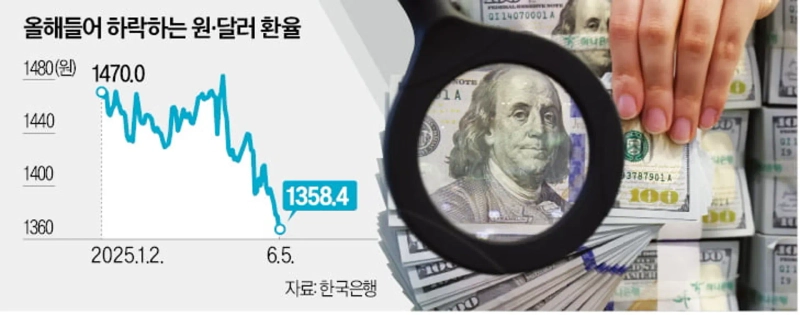
On the 5th, the KRW-USD exchange rate closed at 1,358.49, down 11.1 KRW from the previous trading day in the Seoul Foreign Exchange Market. This marks the first weekly close in the 1,350 KRW range in about seven months since mid-October last year. This week, the exchange rate may fluctuate within the 1,350~1,380 KRW range, with a possibility of a gradual downward trend. The rapid recovery of foreign investor sentiment across the Korean stock market, following the conclusion of the presidential election and a reduction in political uncertainty, is a key factor.
With foreign investors continuing to buy local stocks, a significant volume of dollar sell orders has been flowing into the FX market. The KOSPI Index surpassed the 2,800 mark for the first time in 11 months, as foreign investors recorded net purchases of nearly 1 trillion KRW for two consecutive days. Following Lee Jae-myung’s election as president, expectations for capital market advancement and policies to boost domestic demand have improved foreign capital inflows.
However, as global commodity prices are once again on the rise, increased hedging demand from energy and semiconductor equipment importers may provide upward pressure on the exchange rate. This is because dollar demand remains at a certain level. Consequently, it is unlikely for the KRW-USD exchange rate to quickly fall below 1,350 in the short term.
Another variable is the uncertainty over the global dollar direction ahead of the US Federal Reserve's Federal Open Market Committee (FOMC) meeting scheduled for the 17th-18th (local time).
The bond market is also expected to pay close attention this week to discussions over the new administration's second supplementary budget. Concerns over a 'super supplementary budget' led to a sharp spike in long-term bond yields last week. The yield on 10-year government bonds jumped 0.105 percentage points to 2.891% per annum, while the 30-year yield climbed 0.125 percentage points to 2.754%. Most of this increase occurred on the day after the presidential election, the 4th.
Fears of oversupply led to increased bond selling. Prior to taking office, President Lee stated in a YouTube broadcast on the 2nd, "We will pursue a supplementary budget of at least that scale (35 trillion KRW)." This year’s expected government bond issuance, including the first supplementary budget, is 207 trillion KRW—already 31% higher than last year. According to NH Investment & Securities, this marks the fourth-largest increase since COVID-19, the Global Financial Crisis, and the Credit Card Crisis. Should a second supplementary budget of 35 trillion KRW be financed by bond issuance of the same size, this year’s issuance would jump to 242 trillion KRW, marking a 53% surge from 2024.
The new administration is also likely to feel pressure over such an aggressive government bond issuance. For this reason, expectations are growing that the actual supplementary budget size will fall below 35 trillion KRW. Kang Seung-won, a researcher at NH Investment & Securities, predicted, "The actual supplementary budget will be smaller than feared," forecasting a second supplementary budget of 30 trillion KRW.
If issuance fears are alleviated during government discussions, the uptrend in long-term yields may be curbed. In the medium to long term, given the Bank of Korea's accommodative monetary policy aimed at overcoming low growth, long-term yields may also turn downward. Most securities analysts believe it will be difficult for the 10-year yield to stay well above 3.0% per annum for long.
Jo Mi-hyun/Lee Tae-ho, reporters mwise@hankyung.com

Korea Economic Daily
hankyung@bloomingbit.ioThe Korea Economic Daily Global is a digital media where latest news on Korean companies, industries, and financial markets.