

South Korea–China Leaders Hold 30-Minute Call…Lee Invites Xi to November Gyeongju APEC Summit
Summary
- President Lee Jae-myung, in his first call with President Xi Jinping, emphasized strengthening multifaceted cooperation including economic cooperation.
- President Xi highlighted the importance of multilateralism, free trade, and stability of industrial supply chains, expressing his commitment to developing China–South Korea relations.
- President Lee officially invited President Xi to the November APEC Summit, expressing expectations for further development of bilateral relations and expanded economic cooperation.
Consensus on Strengthening Economic and Security Cooperation
Aim for Bilateral Exchange to Be Tangibly Felt by Citizens
Joint Efforts for Peace and Stability on the Korean Peninsula
Xi Stresses "Core Interests, Multilateralism"
Indirect Pressure on Taiwan Issue, Trade War
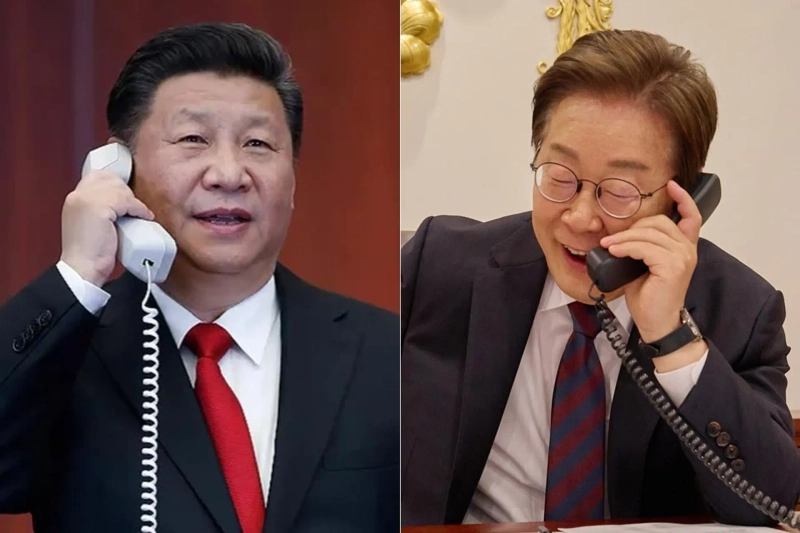
President Lee Jae-myung, in his first phone call with Chinese President Xi Jinping on the 10th, expressed hope that "South Korea and China will actively promote multifaceted cooperation in economy, security, culture, and people-to-people exchange based on mutual benefit and equality." President Xi congratulated President Lee on his election and stated, "I look forward to working with the new South Korean administration to develop the strategic cooperative partnership between China and South Korea."
President Lee officially invited President Xi to the Asia-Pacific Economic Cooperation (APEC) Summit scheduled in Gyeongju, Gyeongbuk this November. President Lee has wrapped up calls with key neighboring leaders, including United States President Donald Trump (on the 6th) and Japanese Prime Minister Shigeru Ishiba (on the 9th).
According to the Presidential Office, President Lee and President Xi spoke on the phone for approximately 30 minutes starting at 11:30 a.m. The Office announced that the two leaders agreed "that it is important to develop South Korea–China relations in ways that tangibly contribute to the lives of the people of both nations." They also committed to boosting mutual communication and people-to-people and cultural exchanges so that the citizens of both countries not only hold friendly feelings towards each other but also witness concrete outcomes in areas such as economic cooperation.
By inviting President Xi to the Gyeongju APEC Summit, President Lee stated, "I hope the summit will be an opportunity for even closer dialogue to advance bilateral relations." If President Xi visits Gyeongju, it will mark his first trip to South Korea in 11 years since the 1-night, 2-day state visit during President Park Geun-hye's term in 2014. A bilateral summit between the two presidents is also expected to be held separately during the APEC meetings.
The two leaders exchanged views on the North Korean nuclear issue. As President Lee specifically mentioned "denuclearization of the Korean Peninsula" and asked for China's constructive role, President Xi replied, "Peace and stability on the Korean Peninsula are our shared interests, and China will work towards resolving the issue and maintaining peace and stability on the peninsula," according to Presidential spokesperson Kang Yoo-jung.
Diplomatic circles noted that President Xi, while emphasizing stronger Korea–China exchanges, also referenced "core interests" and "multilateralism and free trade," as reported by Chinese state media. This is interpreted as China, perceiving the shift towards a U.S.–ROK alliance during the Yoon Suk-yeol administration, seeking to reinforce ties with the Lee Jae-myung government and at the same time intentionally signaling a check on the United States through such remarks.
Xinhua News Agency reported that in the leaders' call, President Xi stated, "Both sides should respect each other’s core interests and major concerns, solidify the overall direction of bilateral relations, and ensure that China–South Korea relations always move on the right track." President Xi also told President Lee that "the two countries should closely coordinate on bilateral and multilateral cooperation, jointly uphold multilateralism and free trade, and ensure the stability and smooth functioning of global and regional industrial supply chains."
The term "core interests" is a diplomatic phrase China uses when referring to issues like Taiwan. According to some diplomatic analysts, "President Xi's remarks are seen as a criticism of U.S. military support for Taiwan and an implicit warning to South Korea not to side with the United States."
By Han Jae-young / Lee Hyun-il, Reporters jyhan@hankyung.com

Korea Economic Daily
hankyung@bloomingbit.ioThe Korea Economic Daily Global is a digital media where latest news on Korean companies, industries, and financial markets.