

As overseas retail investors grow and the forex market fluctuates…MOEF seeks new exchange rate policy
Summary
- The Ministry of Economy and Finance is analyzing how the increased overseas investments by retail investors are affecting the KRW-USD exchange rate.
- While such investing by overseas retail investors is increasing Korea’s net external financial assets and improving external soundness, some are concerned that these assets may not function as a safety valve during crises.
- The MOEF is working on a comprehensive and multi-faceted foreign exchange policy through equilibrium exchange rate estimation and analysis of cases from major countries.
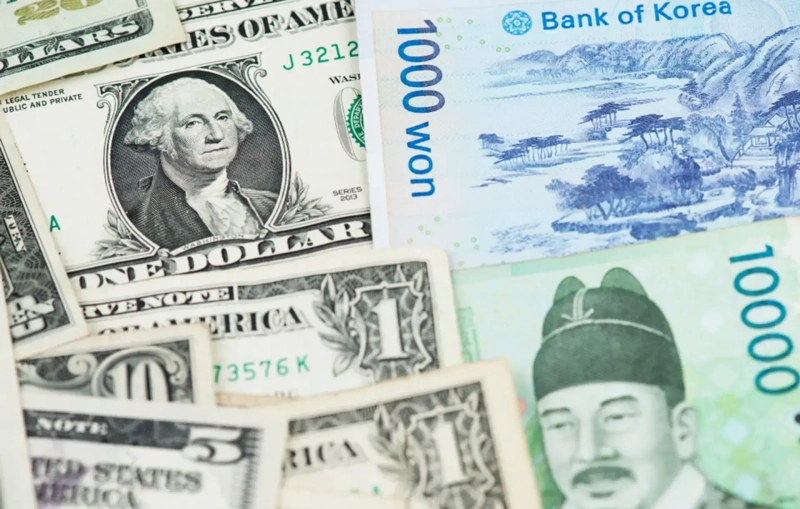
The Ministry of Economy and Finance has begun designing foreign exchange policies in response to the increase in overseas retail investors (individual investors investing abroad). The assets managed by these investors surpassed $1 trillion (approximately ₩1,400 trillion) this year, which has led to greater volatility in the KRW-USD exchange rate. The MOEF plans to assess the impact of increased overseas retail investors on exchange rates and also estimate the appropriate 'average exchange rate.'
On the 12th, the MOEF commissioned a research project titled 'Analysis of International Balance of Payments and Exchange Rates in Korea and Major Countries.' The aim is to analyze the impact of the recent increase in overseas retail investors on exchange rates and to propose appropriate foreign exchange policies in response.
According to the Bank of Korea, at the end of the first quarter this year, Korea's net external financial assets stood at $1.084 trillion, up by over $200 billion from the end of the first quarter last year. Net external financial assets refer to a country's external financial assets held by residents minus external financial liabilities. The sharp increase in net external financial assets results from the growth in overseas investments by Korean residents. At the end of the first quarter this year, residents' overseas securities investment assets amounted to $111.18 billion, a rise of 11.8% ($10.65 billion) compared to the end of the first quarter last year.
As investments by overseas retail investors rise, the so-called 'foreign exchange safety valve,' net external financial assets, also increases. Many believe that this boosts Korea's external soundness. However, there are concerns that the overseas retail investors may actually amplify foreign exchange market volatility. This is because they exchange Korean won into dollars and other currencies to buy foreign stocks, pushing up the exchange rate.
Some experts are casting doubt on the reliability of Korea's ample net external financial assets. For net external financial assets to function effectively, residents must sell overseas assets and purchase domestic assets during economic or financial crises. This would ease volatility in the domestic asset and forex markets. However, when crises unfold, the value of the dollar, considered a safe haven, typically strengthens. In such situations, overseas retail investors have little incentive to sell foreign assets, meaning the net external financial assets might not serve as an 'exchange rate safety valve.'
The MOEF plans to analyze the impact of overseas retail investors on exchange rates using the cases of Japan and Germany, both nations with large net external financial assets. Various factors will be incorporated to estimate Korea’s 'equilibrium exchange rate'—the exchange rate that reflects an appropriate currency value at the current economic level. The Hyundai Research Institute estimated Korea's KRW-USD equilibrium exchange rate to be ₩1,351 as of December last year. Through this research, the MOEF aims to understand the impact of overseas retail investors on the forex market and equilibrium exchange rate, and develop comprehensive and multi-faceted forex policies.
This study gains further attention as negotiations with the United States regarding exchange rates are ongoing. The U.S. has reportedly requested Korea to appreciate its currency. Some also interpret that Korea is analyzing its supply-demand environment and equilibrium exchange rate in response to U.S. demands.
A MOEF official stated, "We will forecast changes in Korea's foreign exchange supply and demand structure, trends in capital movements, and the trajectory of the equilibrium exchange rate, as well as anticipate KRW-USD exchange rate fluctuations."
Reporter: Ikhwan Kim lovepen@hankyung.com

Korea Economic Daily
hankyung@bloomingbit.ioThe Korea Economic Daily Global is a digital media where latest news on Korean companies, industries, and financial markets.