

Silver prices surge to 'gold-like' levels amid safe-haven preference… 'Silver rush' hits savings accounts and ETFs
Summary
- Silver prices, hitting a 13-year high, have been drawing significant interest from investors.
- Investments are expanding as returns from silver banking and ETFs surge.
- Silver’s volatility is greater than gold’s, and it is important to factor in taxes and fees when investing.
Silver prices hit 13-year high
Large inflows into silver banking
Weakened dollar and trade disputes overlap
Silver prices up 25% this year alone
Hot investment despite rising value
Related accounts increase by 1,704
ETF and ETN returns soar
Expected to surpass $40 in the second half
"High volatility in silver"—caution advised
Taxes and fees must be considered
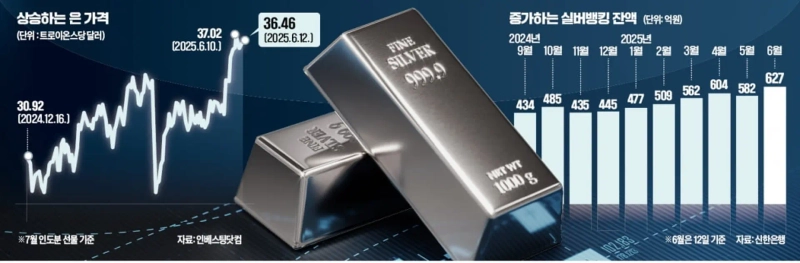
While the gold rally has somewhat eased, silver prices have surged and attracted attention. With growing concerns over U.S. fiscal deterioration and increased demand for safe-haven assets, funds are flowing into silver en masse. Capital is pouring into various products such as silver banking (silver passbooks) and exchange-traded funds (ETFs). Experts predict silver prices could rise further but also caution that potential price drops due to economic fluctuations should be considered. They also advise carefully evaluating taxes, fees, and other associated investment costs.
◇Silver banking balance exceeds ₩60 billion
According to the U.S. New York Mercantile Exchange (COMEX) on the 15th, the price of July silver futures rose to $36.46 per troy ounce on the 12th. This marks a 24.6% increase just since the start of this year. During trading on the 10th, it soared to $37.02, hitting its highest value in 13 years and 3 months since February 29, 2012 ($37.23). Analysts say the sharp rise is due to the simultaneous weakening of the U.S. dollar and treasury bonds stemming from global trade disputes and fiscal concerns, which has driven up demand for safe assets like silver. Industrial demand growth is also cited as a price driver, with silver being widely used across semiconductors, electronic devices, solar panels, and more industries.
Because gold, the representative safe-haven asset, had already made significant gains, silver—which rose less by comparison—has now come into focus. As of the 12th, the gold-to-silver ratio (based on futures prices) stood at 93.7, up significantly from 79.6 a year ago. This indicator shows how much silver is needed to buy 1 ounce of gold.
With repeated surges in price, enthusiasm for silver investment is heating up in Korea as well. The silver banking balance at Shinhan Bank reached ₩62.7 billion on the 12th, a 40.8% rise compared to the end of last year (₩44.5 billion). The number of accounts (18,580) also increased by 1,704 during the same period. Shinhan Bank is the only commercial bank in Korea offering silver banking products.
Returns for products invested through securities accounts are also soaring. The 'KODEX Silver Futures(H) ETF' has risen 19.0% so far this year (as of the 13th). The 'Samsung Leverage Silver Futures(H) ETN' also increased by 36.7% over the same period.
◇Demand outstripping supply
The financial market expects the silver price rally to continue for now. This is fueled by ongoing safe-haven demand and a persistent supply shortage. According to the Silver Institute, global silver supply last year was about 1,015.1 million ounces, which was 149 million ounces less than the demand (about 1,164.1 million ounces). The organization projects that, even this year, demand will exceed supply by more than 100 million ounces.
However, since silver also serves as an industrial material, if the economy sours, there’s a possibility prices could drop. NH Investment & Securities researcher Hwang Byung-jin stated, "At the current trend, silver prices are highly likely to surpass $40 in the second half of the year," but cautioned, "Silver is more volatile than gold, so depending on domestic and global economic conditions, sharp short-term price declines are also possible."
Various investment costs are also noted as a key point. When buying silver coins or bars directly, a 10% value-added tax applies. There is no capital gains tax on trading profits, but considering transaction fees and other costs, prices must rise by at least 15% to be profitable. Capital gains from silver banking and ETFs are subject to a 15.4% dividend income tax.
Reporter: Kim Jin-sung jskim1028@hankyung.com

Korea Economic Daily
hankyung@bloomingbit.ioThe Korea Economic Daily Global is a digital media where latest news on Korean companies, industries, and financial markets.