

Summary
- It was reported that if geopolitical tensions in the Middle East increase, the KRW-USD exchange rate could rise to as high as ₩1,380.
- It was noted that hawkish remarks by Bank of Korea Governor Lee Chang-yong and international oil price trends are expected to sensitively affect bond yields and the exchange rate.
- Investor caution was advised, as concerns over government bond supply due to ongoing discussions about the second supplementary budget may increase long-term yield volatility.
Weekly Outlook on Exchange Rate and Bonds
Korean Won to Dollar Exchange Rate Stabilized
May Respond Sensitively to International Oil Price Trends
Hawkish Remarks from the Bank of Korea Governor
Could Spur a Rise in Bond Yields
Close Attention to the Second Supplementary Budget Discussion
Last week, the KRW-USD exchange rate fluctuated within a narrow range of ₩1,350–₩1,370, maintaining its stabilization phase. On the 13th, Israel launched a sudden airstrike on Iran, escalating geopolitical tensions in the Middle East and halting the won's appreciation (exchange rate decline). On that day, the KRW-USD rate closed at ₩1,369.60 in the Seoul Foreign Exchange Market, up ₩10.90 from the previous session.
This week, the KRW-USD exchange rate is expected to move between ₩1,340 and ₩1,380 depending on developments in the Middle East. There is an outlook that if geopolitical tensions increase further in the region, the exchange rate could climb to ₩1,380. Min Kyung-won, an economist at Woori Bank, said, "Until Middle East uncertainties subside, risk aversion may prevail," adding, "The rapidly declining exchange rate due to recent net buying by foreigners could attempt a short-term rebound." Although the current Middle East situation may act as immediate upward pressure on the exchange rate, some analyze that it won't be enough to alter the overall trends in the global forex market. Lee Min-hyuk, an economist at Kookmin Bank, commented, "Given the easing of key economic indicators like U.S. inflation, this Middle East issue is not enough to reverse the global dollar weakening trend," and, "the won is still undervalued versus the dollar, leaving more room for the exchange rate to fall further."
Some expect the KRW-USD exchange rate will be even more sensitive to international oil price movements. Typically, when oil prices rise, the KRW-USD rate increases (the won weakens); when oil prices fall, the exchange rate drops. Baek Seok-hyun, an economist at Shinhan Bank's S&T Center, noted, "The correlation between international oil prices and the won might strengthen again," and said, "international oil prices will become a barometer of Middle East risk."
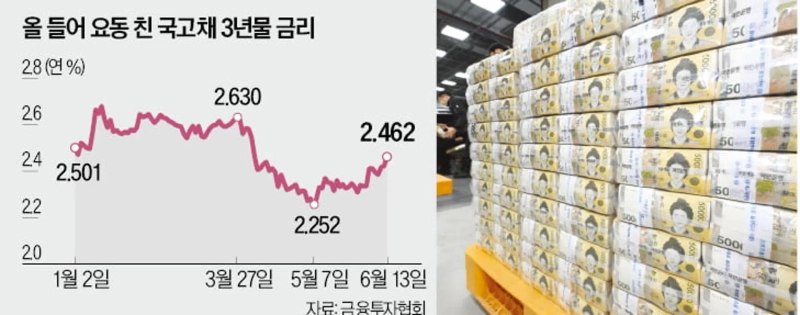
The bond market is forecast to be influenced this week by hawkish remarks from Lee Chang-yong, Governor of the Bank of Korea. On the 13th, the 3-year government bond yield finished at an annual rate of 2.462%, up 0.033 percentage points from the previous day. The 5-year yield and 2-year yield rose by 0.016 and 0.043 percentage points, closing at 2.597% and 2.466% per annum, respectively.
The rise in short-term bond yields is largely attributable to comments from Governor Lee. In his speech marking the Bank of Korea's 75th anniversary on the 13th, he said, "Since March this year, Seoul apartment prices have increased by about 7% on an annualized basis, and household loan growth in the financial sector is also accelerating," adding, "We must break away from the past practice of allowing excessive real estate investment to stimulate the economy easily."
Following this, Nomura Securities projected that the Bank of Korea will not lower the base rate in the second half of this year. Park Jung-woo, an economist at Nomura Securities, predicted, "With easing financial conditions fueling the housing market, the policy rate cut (in the latter half) will likely pause, with a 0.25 percentage point cut expected in February next year."
The market is expected to pay close attention to the new government's second supplementary budget discussions. Following Lee Jae-myung's presidential election, the Democratic Party of Korea's talks on a 'super supplementary budget' have led to a sharp rise in long-term yields. The 10-year government bond yield surged to a high of 2.891% per annum, with the 30-year yield jumping to 2.754%. Fears of oversupply in government bonds prompted some selling in the bond market. In the market, the uncertainty about the size of the second supplementary budget is gradually easing, and the selling pressure on long-dated government bonds is expected to subside.
Jomi-hyun / Bae Jeong-chul, correspondents mwise@hankyung.com

Korea Economic Daily
hankyung@bloomingbit.ioThe Korea Economic Daily Global is a digital media where latest news on Korean companies, industries, and financial markets.