

Household Loans Surge by KRW 2 Trillion... Authorities Urgently Summon Deputy Bank Chiefs
Summary
- The household loan balance at the country’s five major banks has exceeded KRW 750 trillion, with nearly KRW 2 trillion growth this month alone.
- Mortgage loans and credit loans have surged ahead of the implementation of the Phase 3 stress DSR regulation and due to a bullish stock market.
- Financial authorities have stated that they are considering additional regulations if the increase in household loans continues.
5 Major Banks’ Balances Exceed KRW 750 Trillion
Mortgage Loans Rise by KRW 1.4799 Trillion
Credit Loans Increase by KRW 600.2 Billion
Authorities Convene Emergency Meeting on the 16th
Attention on Possible Additional Regulations
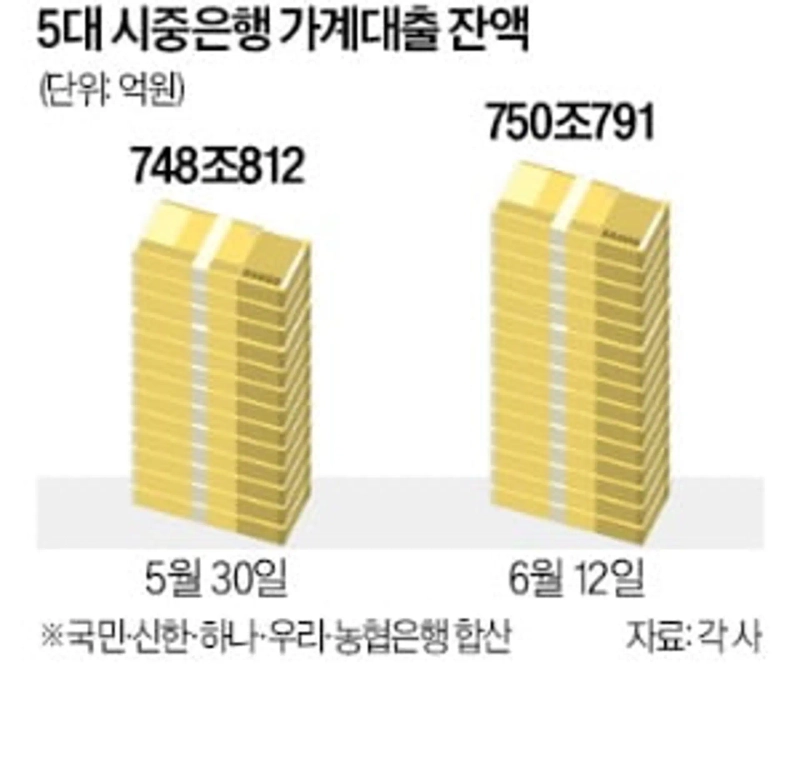
The household loan balance at Korea’s five major banks—Kookmin, Shinhan, Hana, Woori, and NongHyup—has surpassed KRW 750 trillion. In less than ten business days this month, it has grown by nearly KRW 2 trillion. This is interpreted as a result of increased pre-emptive home purchase funding ahead of the upcoming implementation of the Phase 3 stress-based DSR (Debt Service Ratio) regulations, as well as the boost in ‘leverage investing’ driven by a bullish stock market. Financial authorities have decided to summon senior executives from major banks to demand stricter loan management.
According to the financial sector on the 15th, as of the 12th, the household loan balance at the five major banks in Korea was KRW 750.0791 trillion, up KRW 1.9979 trillion from the end of last month (KRW 748.0812 trillion). If this trend continues through the end of the month, the increase in household loans for June is likely to exceed KRW 5 trillion. The household loans of these five banks rose by over KRW 4 trillion in succession in both April (KRW 4.5337 trillion) and May (KRW 4.9964 trillion).
By loan type, mortgage loans increased by KRW 1.4799 trillion. There was strong ‘last-minute demand’ to borrow up to the maximum limit before Phase 3 stress DSR—centered on reducing mortgage limits in the capital region—takes effect next month. Once the regulation is implemented, the mortgage borrowing limit in the capital region will fall by 3–5%. Given the recent strong buying trend and surging apartment prices in Seoul, there is widespread expectation that mortgage loans will continue to grow for some time. According to the Korea Real Estate Board, Seoul apartment sale prices for the second week of June rose by 0.26% from the previous week, marking the highest increase since the fourth week of August last year (0.26%). This marks 19 consecutive weeks of gains.
Credit loans also rose by KRW 600.2 billion this month. This is largely attributed to the ‘all-in’ phenomenon—where borrowers max out loans to purchase homes—as well as increased leverage investing due to the buoyant stock market. On the 13th, the KOSPI Index reached 2,894.62, soaring by 7.3% over seven trading days since the presidential election on the 3rd. On the 12th, it even climbed to 2,920.03. Optimism about new government stock market stimulus policies has prompted rapid inflows of funds into the equity market.
A commercial bank official stated, “With even greater enthusiasm for stock investment, it has become even more difficult to curb the increasing trend in household loans. We will closely watch to see if this pattern persists after Phase 3 stress DSR is implemented.”
Alarmed by the surge in household loans, the Financial Services Commission and Financial Supervisory Service have decided to convene an emergency meeting with the deputy heads of lending departments at domestic banks on the 16th. At the meeting, warning actions are reportedly expected for banks such as NongHyup Bank and Standard Chartered Bank Korea, where household loan surges have been most pronounced. The FSS also plans to inspect whether these banks are circumventing DSR regulations.
Financial authorities maintain that, if household loans do not slow down, they will consider further tightening regulations, such as assigning higher risk weights to new mortgages or lowering the guarantee ratio on jeonse (lease) loans in the capital region.
Jinseong Kim / Jaewon Park, jskim1028@hankyung.com

Korea Economic Daily
hankyung@bloomingbit.ioThe Korea Economic Daily Global is a digital media where latest news on Korean companies, industries, and financial markets.