

Strait of Hormuz Crisis: Is Your Portfolio at Risk? [Investing.com]
Summary
- The possibility of Iran blockading the Strait of Hormuz could deliver a serious shock to global financial markets, including U.S. stocks.
- If the Strait of Hormuz is closed, 20% of the world's oil supply would be affected, and oil prices could surge above $300 per barrel.
- If the military conflict between Israel and Iran escalates, Iran could actually move to blockade the strait, posing a very real risk of a global recession.
By James Kostohryz
On Friday, the U.S. stock market showed a relatively mild decline despite the news of Israel's large-scale attack on Iran and Iran's substantial initial retaliation. The S&P 500 index fell by only 1.13%. This may reflect the expectation that Israel's early offensive was so successful that the war could end quickly.
However, with Iran's missile attacks hitting densely populated areas and major economic infrastructure in Israel on Friday evening and Saturday, it has become clear that the Israel-Iran war is likely to become a drawn-out conflict inflicting significant damage on both sides.
Now, many Americans and global investors are asking: "Why does a war in the Middle East affect my investment portfolio?" This article focuses on one of the main reasons—the possibility that the Strait of Hormuz could be closed to commercial shipping.
Why is the Strait of Hormuz important?
The most important fact readers must understand is that about 20% of the world's crude oil supply (including petroleum products) passes through the Strait of Hormuz. Geographically, the strait is only about 20 miles wide at its narrowest point, and the actual shipping channel is just 2 miles wide.
Due to the narrow channels and unique geography, Iran can easily block the Strait of Hormuz for months using various means such as laying sea mines, sinking ships (physical blockage), launching rockets, and drone attacks on vessels.
Consequently, war in this region could deliver a direct shock to global energy markets, with broad impacts on worldwide stock markets and individual investor portfolios.
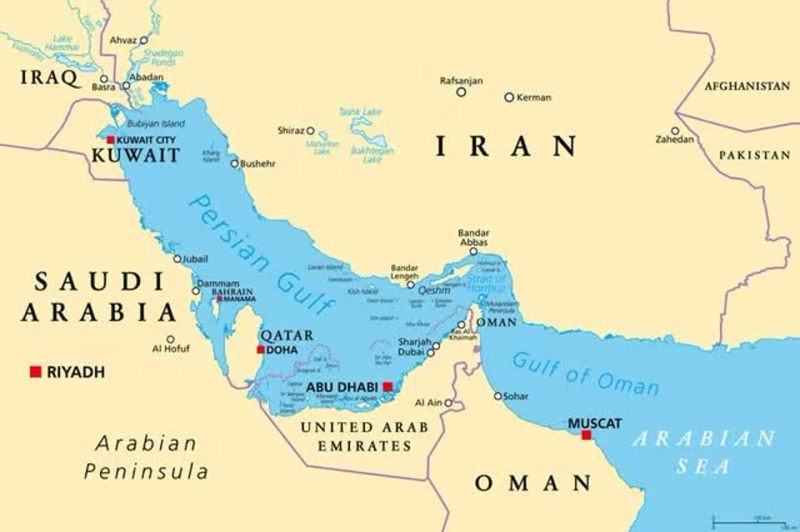
Strait of Hormuz (Marine Link, Investor Acumen)
While many remain skeptical, Iran does have the military capability to block nearly all commercial traffic passing through the Strait of Hormuz. Detailed discussion is available in my video "Iran Can Crash Global Markets: Blocking The Strait of Hormuz." (*This video can be played directly at the bottom of the article.)
Many assume that the U.S. Navy can prevent such a scenario. But they cannot. All Iran has to do is declare, "Any ship attempting to transit the strait will be sunk." Just this single statement would bring all commercial shipping through the Strait of Hormuz to an immediate halt.
Why? Because marine insurers would refuse coverage for any vessel going through the strait. No shipowner would risk sailing uninsured, and no shipping company would put crews and ships at risk by attempting a transit without insurance. Iran doesn't even need to actually sink U.S. Navy warships (though it has the capacity to do so). Iran only needs to be capable of sinking civilian shipping. That capability has been demonstrated several times, most recently through repeated actions by Iran and their Houthi allies.
According to a senior official of the world’s largest shipping association:
"If a full-scale war breaks out between Israel/U.S. and Iran, the Strait of Hormuz is almost certain to be effectively closed for at least a period of time..."
In reality, the suspension of commercial traffic in the Strait of Hormuz may not even be triggered by Iran itself. It is more likely to be the result of decisions by shipping insurers and transportation companies.
So, what happens if about 18–20 million barrels of crude oil per day cannot pass through the Strait? Are there alternative routes? There are no viable sea alternatives, and land alternatives are extremely limited. For more on the military strategies affecting the strait, see the "Oil Shock" playlist.
What will happen if the Strait of Hormuz is closed?
According to estimates including those from the U.S. Government Accountability Office (GAO), a closure of the strait could send global oil prices soaring by three or four times, meaning oil could exceed $300 per barrel. There is historical precedent:
During the 1973–1974 Oil Embargo, global oil prices quadrupled. Interestingly, that supply restriction impacted less than 4% of total world supply, and only for a few months. In today's terms, that equates to a supply shock of about 4 million barrels per day.
In contrast, closure of the Strait of Hormuz would affect between 18 and 20 million barrels daily, 4–5 times larger than the oil supply cut during the embargo. Yet even in the 1970s, a comparatively smaller loss drove prices up 4-fold.
Today’s world, with its strategic petroleum reserves and other measures, is more prepared than before—but a disruption lasting months could still easily send prices above $300 per barrel. The reason is simple: oil demand is extremely inelastic. With demand not easily reduced, any supply loss drives prices sharply higher.
What happens when oil prices spike?
Historically, most U.S. recessions have followed spikes in oil prices (oil shocks). Such events triggered recessions in the following years: 1973–1974, 1979, 1982, 1991, 2000, and 2008. Most recently, in 2022, a sharp spike in oil prices led the U.S. to two consecutive quarters of negative growth, bringing it close to a recession. Historical evidence shows that if oil remains above $150 per barrel for several months, the likelihood of a U.S. recession is very high.
Why would Iran seek to blockade the Strait of Hormuz?
The reason can be summed up in one word: blackmail.
If Iran feels pressured by Israel and possibly the United States, the regime could play the "Hormuz card." As explained above, blockading the strait would trigger a global recession and financial crisis. In such situations, major world powers would apply immense pressure on Israel and the U.S. to end hostilities quickly. In extreme cases, this could be the regime's only means of survival.
So could Iran actually go through with a blockade? Iran recognizes this is risky (as it could turn the world against it), but it has spent decades preparing for this scenario—training its military and developing specialized tactics and technology to execute such a move.
Iran actually claims the Strait of Hormuz as part of its territorial waters and believes it has the legal right to restrict passage anytime it wishes. The regime has developed extensive legal arguments to support this view.
Thus, blockade of the strait is an actively considered policy option in Iran, and no one should dismiss this threat. In fact, in February, March, and April 2025, IRGC Navy Commander Alireza Tangsiri repeatedly reiterated Iran’s capability and readiness to blockade the strait. Additionally, President Masoud Pezeshkian and his spokesperson have declared that if Iranian oil exports are impeded, the strait will be blocked. Similar threats have been made dozens of times by top Iranian officials over the past two decades.
On Saturday, Esmail Kowsari, an IRGC general and current member of parliament, mentioned the possibility of a blockade and said Iran’s leadership is seriously considering such action.
Blockade of the Strait of Hormuz is a matter of national policy for Iran, and the regime has long threatened—and is prepared—to take such action.
Conclusion
Iran has the ability to completely block all commercial shipping through the Strait of Hormuz. The country has an explicit national policy on the issue, and has already developed sophisticated asymmetric strategies to enable such a closure.
Global financial markets seem largely unaware of—or dangerously complacent about—this risk. But it is likely to become a major focus in the weeks ahead.
If Israel strikes Iran’s oil export infrastructure, Iran’s highest leaders, including its president and supreme leader, have repeatedly stated the following policy: "If Iran’s oil exports are cut off, no country in the region will be allowed to export oil." In other words, a strike on Iran's oil infrastructure could instantly trigger a Strait of Hormuz blockade.
So, will Israel actually attack Iran’s oil facilities?
Israel has already warned Iran that if it targets Israeli civilian areas, Israel will retaliate by striking Iran’s oil infrastructure. Defense Minister Israel Katz suggests that this "red line" may have already been crossed. In reality, Israel has already targeted some energy infrastructure within Iran (not for export purposes). The current situation appears to be part of a chain of escalation that now brings the real risk of an Iranian blockade of the Strait of Hormuz.
This article was provided by Investing.com. Copyright belongs to the original publisher. For inquiries regarding the content, please contact the media outlet.

Korea Economic Daily
hankyung@bloomingbit.ioThe Korea Economic Daily Global is a digital media where latest news on Korean companies, industries, and financial markets.